

What happens on Wednesday afternoons in a small courtroom in downtown Houston is not a traditional court proceeding.
The people who come here are facing low-level misdemeanor charges, but they’re not called defendants. Instead, they’re called clients. They don’t leave bowing their heads in shame. Instead, they walk out smiling. Judge Imelda Castillo congratulates rather than admonishes.
And the man who opens the court with a roll call? It’s not a uniformed police officer but Scot More, a community resource manager for the nonprofit Coalition for the Homeless of Houston/Harris County.
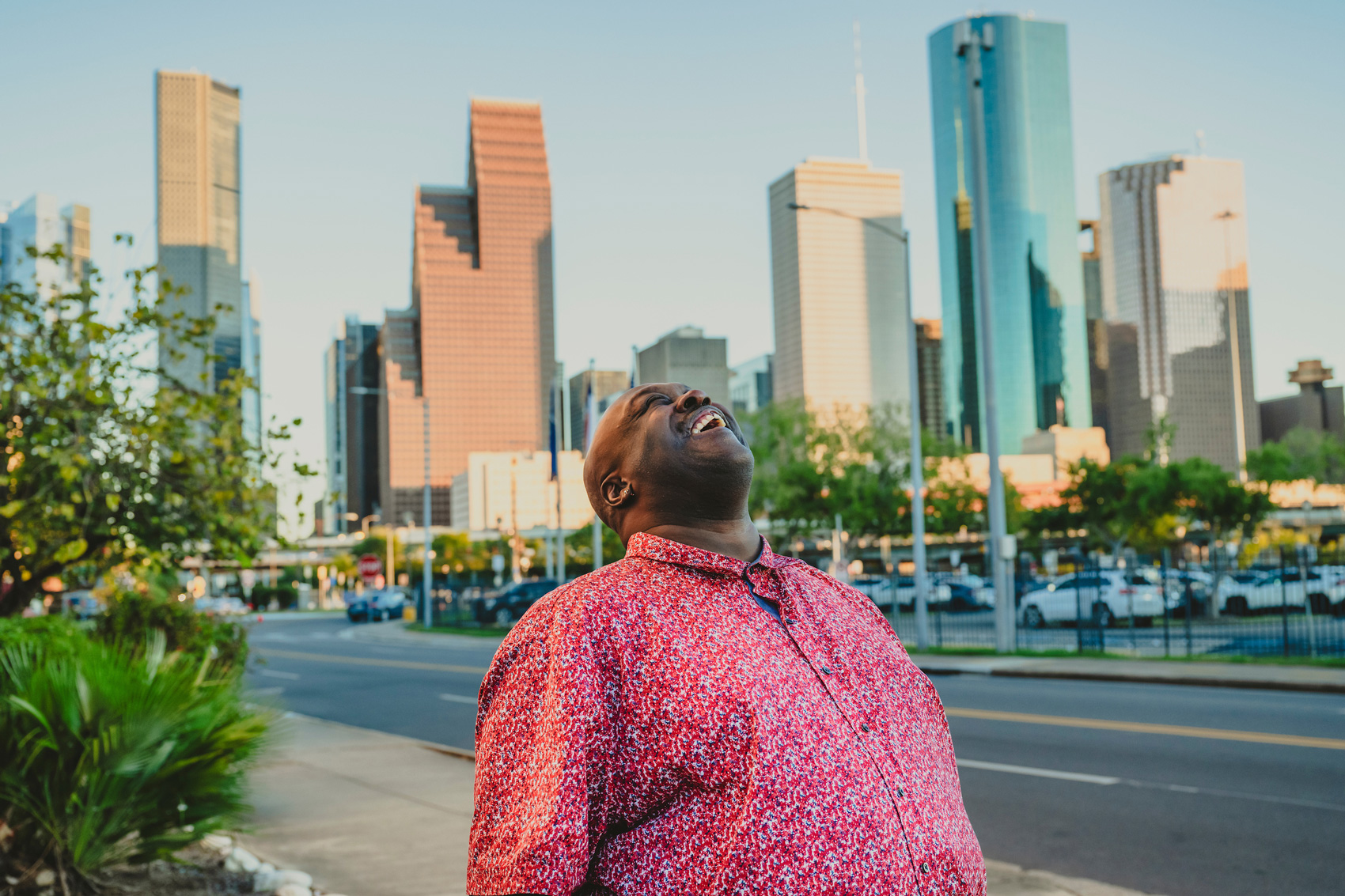
More, 61, administers the city of Houston’s homeless court, a program that helps unhoused participants resolve the low-level criminal charges that can make it harder to restabilize their lives. That’s where More was on a Wednesday afternoon in mid-November, dressed in a red shirt and red sneakers, addressing an assembly of about a dozen clients in a wood-paneled municipal courtroom.
“This is the city’s way, the Coalition’s way and your provider’s way of saying we know how hard it is for you to get out of your situation,” More told the dozen or so “clients” assembled in the courtroom. “You’re gonna walk out of here owing nothing to anyone.”
At his words, a murmur rippled across the room.
“Thank you,” a man said, leaning forward in his seat.
“No, thank you,” More replied. “You all did the work.”

More has administered Houston’s homeless court since its launch in 2006. Over nearly two decades, he’s seen over 2,700 people pass through its doors. The program rewards participants for working with service providers to alleviate the issues that led them to homelessness, often drug addiction, mental illness or domestic violence, by resolving charges at no cost to the client.
Houston’s homeless court has been a success, with low recidivism rates — the vast majority of those who participate only ever do so once, according to data provided by Coalition for the Homeless. And it could soon expand. Currently, it only operates in the Houston municipal courts — but Sean Teare, Harris County’s district attorney-elect, plans to change that as early as next year.
“I fully support it,” he told the Landing in an interview. “I want (an expansion) to happen, I think it’s overdue and I think it is a benefit to the community as a whole.”
That, More said, would be of tremendous help to Harris County’s unhoused population.
“We can’t save the entire world all at once,” he said. “But you can just focus on the person that’s in front of you.”
‘More optimistic than ever before’
Joshua Toran Jr. was living on the streets in midtown Houston in May when officers with the Houston Police Department issued him nine low-level misdemeanor charges.
Among Toran’s offenses? Sitting on a blanket on the sidewalk and possessing a shopping cart.
Toran, 48, said he might have been able to pay his fines “eventually” on a payment plan. But it would have been tough. The charges left him with “a lot of stress,” he said.
Advocates with the nonprofit Harmony House stepped in. They directed him to homeless court, where Toran saw all his charges resolved on Nov. 20. Now, Toran expects to be ordained as a minister and looks forward to attending seminary school.
“Are you in a better place?” Judge Imelda Castillo asked him in court.
“I’m more optimistic than ever before,” Toran told her.
Houston’s homeless court is modeled after an original program from San Diego, California and is now one of more than 70 such programs nationwide.
The objective, More said, was to alleviate barriers to restabilization — and in particular, obstacles to obtaining valid identification.
“The number one barrier in servicing (homeless) clients is that in the state of Texas, if you owe any money, fines or fees to any court, or if you have a warrant or outstanding tickets, you cannot renew your driver’s license or obtain an ID,” said More.
That’s a problem, advocates said, because valid identification is a prerequisite to obtain work and housing in Texas.
“Homeless court is very special because it helps either dismiss or waive the fines and fees and clear up the tickets that could be preventing this person from getting an ID,” said Stephanie Marrone, managing attorney for Beacon Law, a nonprofit that provides legal support to unhoused Houstonians.
The vast majority of homeless court participants, 81 percent, are people of color, with 84 percent reporting a “disabling condition” and 32 percent experiencing domestic violence, according to data provided by Coalition for the Homeless. Yet not just anyone can join — to participate, individuals must be referred by a social worker or case worker associated with one of Houston’s dozens of programs that serve the homeless.

Similarly, homeless court addresses only Class C misdemeanors, the lowest possible type of criminal charge, punishable only by fine. The most common charges More sees in homeless court are fare evasion on Houston’s METRORail and a lack of car insurance, both of which can snowball into onerous debt.
“It’s $1.25 to (ride) the rail,” More said. “If you don’t pay that, the ticket’s $75. If you don’t pay that, it goes up to $250. If you don’t show up to court, they throw a warrant. That’s another $250. So for not having $1.25, they owe $500. None of our clients would be able to pay that.”
That’s why a traditional, punishment-based approach to criminal charges against the homeless is counterproductive, said Steve Binder, a special advisor to the American Bar Association’s Commission on Homelessness and Poverty and co-founder of the San Diego homeless court.
“If they can’t afford a place to live, they can’t afford to pay a fine,” Binder said. “It’s too easy to get a conviction and to mete out punishment for a person who’s homeless and fail to address the problem and really meet everyone’s desire for a healthy individual and a healthy society.”
Homeless court addresses that problem by rewarding participants for their work with service providers to address the issues that led them to homelessness. In 2023 alone, the program helped participants resolve $138,000 in outstanding fines.
“The (homeless) court is essentially compounding the value of those service agencies when it works with them and recognizes the hard-won skills and accomplishments individuals have done in program activity,” Binder said. “Which for us might seem very simple, but for someone who’s been on the streets is very challenging to come by.”
Homeless court to expand
Currently, only the Houston municipal courts operate a homeless court. Their counterparts at the county level — the justice of the peace courts — do not.
That means that only individuals charged by the Houston Police Department or the METRO Police Department can participate in the program. Those charged by other agencies, like local constables or the Harris County Sheriff’s Office, see their charges route into the county courts — and face steeper barriers to restabilization.
“The timeline in terms of resolution is a lot longer and there are a lot more pitfalls our clients can fall into,” said Marrone about cases heard in county courts.
That could soon change, however. One justice of the peace, Steve Duble, whose precinct encompasses much of the city of Houston, has already implemented an informal version of the program in his courtroom in which he resolves charges for clients referred by pro bono attorneys. And Sean Teare, Harris County’s district-attorney elect, said his transition team has already been in talks with service providers about launching the program county-wide.
“Ideally it (will happen) in the first half of 2025, but it will be next year that we at least have an iteration of the program stood up,” said Teare. “I want something like that in order to ensure that we’re treating our unhoused population appropriately while still maintaining a city and a county.”
More is optimistic about the difference that could make for Harris County’s homeless.
“Every single time I go to a docket, I feel more energized to help others and to make it a positive experience for them,” More said. “I never get tired of this.”