

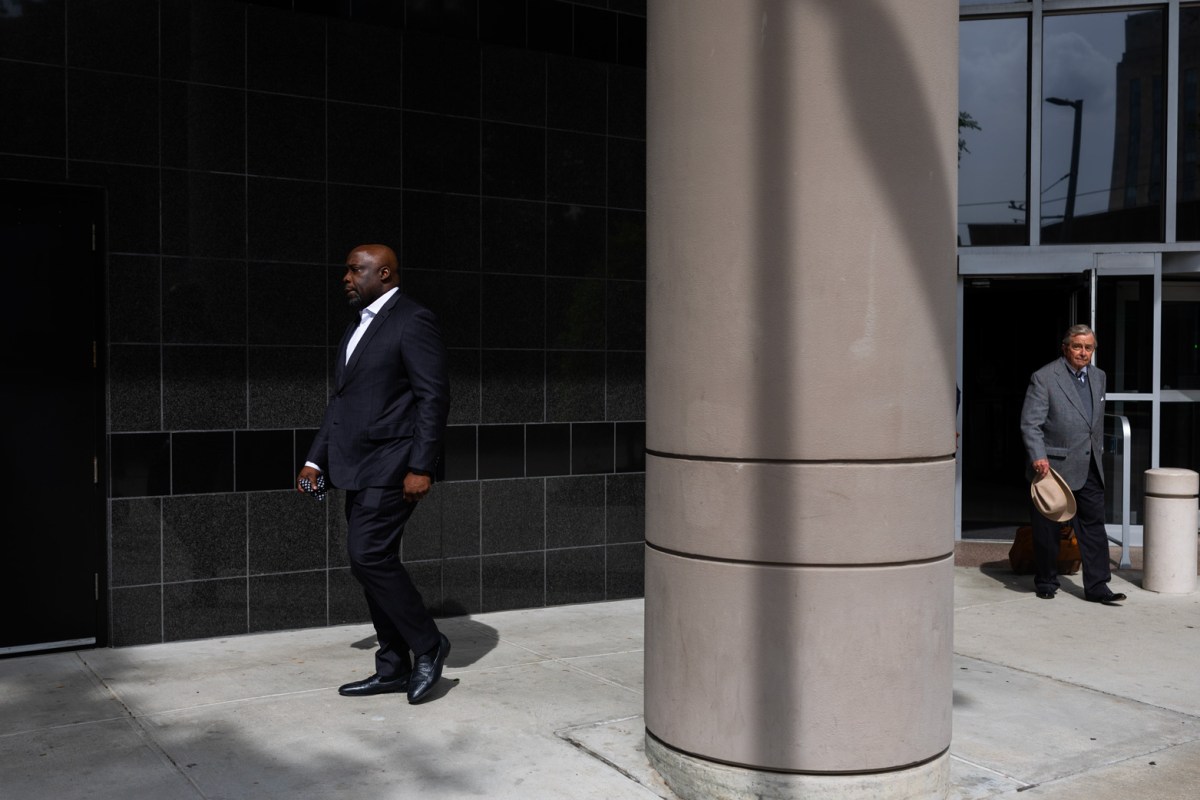
A federal jury on Friday found Brian Busby, former chief operating officer of the Houston Independent School District, and contractor Anthony Hutchison guilty of defrauding the district through a sweeping bribery and overbilling scheme involving Busby and other HISD employees.
The 12-member jury convicted both men on all charges brought against them. Busby was found guilty of one count of conspiracy, six counts of bribery involving programs receiving federal funds, five counts of willfully filing false tax returns, and one count of witness tampering.
Hutchison was convicted of one count of conspiracy, 11 counts of wire fraud, six counts of bribery involving programs receiving federal funds, two counts of willfully filing false tax returns, and one count of witness tampering.
Jurors reached their verdict after about six hours of deliberation, capping 19 days of trial. As U.S. District Judge Andrew Hanen read the verdict aloud, Busby and Hutchison betrayed no emotion and stared straight ahead.
After Hanen briefly left the courtroom to speak with the jurors, both Busby and Hutchison comforted family members and friends who had broken down in tears in the gallery, including Busby’s eldest daughter, who took the stand in her father’s defense.
FBI Special Agent Andy Liu, the lead case agent, also briefly broke down in tears as the verdict was read.
Both Busby and Hutchison were allowed to remain on bond and will be formally sentenced in July by Hanen. They face decades in prison.
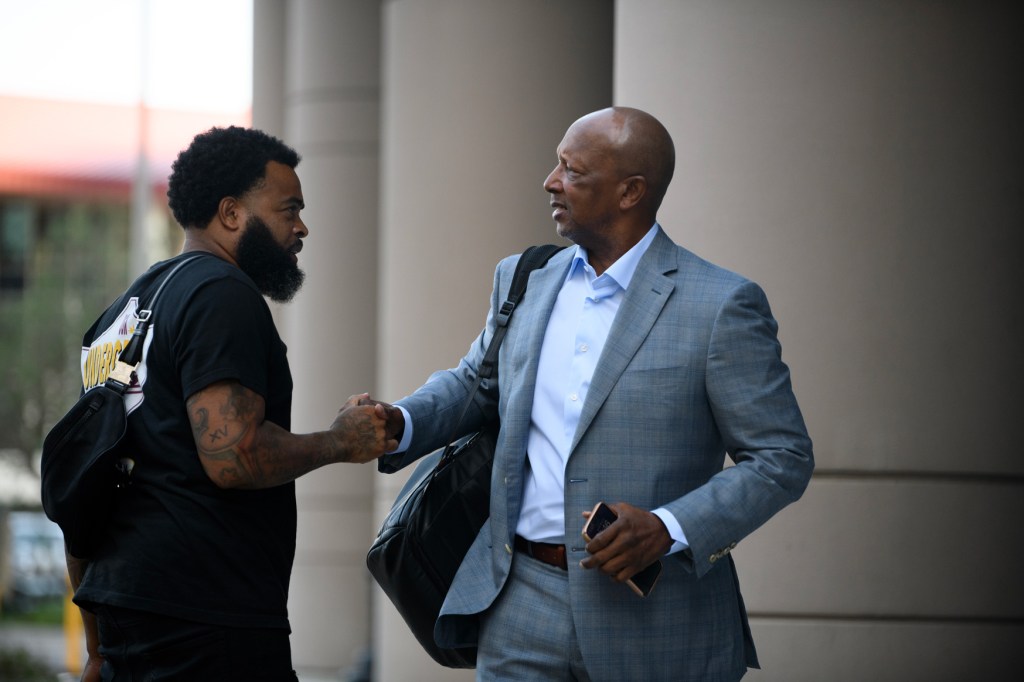
In finding both men guilty, jurors determined beyond a reasonable doubt that Busby and Hutchison conspired to defraud Texas’s largest school district. The verdict capped an exhaustive four-week trial that featured testimony from 51 witnesses, some of whom were called multiple times.
It also marked a dramatic fall from grace for Busby, who dedicated over two decades to the district, rising from a custodian to chief operating officer before his contract expired in 2020.
In a bold move, Busby took the stand in his own defense, denying that he had ever accepted bribes from Hutchison or paid any on Hutchison’s behalf — allegedly including two payments to former HISD board president Rhonda Skillern-Jones, who had testified earlier in the trial.
“Everything he told you was incorrect,” Busby said on the fifteenth day of the trial, referring to Derrick Sanders, a former HISD construction official who had testified that Busby pressured him to hire Hutchison’s firms or assign them the landscaping portions of larger construction projects. “Totally untrue.”
Jurors, however, were unconvinced by Busby’s testimony.
His attorney, Dick DeGuerin, expressed disappointment and shock at the verdict outside the courthouse. “The verdict was too quick. 33 counts, two defendants, it was too quick,” the veteran criminal defense attorney said.
Rusty Hardin, who represented Hutchison alongside Letitia Quinones-Hollins, declined to comment.
As part of their case-in-chief, Assistant U.S. Attorneys Robert S. Johnson and Heather Rae Winter called 30 witnesses over 14 days. Testimony came from current and former employees of Hutchison’s companies, federal agents from the FBI and IRS, current HISD officials, interior designers, and even a professional poker player, who described Hutchison as likely being a compulsive gambler.
On the defense side, attorneys Hardin, Quinones-Hollins, DeGuerin, and Mark W. White called 21 witnesses, including two who had already been questioned by the prosecution but were recalled for further testimony. Three were former HISD principals who painted Busby and Hutchison in a positive light, describing both men as reliable and responsive.
“Top notch,” said Keri Fovargue, former principal of River Oaks Elementary, describing Busby. “If you needed something, he delivered,” she added, noting that she often bypassed the chain of command and called Busby directly.
As for Hutchison: “Excellent. It was top-notch service,” she said of his mowing work. “Our PTO wouldn’t have paid for services if they didn’t meet our standard of excellence.”
Throughout much of the trial, the defense argued that Hutchison had earned a reputation for high-quality work and that the frequent requests for his services negated any need for bribery. They also contended that Busby had never shied away from his responsibilities and was consistently reliable in resolving problems as they arose.
In their final argument, the defense claimed that federal authorities had long since made up their minds that Busby and Hutchison were guilty, operating with tunnel vision throughout the eight-year investigation.
“If you approach a case with a fixed perspective from the start, it inevitably colors your focus,” Hardin said in his closing argument. “And that’s exactly what happened here. We are all prisoners of our point of view — shaped by our backgrounds, perspectives, and roles.”
Paperwork, technical jargon dominated proceedings
The trial was filled with technical jargon and paperwork. Terms like “procurement,” “requests for proposals,” “straight billing,” and “purchase orders” dominated the proceedings. Still, many jurors appeared engaged, often taking notes in red binders provided by Judge Hanen’s staff and using blue Bic pens as they followed along with the exhibits.
At other times, however, their energy waned. Some jurors were seen nodding off or closing their eyes, especially during testimony that lasted an entire day with only one or two witnesses. On multiple occasions, Judge Hanen expressed concern that attorneys were losing the jury’s attention.
“Do y’all ever look at the jury when you ask your questions?” Hanen asked during one afternoon break. “Because they are bored stiff.”
He added that both sides had spent more than an hour with a witness, who, in his view, should have taken only 20 minutes. “You’re needlessly dragging this out,” he said. “Maybe I don’t know all the facts, maybe I don’t know all the issues, but it seems like you’re killing this jury.”
By the final week, jurors were in session from 8:45 a.m. to 6 p.m. each day, excluding scheduled breaks.
According to prosecutors, the fraudulent scheme began in 2011, when Hutchison’s company, Southwest Wholesale, was awarded a contract with HISD to provide mowing and landscaping services. Initially responsible for maintaining two or three dozen campuses, Hutchison’s role expanded over time to include hundreds of school properties. Eventually, Southwest Wholesale became the district’s exclusive landscaping contractor.
However, from 2013 to 2020, prosecutors allege that Hutchison overbilled the district by approximately $6 million, often charging for four monthly mowings per property, even when the work was performed only twice a month.
The defense countered that HISD used a straight billing system, where discrepancies in the number of mowings were regularly reconciled at the end of each month, and that the invoices presented by prosecutors did not account for “special cuts,” or mows requested by HISD officials in advance of a special event.
Hutchison was also accused of inflating Kiddie Cushion playgroud mulch costs by submitting falsified invoices to HISD.
Prosecutors say Hutchison maintained his dominance by bribing HISD employees, including Busby, with cash. According to the superseding indictment, he funneled nearly $530,000 to Busby, both directly and through contractor payments for home remodeling work.
Prosecutors introduced banking records showing Busby deposited just over $3 million in cash across 18 accounts between 2015 and 2020. Many of the deposits were made on the same day and fell just under $10,000 — behavior prosecutors said was intended to avoid federal reporting requirements.
Busby’s attorneys said the cash came from rental income, business income, gambling winnings, and financial support from his ailing mother, which included a trunk of money. Prosecutors argued those sources couldn’t account for the volume of deposits.
In return for the payments from Hutchison, Busby allegedly pressured HISD managers to steer contracts to Hutchison’s firms, including Southwest Wholesale and Just Construction.
Different recollections from witnesses
During the trial’s opening week, five former HISD officials who pleaded guilty in connection with the scheme in 2021 — Skillern-Jones, Sanders, Luis Tover, Gerron Hall, and Alfred Hoskins — testified about payments they received from Hutchison or from Busby acting on his behalf. Their memories, however, varied. Some recalled dates, locations, and amounts. Others, like Hall, struggled to recall even basic details.
“I told them I wasn’t sure of the dates,” Hall said, referring to federal authorities. “I’m telling the truth. I’m just off on the dates.”
In addition to bribery, both Busby and Hutchison were convicted of witness tampering.
While on the stand, Hoskins, a former manager of HISD’s facilities, maintenance, and operations department, testified that one afternoon while driving to HEB, Hutchison pulled alongside and motioned for him to follow.
After parking on a residential street and getting into Hutchison’s car, Hoskins said Hutchison instructed him to tell the FBI that a four-page ledger found at Hutchison’s home was a record of gambling winnings.
As for Busby, Hoskins said the former chief operating officer called him on the day federal agents executed search warrants across the city in February 2020. Busby allegedly instructed him to tell subordinates that he had no involvement in awarding a 2017 contract to Just Construction.
That contract, an annual vendor agreement, allowed Hutchison’s company to perform emergency, no-bid work for the district. Hoskins said Busby had previously told him to “make sure” Just Construction got it.
The ledger, discovered in a calendar book and marked as Government’s Exhibit 1, became a cornerstone of the government’s case. Prosecutors argued it documented bribes Hutchison paid to HISD officials, linking them to specific district projects. At the top of one page were the initials “BB,” which prosecutors claimed stood for Busby.
Yet the ledger’s value as evidence was complicated by conflicting testimony. According to prosecutors, the ledger showed that Sanders received $10,000 at Gabby’s BBQ on Shepherd Drive in connection with work at Codwell Elementary. But Sanders testified he had no memory of being at Gabby’s or receiving money there.
Another entry appeared to show Skillern-Jones was paid $10,000 at Truluck’s, a Galleria seafood restaurant. She testified that she had no recollection of meeting anyone there, but did remember receiving two cash payments in a Walmart parking lot: one for $5,000 and another for $12,000. Both, she said, followed Busby’s assurances that he would manage projects in her district.
Busby emphatically denied that those payments ever occurred. He testified that he gave her $10,000 in cash only once, inside HISD’s administration building, and that the money was intended for gift cards to aid Hurricane Harvey victims, not as a bribe.
In his closing argument on Thursday, DeGuerin pointed out that while prosecutors introduced text messages showing what they argued were meetings between Hutchison and other HISD officials, such as Sanders and Hall, they did not produce any messages between Busby and Skillern-Jones arranging the alleged Walmart parking lot meetings. He questioned how those meetings were supposedly coordinated, suggesting a lack of concrete evidence to support Skillern-Jones’ claim.

In the trial’s closing days, the defense called Diane Nicholson-Jones, who worked as Hutchison’s part-time assistant in 2017 and 2018. She testified that she saw Hutchison use the ledger to track gambling winnings and company loans used to cover his debts. But under cross-examination, she admitted she couldn’t read Hutchison’s handwriting or make sense of the entries.
“If you can read that, you’re doing better than the 10 years I’ve been working with him,” she said. “I don’t know what that says.”
The only person who might have fully explained the ledger, Hutchison, did not testify. After the jury left on the trial’s eighteenth day, DeGuerin asked if Hutchison could take the stand solely to explain the ledger on Busby’s behalf. Hardin objected, citing Hutchison’s Fifth Amendment right.
According to prosecutors, Hutchison funded the bribes by writing checks to vendors, who would then cash them and return the money to him in cash. One of those vendors, Ulysses Tejada — a subcontractor who performed mowing work for Hutchison’s company — testified that he had done exactly that.
However, his credibility was called into question after he admitted borrowing money from Hutchison on multiple occasions, including to buy equipment and cover payroll when his invoices to Southwest Wholesale were delayed.
Gambling debt payments or bribes?
During more than ten hours of testimony, Busby described a close relationship with Hutchison, saying the two frequently traveled together, often to Las Vegas for sports watch parties. While there, they stayed in casinos and gambled. Hutchison preferred poker, Busby said, while he gravitated toward baccarat, craps, and blackjack. Both men also routinely bet on sporting events, he added.
When federal agents from the FBI and IRS executed search warrants in February 2020, raiding Busby’s then-Cypress-area home, Hutchison’s residence and businesses, and HISD headquarters, they seized $90,150 in cash from Busby’s house.
Busby claimed that most of the money had come from gambling winnings: $60,000, he said he won in Las Vegas just four days prior to the raid, and another $38,000 from an earlier trip in January. But prosecutors cast doubt on that explanation by pointing to money wrappers found on some of the seized bills.
Photos introduced at trial showed wrappers from First Bank and Trust in Cleveland, Texas, dated December 2, 2019, a month earlier than the trip to Vegas. A company that Hutchison used to cash checks and pay gambling debts is based in the same Texas town.
Busby insisted the wrappers were from earlier gambling debts that Hutchison had paid and that he reused the bands to keep his cash organized. He also said that if he won money at the casino and brought it home, he would slide the money into the band without breaking it.
Both Busby and Hutchison were also convicted of filing false tax returns — Busby for failing to report the cash deposits, and Hutchison for misclassifying payments used to settle gambling debts as business expenses.
In her closing argument, Quinones-Hollins highlighted an instance where Hutchison apparently alerted HISD that his company had been overpaid. She also referenced testimony from Hutchison’s tax preparers, who had said Hutchison would call them and request his taxable income be increased.
“Who does that?” she asked the jurors.
Because Hutchison faced more charges than Busby, DeGuerin, representing Busby, often had a quieter courtroom presence. “I’m still here,” the 84-year-old quipped each time opposing counsel mistakenly skipped his turn to question a witness.
Federal jury trials are extremely rare. According to the Administrative Office of the U.S. Courts, during the 12-month period ending December 12, 2024, fewer than two percent of individuals facing criminal charges were judged by a body of their peers. Statistics show that the vast majority of defendants ultimately pleaded guilty.
In a statement, FBI Houston Special Agent in Charge Doug Williams said, “At the end of the day, we want to make sure that corrupt individuals like Busby and Hutchison are brought to justice.”
“Today’s guilty verdict is a step towards that justice,” said Williams, who attended a portion of the government’s cross-examination of Busby. “I’m proud of the FBI Houston’s public corruption squad for the results of its years-long investigation and thank them, and the U.S. Attorney’s Office, for their commitment to this case and to its thousands of victims.”
In a statement, U.S. Attorney for the Southern District of Texas, Nicholas Ganjei, thanked the jury for their time and attention and said the case “demonstrates that theft from schools won’t be tolerated and that the public can have confidence in their institutions.”

