


It isn’t uncommon for Curtis Smith to smell the stench of rotten eggs outside his home in Sweeny. If the wind is blowing just right, the air in the neighborhood smells like gasoline or kerosene, somehow sulfuric, sweet and bitter all at once. He could stand in his yard or down the road or even walk a few blocks east and it’d be there, unrelenting.
Then the next day the smell is gone, like nothing happened. Though Smith knows better. Something is happening. About three miles from his home, a massive petrochemical facility is in operation.
“You can sit out there some days, you know, you can smell the plant,” Smith said. “It’s like (the facility) is blowing, but you don’t feel it. (The air) is still.”
Smith is one of several thousand people who live in the shadow of the Chevron Phillips Chemical Sweeny Complex, which sits about 50 miles southeast of Houston in Brazoria County as one of the world’s largest single-site ethylene facilities. For years, community members have expressed concerns and outrage over the pollution emitted from the facility and the resulting impact on the environment and public health – especially after the company was found violating federal and state pollution control laws in 2022.
Many of these concerns took center stage after Chevron Phillips applied to revise the company’s air quality permit through the Texas Commission on Environmental Quality last summer. The company will be replacing one of the facility’s furnaces, which will reduce fuel consumption and carbon intensity in what the company says is a measure to lower the company’s carbon footprint. However, critics have stressed that the project will also increase other harmful emissions, such as sulfur dioxide, particulate matter and greenhouse gases – all of which would pollute the community.

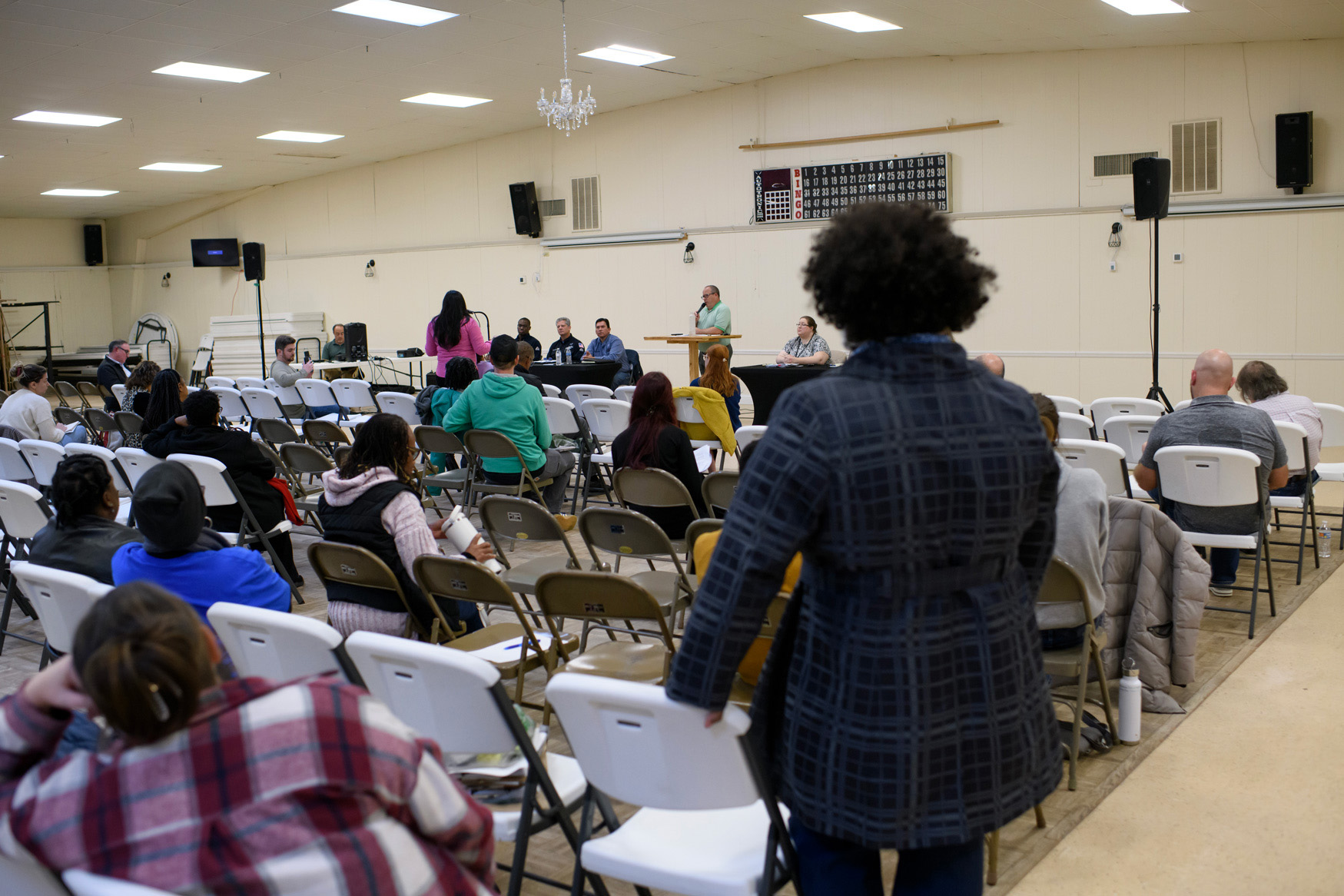
At a TCEQ public comment hearing Tuesday night for the permit, community members and environmentalists spoke heatedly to Chevron Phillips and TCEQ representatives. Overwhelmingly, commenters asked for the permit to be denied, and a chorus of critics ultimately demanded less pollution in the community overall.
Gwen Jones – a cousin of Smith’s late wife – organized a group to attend the meeting, along with other members of the community, experts and environmental advocates. Like Smith, Jones has asthma, a condition she believes is connected to growing up in Sweeny and working in industry all her life.
“I can’t believe they’d want to emit more,” she said. “That’s not right.”
Debate on facility
The Chevron Phillips chemical facility, along with the adjacent Phillips 66 refinery, has been operating in Sweeny for over 80 years. The facility makes over 11 million lbs a day of ethylene, an ingredient used in plastic production, and employs just over 1,800 workers – some of whom reside locally.
The annual impact of the Sweeny complex is about $1.7 billion to the regional economy.
However, the company is one of the worst offenders for toxic releases into the air and noncompliance with drinking water, according to the Environmental Protection Agency, with the community around Chevron Phillips having worse particulate matter and Ozone than 91 and 90 percent of the United States, respectively.
Particulate matter and ozone pollution are linked to increases in asthma, COPD and heart disease, among other conditions.
Jose Trevino, the facility’s plant manager, emphasized that a big reason for the permit change is the environment and supporting the facility’s goals of producing less carbon dioxide emissions into the atmosphere by way of intensity. Carbon intensity means the amount of carbon dioxide emitted per unit of energy produced.
“The (current) ethylene unit has been in operation for 55 years. We are installing a new furnace to replace (it),” Trevino told the crowd on Tuesday. “ We’re taking this opportunity to implement new technology that’s going to support our commitment of lowering our carbon footprint.”
The new furnace will produce twice as much using 30 percent of the energy. It will also produce less nitrogen oxide gas, a greenhouse gas that contributes to climate change.
However, residents expressed concerns that less intensity means little in direct relation to their community. Sue Page, a resident of nearby Surfside Beach, spoke up over concerns over increased pollution versus carbon intensity.
“This feels like if I puffed smoke in your face weakly compared to if I puffed smoke in your face a bit more strongly,” said Page. “You’re still getting the smoke. It’s still there.”

Pollutants such as particulate matter, sulfur dioxide and volatile organic compounds will increase in emissions.
Other community members highlighted the company’s recent history with violations as a reason to mistrust them. In the past five years, there were 191 unplanned emissions events reported by Chevron Phillips to the TCEQ.
In 2022, the Environmental Protection Agency fined Chevron Phillips for violating the Clean Air Act and state air pollution control laws at its Cedar Bayou, Port Arthur and Sweeny facility locations. The company had failed to properly monitor its industrial flares, which caused excess emissions in harmful air pollution.
In the resulting consent decree, the company agreed to pay $118 million in upgrades and compliance measures, including a fenceline monitoring system. In an email exchange with the Houston Landing, Chevron Phillips Chemical confirmed it does have an air monitoring system at the facility that has been in place for over a year and it publicly reports readings on a bi-weekly basis.
Health and engagement
A few years back, Smith’s wife, Dorothy, passed away from an asthma attack in their home in Sweeny after 42 years of marriage. Smith called 9-1-1 when she called out from the bedroom saying she couldn’t breathe, but even after emergency responders arrived and took her to the hospital, they lost her.
“They didn’t pronounce her really gone until she got to the hospital, but I knew she took her last breath,” Smith said. “And things haven’t been the same since.”
The rate of asthma in Sweeny is worse than 67 percent of Texas and nearly 50 percent of the United States. Smith, along with Jones, knows more people with asthma and COPD than not. Jones’ good friend passed away from respiratory issues just earlier this January and her father and her uncle passed from heart attacks before that.
In a statement to the Houston Landing, Chevron Phillips Chemical said emissions of volatile organic compounds, nitrogen oxides and carbon monoxide at the Sweeny facility have decreased between 2020 and 2023.
The community in Sweeny has also had issues with drinking water, which the city says is due to aging infrastructure and a chemical called manganese infiltrating the water supply. The Phillips 66 Refinery, adjacent to the Chevron Phillips Chemical Complex, has also discharged more wastewater from its refinery than allowed by the state-imposed limit 42 times between 2019-2021, according to the EPA’s enforcement database.
Because of this, residents generally drink bottled water on top of concerns over air pollution.
“The plant should take a little more responsibility,” Smith said. “I mean, you know people are complaining about these things. You can’t put a bandaid on it and expect it to be fixed.”
All of these concerns and more pushed Jones to work on environmental justice in the community, though reaching everyone about these concerns can be difficult. The turnout at the TCEQ public meeting was lower than she anticipated. She says this was partially because she only started outreach the Saturday before, having been caught up in the holidays.
Thelma Scott, founder of the nonprofit SAFE Diversity Communities, addressed the concern of engagement with the Chevron Phillips representatives – expressing concerns over members of the community being left out.
“I have over 500 family members that live in this county, some that live here in Sweeny, some in Brazoria, but nobody knew about this meeting at all or they didn’t understand the terms that you have in your data,” Scott told the representatives.
In response, Trevino with Chevron Phillips said the company has a strong commitment to ensure that we are communicating and engaging with community members.
“We will be glad to go out there and provide necessary information, contact information so we can have a conversation,” Trevino told the crowd. “A conversation and future out what’ the appropriate thing for us to engage on questions and concerns you might have.”

