


Haz clic aquí para leer nuestra investigación en español.
CLEVELAND, TX — In late 2017, Texas lawmakers established a special taxing district in unincorporated Liberty County at the request of Colony Ridge Inc. developers and brothers William “Trey” and John Harris.
Liberty County Municipal Management District No. 1 was created to enhance law enforcement and firefighting services, improve infrastructure, such as roads and drainage, and foster economic development in the rapidly expanding collection of subdivisions.
Although the district has made efforts to achieve these goals, records obtained by Houston Landing show the district has fallen short of its stated purpose. As of March, those records — meeting minutes, financial reports, public filings and interviews — reveal that the municipal management district has:
- Spent only $350,000 on two county constables to patrol the district.
- Approved $22.5 million in contracts for a company in which two current and one former board member(s) have a financial stake.
- Not publicly discussed or voted on the local volunteer fire department’s proposal to provide services to the district.
- Has not granted or accepted any tax incentives to attract commercial development.
The Landing’s investigation also found that the Liberty County Municipal Management District No. 1 has collected nearly $13 million in taxpayer funds, yet much of that money remains unspent, financial records show. Most of it sits in a government investment account, collecting on average between 4-5 percent in annual interest, according to the records.


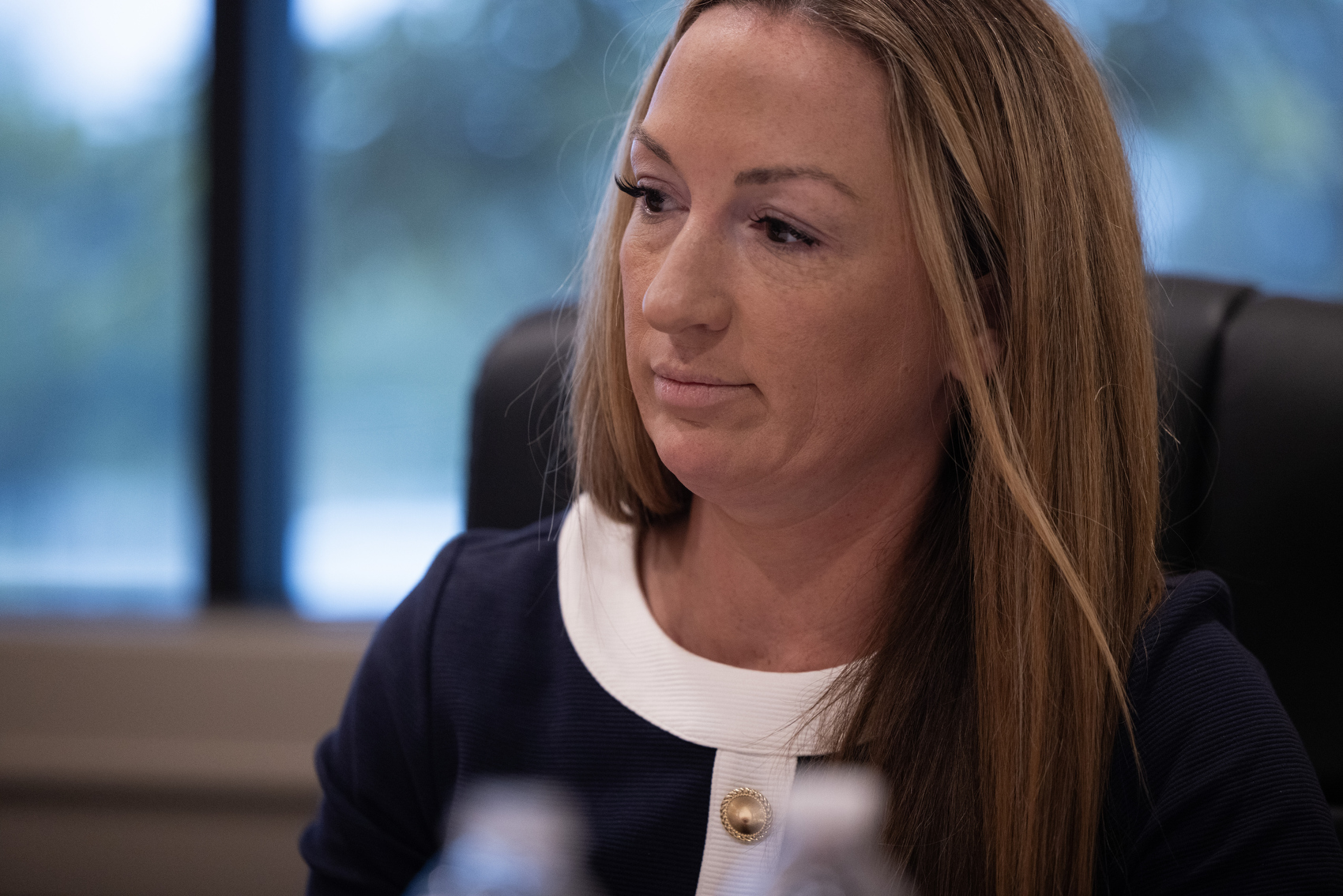

The district is governed by a tight-knit group of family and friends, all of whom are connected to Colony Ridge Inc., according to meeting minutes. Notably, John Harris, president of the development company, also serves as the district’s board president. The other four members who have served on the five-person board since its inception include Harris’s niece and three Colony Ridge employees.
Art Rascon, a former Houston news anchor who manages media relations for Colony Ridge Inc., declined to respond to written questions sent via email and FedEx in February and again this month.
Previously, Rascon said in an October 2024 statement on John Harris’ behalf: “This story is far more involved than what a simple article can provide. So we prefer to reserve comment until there is an adequate forum to discuss.”
Rascon did not respond when asked what constitutes an adequate forum.
Experts in municipal government and the creation of management districts, such as the one in Liberty County, say that the revolving circle of leadership raises significant conflict of interest concerns.
“The scandal isn’t what is illegal,” said Matthew Poston, elected Liberty County attorney in 2016. “The scandal is what is legal. All the complicated ways developers have so much power. Nobody is interested in reviewing that at the state level.”

The findings arise as Colony Ridge Inc. and its primary subsidiaries remain embroiled in two lawsuits: one from the U.S. Department of Justice and the Consumer Financial Protection Bureau and another from Texas Attorney General Ken Paxton.
Both lawsuits accuse the developer of targeting and deceiving Latino land buyers with predatory loans, false advertising and failing to disclose utility installation costs.
John Harris, who declined multiple interview requests and did not respond to written questions sent via email and FedEx, previously told reporters that the allegations in both lawsuits lack merit and that the legal actions were prompted by Texas lawmakers’ heightened scrutiny of his company.
The Colony Ridge development has recently been in the national spotlight due to increased scrutiny from Texas Republicans and President Donald Trump’s “border czar,” Tom Homan, who led a U.S. Immigration and Customs Enforcement operation inside the development last month that culminated in the arrest of 118 people.
$13 million in taxpayer money collected, little spent
Municipal management districts are political subdivisions in Texas designed to fill gaps in municipal services. They can be established either by legislation or when business owners petition the Texas Commission on Environmental Quality.
Financial records show that despite collecting about $13 million in taxpayer funds since 2017, the Liberty County Municipal Management District had spent just $350,000 on two county constables to patrol the district as of November. (According to meeting minutes, the district encompasses about half of the 33,000-acre Colony Ridge development.)

The district has spent close to the same amount of money on its law firm, Coats Rose, to run board meetings and manage legal documents, the records show.
In September 2024, the district agreed to a cost-sharing agreement with the development’s property owners association — which, according to state records, is also controlled by John Harris and his associates — to help cover the cost of patrols by the county sheriff’s department. Meeting minutes show that in November, the district contributed nearly $440,000 toward that effort.
Certainly, the Harris brothers have invested in the community, whether through their companies or personal endeavors. In December 2023, they donated $360,000 to West Liberty County Fire & Rescue, preventing severe budget cuts and potential closure for the volunteer department.
The brothers also paid for a new fire station in the sprawling community. In March, Fire Chief Brandon Frazier said the district had yet to finalize an agreement to cover the department’s projected $1 million annual budget after the brothers’ donation ends this year, but he remains hopeful about the project’s future.


But despite those investments, in the eight years since Trey Harris told the Associated Press that he wanted the management district to function as the Colony Ridge development’s “commercial arm,” the district as of November had not granted or accepted a single tax incentive to attract commercial development, according to a review of district records.
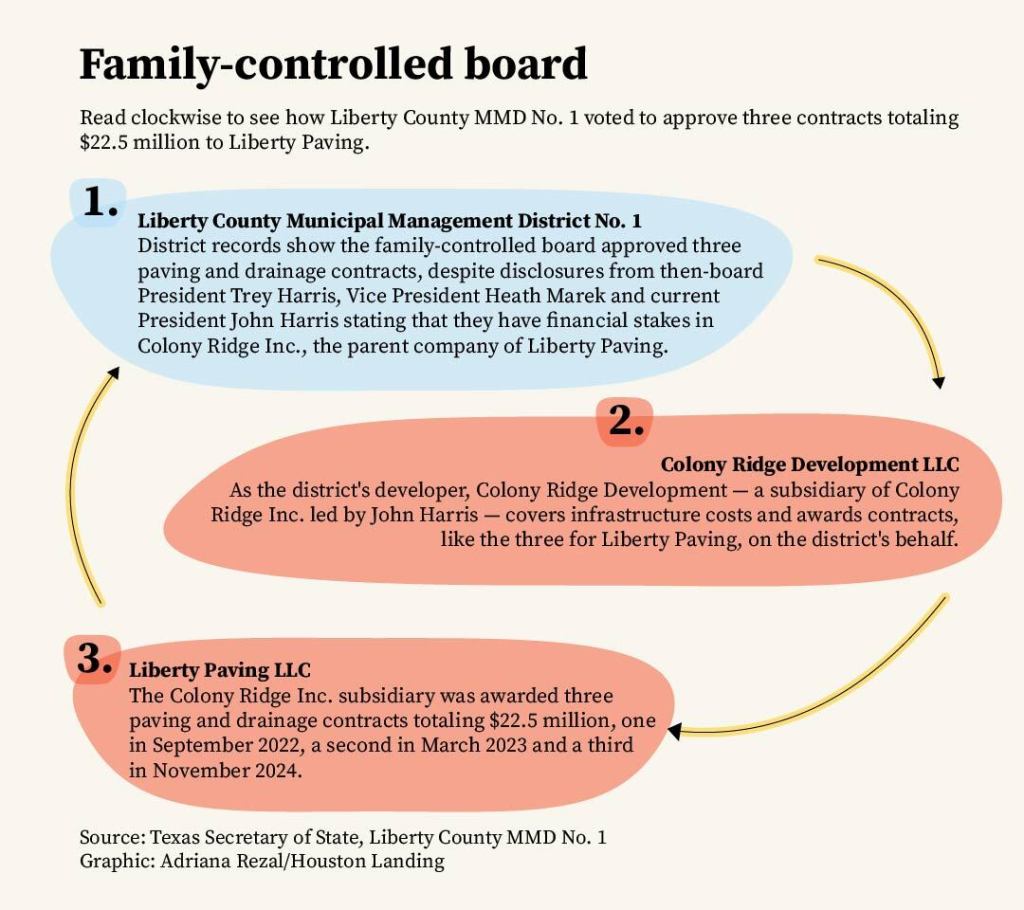
Meeting minutes show that the district’s only action to tackle road and drainage issues has been to approve three multimillion-dollar paving and drainage contracts with Liberty Paving, a company indirectly owned by the Harris brothers and another board member.
Meeting minutes and district records show that between 2022 and 2023, the family-controlled board unanimously approved two contracts totaling $16 million for the Colony Ridge Inc. subsidiary. According to the minutes, a third contract for Liberty Paving was approved in November 2024 for $6.5 million.
“The scandal isn’t what is illegal. The scandal is what is legal.”
Matthew poston, liberty county attorney
Conflict of interest statements show that former board President Trey Harris and Vice President Heath Marek have financial interests in Colony Ridge Inc. However, those disclosures did not stop them from voting to approve the first two paving and drainage contracts.
According to financial disclosures, John Harris, the current board president, owns at least 10 percent of Liberty Paving. He abstained from voting on the third contract granted to the subsidiary, meeting minutes show.
Experts told the Landing that state law does not prohibit management district board members from doing business with companies they own or have a financial stake in, even after mandatory disclosures are made.
Additionally, districts are responsible for policing themselves through bylaws and best practices, and developers can legally reimburse themselves with taxpayer money through a municipal board.
“This is one of many tools the legislature has given developers that we deal with all the time,” Poston said. “Management districts, utility districts, tax reinvestment zones — all of that stuff — are ways for developers to recoup the portion of their investment that is at least tied to the public interest.”
Harris serves dual roles: Experts call this ‘unethical and inappropriate’
When new management districts are formed, they usually negotiate agreements with developers for infrastructure projects. The developers are eventually reimbursed with tax dollars or the proceeds from bond sales.
The developer for Liberty County Municipal Management District No. 1 is Colony Ridge Development, another subsidiary of Colony Ridge Inc. According to the district’s most recent audit from June 2024, it owes Colony Ridge Development, also led by John Harris, $15.4 million and intends to pay that amount using the proceeds from “future bond issues subject to the approval of Texas Commission on Environmental Quality (TCEQ).”
According to the audit, the district had not issued a total of $60 million in bonds as of June: $22 million for water, sewer, and drainage facilities and nearly $38 million for road facilities.
David Hawes, managing partner of Hawes Hill & Associates, a consulting firm that administers contracts for several Houston-area districts, said it’s unusual for management districts to have such direct ties to the developers they do business with.

The board of Liberty County Municipal Management District No. 1 consists of five people: John Harris, Heath Marek, Damaris Watson, Clifton Cadle, and Savannah Crihfield.
An article from My San Antonio quoted Marek as Colony Ridge Inc.’s sales manager. In a lawsuit filed against the company, Watson identified herself as an employee of Colony Ridge Development. The local utility district’s meeting minutes identify Cadle as an employee of Colony Ridge Development.
In addition, family obituaries show that Crihfield is Harris’s niece. Crihfield is listed in Texas Secretary of State filings as the president of CH&P Management, the registered agent for most Colony Ridge subsidiaries.
Hawes, who at the Landing’s request reviewed the district’s reimbursement agreement with Colony Ridge Development, its ethics code and audits, said John Harris should not be board president. He described the arrangement as having an appearance of being “unethical” and “inappropriate.” He also emphasized that a management district and its developer should operate as completely separate entities.
“That doesn’t even come close to passing any sort of smell test, quite frankly,” Hawes said, adding that he previously forced a board member from a district he consults with to resign over the same issue.
“I don’t think it serves the public interest,” the consultant said. “He is a public official as board chair serving on that board and has a higher duty to the people who pay the taxes beyond just himself.”
Colony Ridge should be regulated, experts say
When Gov. Greg Abbott signed the legislation creating Liberty County Municipal Management District No. 1, the Cleveland Independent School District and the Liberty County Commissioners Court were each supposed to appoint two board members, while Colony Ridge, as the district’s largest property owner, would designate a fifth member.
Public records show that neither Cleveland ISD nor Liberty County has ever appointed board members. Despite staggered four-year terms, the board has consisted solely of the Harris brothers, their niece, and business associates.
When a board member’s term ends, fellow board members recommend a replacement, whom the TCEQ must approve.
Aside from Trey Harris, succeeded by his brother John as president in 2023, Marek, Crihfield, Watson, and Cadle have all been reappointed to subsequent terms by the TCEQ after being nominated by their fellow board members.
In January, the board approved a motion to submit a petition to the TCEQ for the reappointment of John Harris, Crihfield, and Cadle, whose terms expire in June.

Bill King, a public finance fellow at Rice University’s Baker Institute and former Houston mayoral candidate, said his research has shown that management districts in unincorporated areas typically operate with little oversight.
“It’s kind of the Wild West out there,” he said. “(The development) certainly is an area that cries out for more comprehensive legislation and some kind of enforcement mechanism.”
Former State Rep. Ernest Bailes (R-Shepherd) and State Sen. Robert Nichols (R-Jacksonville), both of whom sponsored the bill that created Liberty County Municipal Management District No. 1, did not respond to multiple requests for comment.
‘Just because it’s legal doesn’t make it right’
Under state law, management districts are required to adopt investment policies and deposit their funds in investment funds or government pools.
“It’s not about long-term interest or whatever. It’s about protecting the cash,” Hawes said.
According to eight years of financial records, Liberty County Municipal Management District No. 1 has done just that — protected cash rather than investing in the Colony Ridge development.
District residents are taxed at 35 cents per $100 of assessed value on their properties and charged an additional 1.5 percent sales tax for every good they purchase within district boundaries, the financial records show.
As a result, the district has accumulated approximately $13 million in tax revenue since 2017. By November, around $11.1 million of that amount had been transferred into a TexPool account, a multi-billion-dollar investment pool managed by the state of Texas.
Meeting minutes show that over the past seven years, the district has made only one withdrawal from the account — $390,000 in November.
Experts cite the board’s decision to approve the Liberty Paving contracts as their primary concern, which appears to contradict Trey Harris’s 2017 pledge that no taxpayer funds would be directed to him or Colony Ridge Inc.
“The MMD that I am proposing will only help support the county with expenses associated with the growth within that MMD with absolutely no money going back to Colony Ridge or Trey Harris or any of my associates,” he said in the interview with the Associated Press.
Hawes said the approval of the contracts raises questions about whether the board is acting in the public’s best interest.
“Just because it’s legal, doesn’t make it right,” he said.
District documents reveal that in August 2022, Liberty Paving and Houston-based Rollcon submitted bids for the first contract, which involved paving and drainage work in Section 14 of the Santa Fe subdivision within the Colony Ridge development.
(According to Colony Ridge Inc.’s website, Santa Fe is the largest of the six subdivisions within the Colony Ridge development, currently consisting of 14 sections, with several additional sections still under construction.)

Colony Ridge Development later awarded the contract to Liberty Paving on behalf of the Liberty County Municipal Management District No. 1, accepting a $10 million bid over Rollcon’s $14.1 million offer. A Rollcon spokesperson, reached by phone, declined to comment.
Although Colony Ridge Development managed the bidding and contract award process, the contract still required approval from the district.
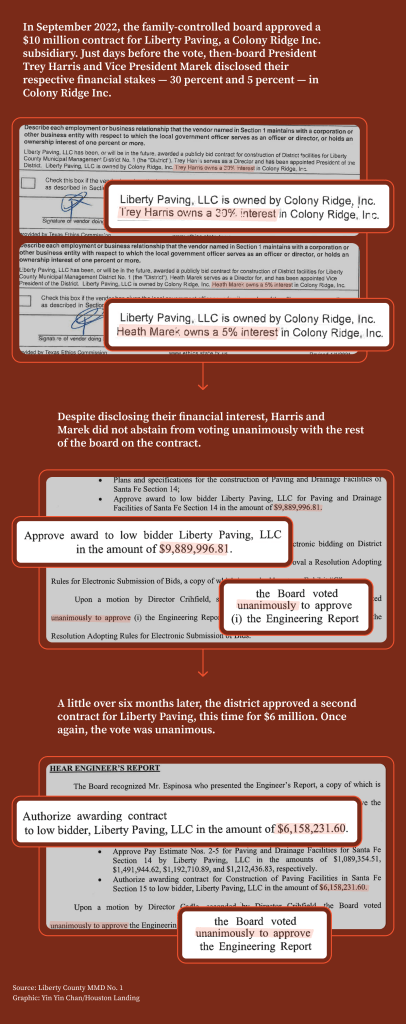
Twelve days before the district voted to approve the contract, then-board President Trey Harris and Marek submitted conflict-of-interest questionnaires, disclosing that they each held 30 percent and 5 percent interests in Colony Ridge Inc., respectively. (State law requires that these questionnaires, provided by the Texas Ethics Commission, be filed with the district’s records administrator.)
A week later, Trey Harris and Marek submitted affidavits indicating that they had a “substantial interest” in Liberty Paving and Colony Ridge Inc. According to state law, a substantial interest is defined as owning 10 percent or more of a business or having a fair market value of $15,000 or more.
State law also mandates that management board members file these affidavits when the companies they are associated with do business with the district. If a majority of the board has a financial interest in the business and discloses that interest, those board members are permitted to participate in votes involving their business.
However, that doesn’t appear to have occurred in this case. District records show that only Trey Harris and Marek filed affidavits, falling short of a three-person majority. Both men voted to approve the $10 million contract for Liberty Paving, meeting minutes show.
Their fellow board member, Damaris Watson, notarized the affidavits.
Jim Murphy, a former Texas lawmaker who chaired the Special Purpose Districts Committee in 2017 and served as the general manager of the Westchase District, said that abstaining from voting on issues where you have a declared conflict of interest significantly reduces the appearance of impropriety.
“I’m not sure what their legal counsel is telling them to do about these kinds of things, but they are really close to the line,” Murphy said.
Attorneys at Coats Rose did not respond to an email seeking comment. Neither Trey Harris nor Marek provided a response to questions, including why they chose not to abstain from the vote.
“It’s kind of the Wild West out there.”
Bill king, public finance fellow at Rice University’s Baker Institute
In March 2023, Colony Ridge Development awarded Liberty Paving a second paving and drainage contract for work in Section 15 of the Santa Fe subdivision, according to meeting minutes. This time, Liberty Paving was the only company to submit a bid, and the board unanimously approved the $6 million contract.
Later that year, in November 2023, John Harris succeeded his brother Trey as board president. Two weeks into the role, John Harris submitted a conflict of interest questionnaire that revealed he owned 30 percent of Colony Ridge Inc.
(According to state law, the questionnaire must be filed no later than the seventh business day after a vendor doing business with a management district becomes aware that it needs to be.)
John Harris also simultaneously submitted an affidavit revealing he owned at least 10 percent of Liberty Paving.
A year later, in November 2024, the board approved a third contract for Liberty Paving after Colony Ridge Development received a $6.5 million bid from the Colony Ridge Inc. subsidiary for construction work in Section 19A of the Santa Fe subdivision. Minutes from that meeting show John Harris abstained from the vote, and Marek was absent.
According to an email included in the minutes from John Hardey, the director of engineering for Colony Ridge Development, Liberty Paving was the only bidder for the project.

Murphy, who reviewed the district’s bidding documents for the first two paving and drainage contracts at the Landing’s request, found it unusual that Colony Ridge Development received only one other bid between those two contracts.
(District records show that an engineering firm hired by Colony Ridge Development paid Hearst Publications to publish two legal notices for each of the two contracts in local newspapers, including The Courier of Montgomery County.)
“The boards I’ve worked with would just not award a contract like that unless they were sure that the contractor was competent, that there had been other bonds, that there had been a diligent effort to find other bidders,” Murphy said. “Because usually, you can find somebody who’s hungry and ready, particularly with a contract of that size.”
Hawes, who has 30 years of experience working with management districts, wants the Texas Legislature to pass laws preventing developers from serving on management boards. He noted that management districts are political subdivisions of the state, and board members are public officials who act on the public’s behalf.
“If the developer, John Harris, is the board president, then he’s not acting on behalf of the public,” Hawes said. “He’s acting on behalf of himself.”
John Harris did not respond to questions sent by the Landing via FedEx and email.
‘Do we have to abstain?’
Since late 2017, the Liberty County Municipal Management District’s board has convened more than 40 times. According to district records, with the exception of Trey Harris and members of the local utility district’s board, no members of the public appear to have attended any of the meetings.
When two Landing reporters and a photographer attended an April 2024 meeting, the journalists appeared to be the first members of the public to be officially recorded in the minutes.

According to a review of the minutes, a board member also asked if they were required to abstain from a vote. Crihfield, the board’s secretary, spoke up after the board discussed approving a cost-sharing agreement with the local property owners’ association to install lights along the Colony Ridge development’s roundabouts.
“Do we have to abstain from the vote?” Crihfield asked John Harris. “Because we’re associated with the POA?”
“Oh,” her uncle, John, said. “Yes.”
In addition to his roles as board president and president of Colony Ridge Development, John Harris also serves as the president of the El Norte Houston Property Owners Association. According to Texas Secretary of State filings, Crihfield’s company, CH&P Management, acts as the registered agent for the POA, Liberty Paving and several other Colony Ridge subsidiaries.
Crihfield stumbled during the April 2024 meeting when an attorney from Coats Rose asked each board member to vote on the cost-sharing agreement.
“Yes,” she said at first. “Wait… I can’t say yes; I abstain.”
Meeting minutes show that despite her personal and professional connections to Colony Ridge Inc., Crihfield did not abstain from the vote to approve the two paving and drainage contracts for Liberty Paving in 2022 and 2023.


Over the past year, Landing reporters have attended several management district board meetings, which are typically held every other month. On average, they lasted no more than an hour and were held concurrently with the local municipal utility district’s board meetings.
The district’s most recent meeting, on Jan. 13, lasted 26 minutes. Cadle briefed the district for 48 seconds about ongoing construction related to his employer, Colony Ridge Development.
Can a management district be regulated?
Liberty County Attorney Matthew Poston said counties are limited in what they can regulate.
Even if residents claim a management district has not made a good-faith effort to deliver promised services, Poston said his office lacks the authority to take legal action against it.
“At the end of the day, the ultimate check on an entity is the voters or residents who are being taxed, and if they agree with how their money is being spent,” he said.
Residents can file lawsuits or petitions to dissolve districts, but experts say that can be challenging for most people, particularly non-native English speakers.
That’s particularly true in Liberty County, where, according to the latest U.S. Census, about 40 percent of the county’s 108,000 residents identify as Hispanic or Latino. County Judge Jay Knight and county sheriff’s officials believe the figure is a significant undercount and have estimated that the Colony Ridge development houses over 75,000 people.
Currently, residents must gather signatures from at least two-thirds of property owners to trigger dissolution.
“The board members don’t have to listen to you. Property owners don’t get to elect the board members,” said State Rep. Gary Gates (R-Richmond), who pushed for legislation in 2021 to lower the threshold for dissolution.
As of March, no petitions seeking the district’s dissolution had been filed with Poston’s office.
“It’s the ultimate taxation without representation,” Gates said.


