

Zoe Espinosa and her daughter Savanna Lee never paid attention to the pipelines dotting the grassy fields near their Deer Park home – or the absence of concrete barriers to prevent vehicles from crashing into them.
Then one of the pipelines exploded in September – hit by a sports utility vehicle. The crash killed the driver and produced a tower of flames that burned and melted nearby homes, cars and power lines for nearly four days.
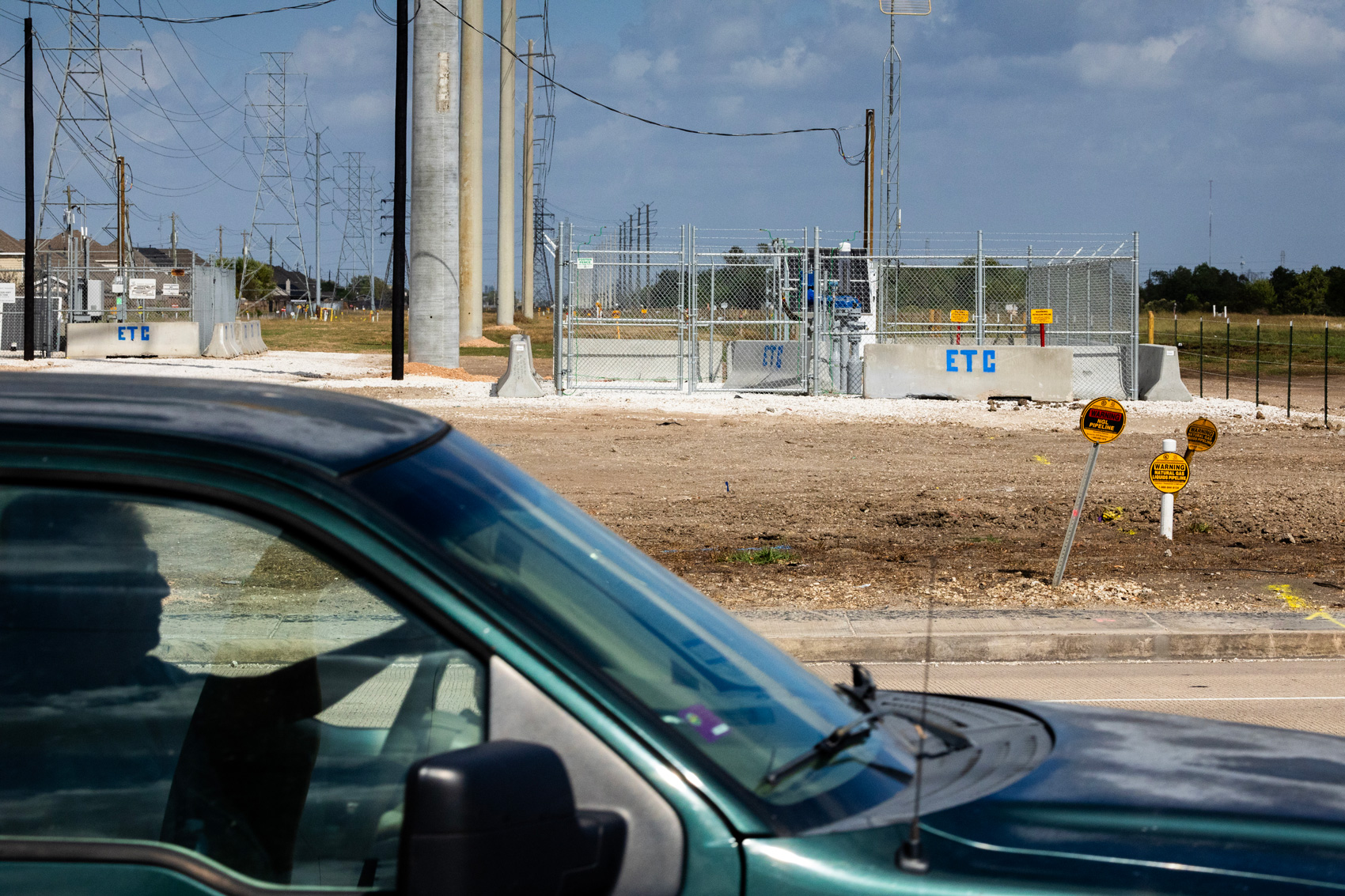
As she stood on the sidewalk outside her damaged home on a recent afternoon, Espinosa gestured toward newly installed concrete barriers that now surround the natural gas liquids pipeline hit by the SUV.
“I don’t understand, how come now they’re barricading that? They should have done that a long time ago,” she said as she waited for a contractor to assess what the fire and intense heat did to her roof.
When the Sept. 16 crash happened, only a chain link fence stood between the SUV and the pipeline after the vehicle veered out of a Walmart parking lot and sped across the grassy field.
The Deer Park pipeline crash was far from an isolated event.

A Houston Landing examination of federal accident reports has found that since 2019, pipeline operators have reported 36 dangerous collisions nationwide – 12 of them in Texas – that involved cars, trucks and other vehicles crashing into above-ground gas transmission and hazardous liquid pipelines. The number of collisions is likely higher because operators don’t have to report incidents to regulators at the federal Pipeline and Hazardous Materials Safety Administration where damage is minimal.
The pipeline collisions during this period have resulted in evacuations, fires, gas and oil leaks, contaminated rivers and more than $21 million in property damage. Three people have died.
Accidents in Texas and across the country include:
- A Nebraska State Patrol trooper following a speeding vehicle missed a curve in the road and smashed into a gas transmission pipeline valve in Dakota City on July 7, injuring the trooper and causing a significant gas leak that necessitated emergency responders keeping people out of the area. While the gas didn’t ignite, the collision caused about $195,000 in property damage.
- A natural gas pipeline next to a highway intersection in Mansfield, Texas, south of the Dallas-Fort Worth Metroplex, exploded and sent flames skyward in March 2022, fatally injuring the driver and forcing the evacuation of about 300 homes.
- Crude oil pipelines operated by Energy Transfer and its affiliated companies, spilled 472 barrels of oil in the Harris County community of Huffman on Oct. 15, another 200 barrels of oil east of Athens, Texas in September 2022; and about 4,300 barrels of crude oil in Chester County, Tenn. in June 2022, incident reports show. The Tennessee oil spill was reported at the time to be one of the largest in that state’s history. The incidents were caused by exposed pipelines being hit by workers driving brush clearing or mowing vehicles while doing maintenance for the pipeline companies.
The Landing’s review found pipelines damaged in collisions often had little protection against drivers who were drunk, were stricken by medical emergencies or simply careless in the moments before they slammed into them. These limited barriers included chain link, wooden fences and dirt berms – even when the pipelines were located next to roadways.
Despite the potential for catastrophic explosions, fires and damage to the environment, records show regulators give pipeline operators wide discretion to decide on their own how much protection pipes require.
In the recent Deer Park explosion, the pipeline’s operator Energy Transfer said in a brief statement that it installed the new concrete barriers during repairs and they “served as a boundary for the construction crews.” It’s unclear “if or when they may be removed.”
The company blames the damage on the motorist who “drove along the private right-of-way and crashed into our pipeline.”
But Energy Transfer officials wouldn’t answer questions about whether their pipeline was sufficiently protected before the Sept. 16 collision. Nor would they discuss the adequacy of barriers at six other pipelines operated by Energy Transfer and its affiliated companies that have leaked or ruptured in recent years when vehicles hit them.
"Energy Transfer adheres to all applicable rules and regulations that govern the operation of our assets," the company said.
Some in the pipeline industry say the current system of safety is working and noted that pipelines are damaged far more frequently by people digging and doing excavation work than by vehicle crashes.
“Tragic incidents like this are extremely rare,” the Liquid Energy Pipeline Association said in an emailed statement after the Energy Transfer explosion. “We hate to see this kind of thing happen, but we don’t know if such a rare incident would support a nationwide change to requirements.”
However the explosion and fire in Deer Park – so massive that a Houston astronaut even photographed it from space – highlights whether pipeline structures need to be better protected against vehicle collisions.
“There’s a concern that’s increased after this event,” said Johnny Morales, the City of La Porte’s emergency management coordinator, who was involved in the emergency response to Energy Transfer’s pipeline explosion. The crash occurred in a utility right of way next to the Deer Park-La Porte city border.

Morales noted that pipelines play an important role in reducing the safety risks associated with transporting hazardous materials by truck or train, and that the risk of vehicles colliding with pipelines is low. Even so, he said the recent explosion has prompted discussions among local, state and federal officials about the damage and disruption that can occur when vehicles collide with pipelines in heavily populated areas.
“I think we’ll see some kind of regulatory push to make sure the pipeline operators conduct an evaluation or risk assessment,” Morales said. “We have a lot of that chatter right now that we know there's a lot of people looking into this, especially for such a densely populated area.”
Chain link used to protect explosive, flammable chemicals near busy road
Above-ground pipelines are a common sight across the Houston area. They snake out of the ground in utility right of ways, often under power line corridors, and provide access points to help their operators manage the gases and hazardous liquids coursing through them.
Texas has the largest pipeline infrastructure of any state in the nation, with nearly 480,000 miles of pipeline – about one-sixth of the country’s total pipeline miles, according to the Railroad Commission of Texas, which regulates pipeline safety within the state.
Maps show these pipelines are concentrated in the Houston area – a national hub for petrochemical manufacturing – before they fan out across the state and the nation.
Under federal and state regulations, pipeline operators are supposed to ensure the safety of their lines, including protecting them from damage. But the loosely written rules largely leave it up to pipeline companies to decide whether above-ground structures might need reinforced concrete barriers or bollards, a few guard rails, or some kind of fence.
The Energy Transfer pipeline valve station that exploded in September in an area bordered by homes, shops and restaurants had a chain link fence around it during the years before the SUV crash, archived Google Street View images show. A portion of the utility right-of-way along nearby Spencer Highway was lined with some extra metal fencing, the images show.
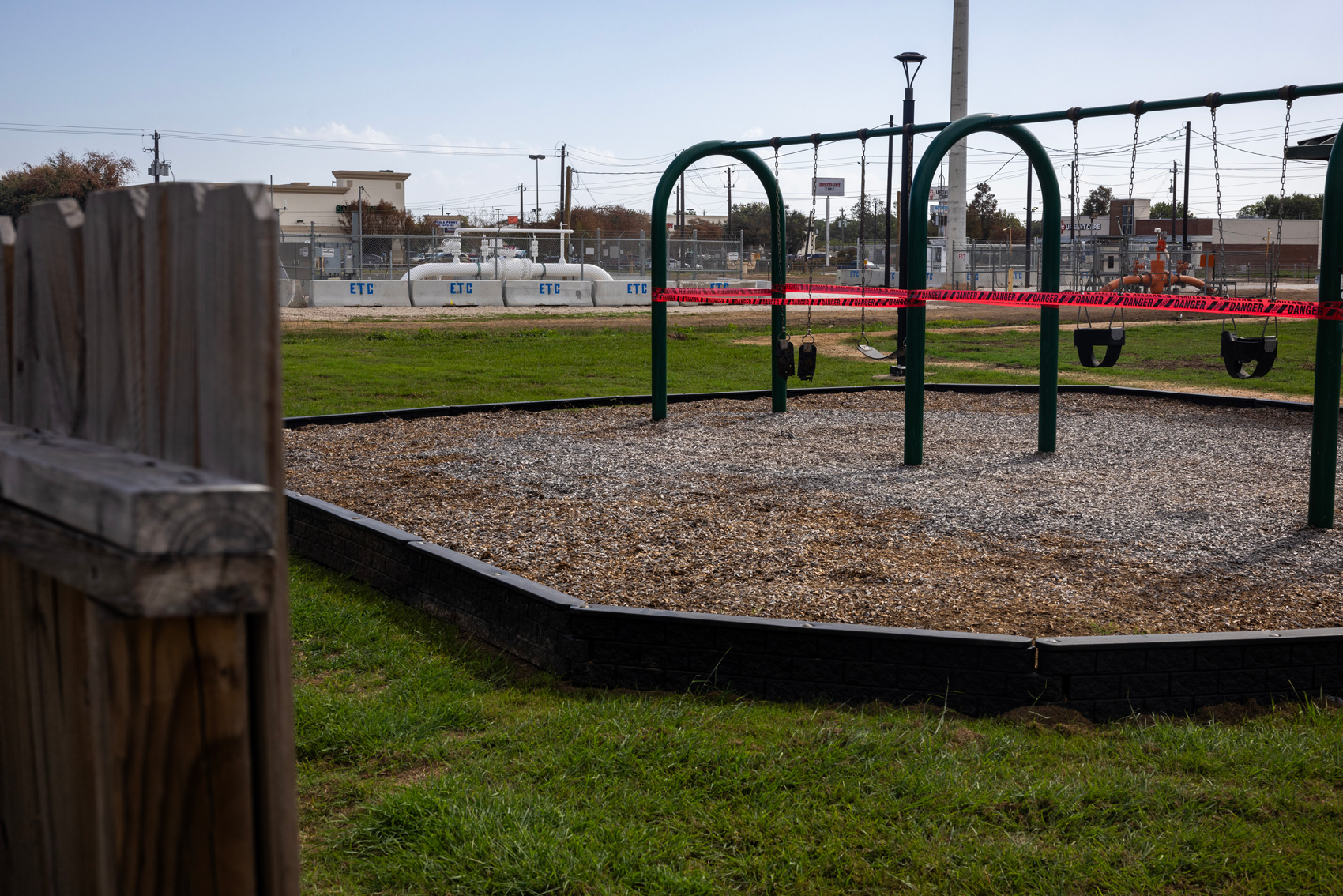
Energy Transfer’s pipeline structure was within about a block of a playground and homes to the west, adjacent to the busy Walmart parking lot to the northeast, and next to a busy section of Spencer Highway to the south, a major traffic artery.
Just across Spencer Highway from the explosion site, there are several more exposed pipelines with limited barriers on the La Porte side of the utility right of way.
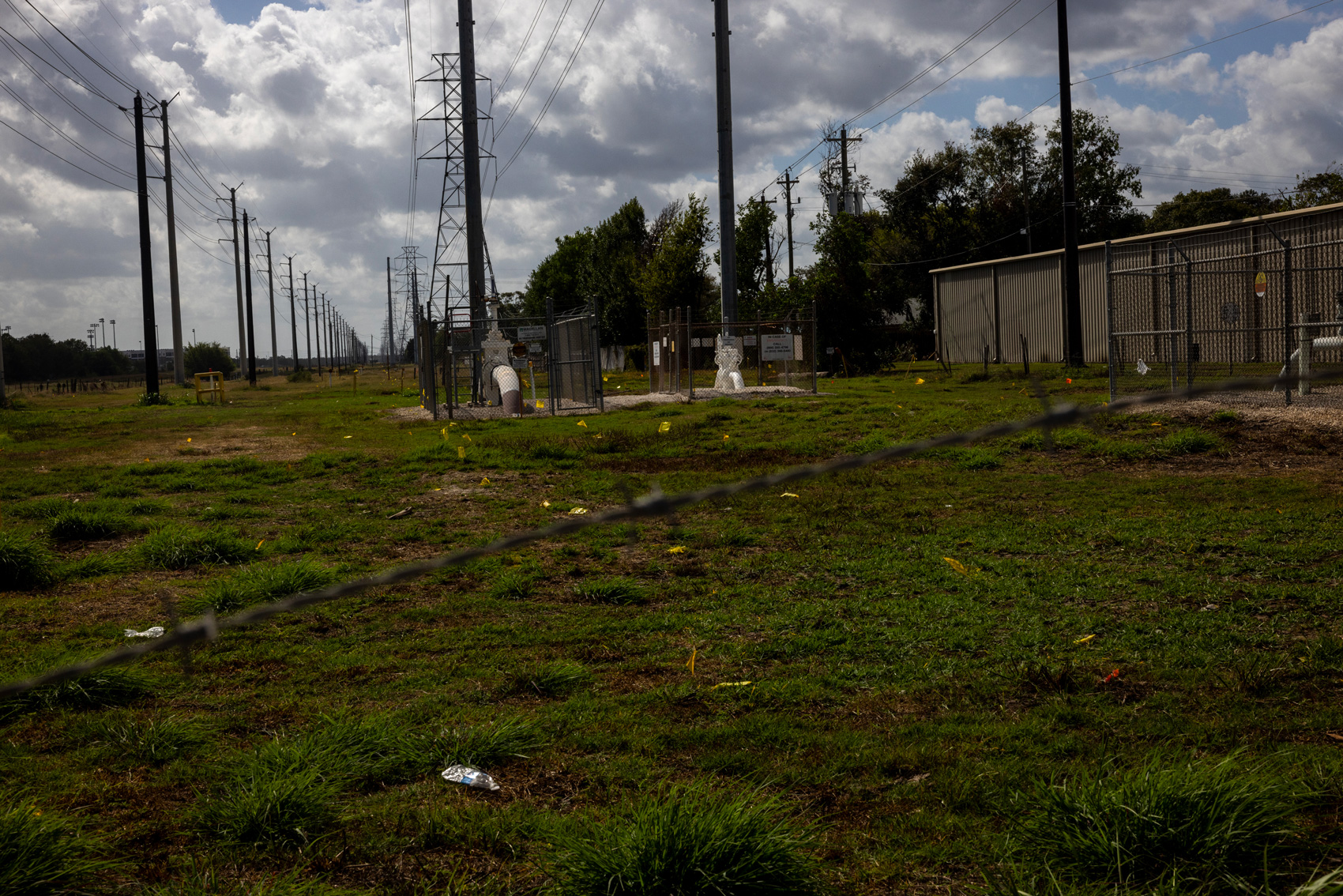
One of these above-ground pipelines carries crude butadiene, an extremely flammable chemical that can explode when it mixes with air. Exposure to butadiene has been linked to causing cancer and genetic defects.
Yet all that stood between the butadiene pipeline structure and Spencer Highway’s high-volume traffic during recent visits was a tangle of partially collapsed barbed wire along the roadway, a few yards of distance and the pipeline’s chain link fence.
Officials with Shell Chemical L.P., which the signs say operate the butadiene pipeline, did not respond to multiple calls and online media form requests asking about the adequacy of chain link fencing to protect against it being hit by one of the 25,000 vehicles per day that travel that section of Spencer Highway.
Shell’s butadiene pipeline is located only about 72 feet from Spencer Highway's traffic – about the length of a tennis court. The adjacent retail parking lot is even closer.
A bit farther down Spencer Highway, there are some more above-ground pipelines that are located next to the roadway near the La Porte Municipal Airport.
One of these above-ground pipelines carries ethylene, an extremely flammable chemical. Like others in the area, it appears to be protected only with a chain link fence.
Spokespeople for Equistar Pipeline, which a sign on the fence says operates the pipeline, and its parent company, LyondellBasell, did not respond to Houston Landing’s questions about whether the pipe is located appropriately and has adequate barriers.
In addition to being next to the traffic of Spencer Highway, the ethylene pipeline is located near the end of one of the airport’s runways.
A single-engine airplane hitting one of these nearby pipelines was the scenario used in an emergency response exercise the City of La Porte conducted with pipeline operators a few years ago, said Morales, the city’s emergency management coordinator.
Accidents involving exposed pipelines are a hazard that needs to be prepared for, he said. “Same thing with hurricanes, tornadoes, chemical emergencies at our facilities: we know that the risk is there and so we’re going to still plan and prepare for something happening, even though that likelihood is low,” Morales said.
But local governments don’t have authority to regulate the safety of pipelines.

The Federal Aviation Administration told Houston Landing it also doesn’t have the authority to address facilities like the above ground pipelines located outside of an airport’s property, and referred questions to pipeline regulators.
Federal and Texas pipeline regulators didn’t answer questions from the Landing about whether the chain link fences around Equistar’s ethylene pipeline and Shell’s butadiene pipeline provide sufficient protection from damage by nearby vehicles.
Bill Caram, executive director of the Pipeline Safety Trust, a national safety advocacy group, said a chain link fence “is more than nothing – but it’s not a whole lot more than nothing.”
It’s not going to prevent an act of terrorism, he said. And as the Deer Park SUV crash showed, he said, a chain link fence isn’t going to stop a car.
“It is the operator’s responsibility to protect the public from these threats,” Caram said. “We have seen many times at this point that a chain link fence is not enough. A lot of operators install concrete bollards and other kinds of more durable protection, and that seems to do a much better job protecting the public from damage from vehicles.”
It’s unclear how many pipeline structures in the Houston area and across the country have such little protection around them – or what regulators are doing to ensure pipeline operators have installed appropriate barriers against vehicle collisions.
The federal Pipeline and Hazardous Materials Safety Administration media office provided no answers to Houston Landing’s questions since Nov. 7 about whether current regulations, guidance and enforcement are effective in ensuring pipelines are adequately protected from vehicle crashes.

The Texas Railroad Commission, which regulates intrastate pipelines, said its investigation of the Energy Transfer explosion is ongoing but did not answer many of the Landing’s questions about its oversight of pipeline protections against vehicle collisions.
The commission provided a general statement saying its inspectors “work diligently on pipeline safety matters,” that the agency conducts comprehensive safety inspections of pipeline facilities at least every five years, and that “security concerns preclude divulging sensitive information about certain facilities to prevent them from falling into the wrong hands.”
Yet these above-ground pipeline components are hardly secret structures. They are located in plain sight where anyone can read their posted signs declaring the types of gas or hazardous liquids they carry and the names of the companies that operate them.
Residents still recovering from Energy Transfer explosion
Federal pipeline records say the Energy Transfer explosion on Sept. 16 caused an estimated $3.3 million in damage. Yet the harm experienced by the surrounding community isn’t fully captured in that figure.
It was a terrifying event that Monday morning for thousands of people living and working in nearby homes, shops and restaurants.
The flames from the ruptured pipeline shot skyward just beyond Frances Zann’s backyard fence. At age 97 she doesn’t drive anymore. She sold her car years ago.
In the chaotic minutes after the blast, Zann recalls her next door neighbor helping her evacuate. “We gotta go! We gotta go!,” the neighbor told her.


Weeks after the fire was extinguished and the pipeline rebuilt, Zann’s home was still in the process of being put back together. “I can’t even get in the kitchen,” she said looking toward the tarps that workers had put up to help keep dust and debris out of her living room.
Zann said firefighters saved her home by streaming water onto it during the nearly four-day pipeline inferno. But some of the water came into her kitchen through the damage to her roof. “It’s a mess,” she said, during a recent visit. Her back fence burned and had to be replaced.
“I didn’t know the pipeline was even there,” she said.
Across the street, neighbor Bruce Gale fears he’s going to be left with many of the bills to get his home repaired.
“It’s going to be an uphill battle,” he said, as he walked around his house recently and pointed to cracks in the walls and foundation, damaged windows and the dead landscaping that fried in his front yard from the pipeline fire’s blistering heat.
Gale said his insurance company, Allstate, questions whether the cracks are a result of the explosion, which Gale says shook the ground and sounded like an airliner had crashed. The insurer is also balking at addressing damage to his home’s roof, he said, offering to replace only a small portion of it even though he said he’s been told the fire’s extraordinary heat has voided his roof’s warranty. Allstate, in a one-sentence statement, said it is resolving customers’ claims “according to their policies.”
While Energy Transfer has helped pay for temporary hotel housing and some personal expenses for some in the neighborhood, Gale expressed frustration that the company isn’t doing more to fix the damaged homes on his block.

As a retired chemical operator, Gale said he recognizes the importance of the chemicals and other materials carried by pipelines. “We’ve got to have pipelines,” he said. But he wants to know what’s going to be done to ensure something like this doesn’t happen again.“They say it’s not their fault. Well, you know what, it’s their pipeline that blew up,” he said, noting it was only protected with “a little chain link fence.”
Morales, La Porte’s emergency management official, said he understands the concerns of people living near the site of the Energy Transfer explosion and other area pipelines.
“The biggest thing is to assure them that it's still the safest way to move the product,” Morales said.
Where there are specific concerns about pipeline structures, Morales said he sees an opportunity for residents and local officials to discuss solutions with the pipeline operator.
“There will probably be some type of regulatory push in the future,” he said, “but what can they do now?”
Figuring out the best types of barriers for pipelines carrying various products with different hazardous properties will require study to ensure the barriers don’t create additional risks or impair the ability to respond in emergencies, Morales said.
Morales says he’s already spoken with some companies about the vehicle crash issue. “Many of those operators have said we're going to push our own legal and management to invest in additional protective barriers,” he said.
Help Houston Landing investigate pipeline safety: Are there above-ground pipelines near where you live that may not be adequately protected from vehicle crashes? Tell us about them. Send an email to Associate Editor-Investigations Alison Young with the location of the pipeline, information about why you are concerned, and if possible, a photo of the pipeline. You can reach her at alison@houstonlanding.org or by calling 346-554-0323.

