

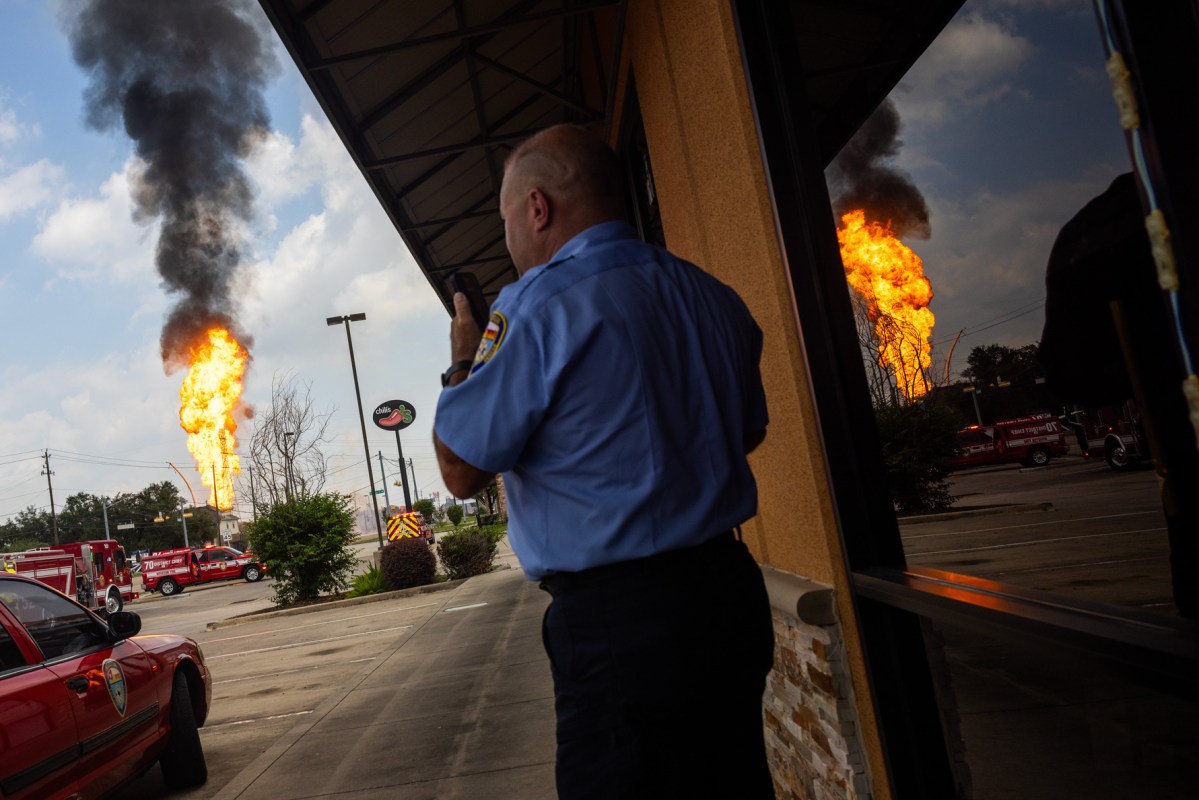
The driver who caused a massive pipeline explosion and fire in Deer Park last fall died by suicide, according to the Harris County medical examiner’s office.
Jonathan McEvoy Sr., who was driving the white Lexus SUV that veered out of a Walmart parking lot before crashing through a chain-link fence and into the above-ground pipeline on Sept. 16, died from “blunt traumatic and thermal injuries” and the manner of death was “suicide,” according to an online summary of the death case on the Harris County Institute of Forensic Sciences website.
The Sept. 16 crash caused the natural gas liquids pipeline to explode and shoot flames skyward for nearly four days. Hundreds of homes and businesses in Deer Park and LaPorte were evacuated and the intense heat burned and melted overhead power lines as well as some nearby homes and cars.
It’s unclear what evidence led medical examiners to rule McEvoy’s death a suicide. Officials with the institute were not immediately available for comment. The case summary was updated late Tuesday to say the medical examiner’s report has been completed.
The Deer Park Police Department, which has had an ongoing criminal investigation into the crash, declined to comment. “We are still waiting on the ME’s final report before commenting further,” Lt. Chris Brown, the department’s spokesman, said Tuesday.
Members of McEvoy’s family, who were not immediately available for comment, previously said the man had suffered in recent years from occasional seizures and that they believed he likely suffered a seizure before the crash.
Delma McEvoy, the man’s former wife, previously told the Houston Landing that McEvoy had borrowed his roommate’s SUV to go to the nearby Walmart to buy some new shoes, and had even asked the roommate if she wanted to go with him.
Investigators had asked family and close friends whether Jonathan McEvoy Sr. had left any note, or if he had been in any arguments, or if he had been paid to crash into the pipeline, Delma McEvoy said. She said there was no note, there had been no arguments and there was nothing unusual that had occurred in the days before the fiery crash.
The implication of the questions, she said was: “what are the odds of somebody having a seizure, what are the odds of them going and picking up speed and hitting – of all spots – hitting that spot, right?”
The Landing reported in November that top officials in Deer Park and LaPorte were saying the pipeline crash was not an accident and was not caused by the driver suffering from a medical event.
Deer Park Mayor Jerry Mouton, Jr., told the Landing at that time: “It was a criminal investigation because for all intents and purposes, it was an intentional act.” Moulton added: “You don’t just accidentally end up where that car ended up at. It wasn’t an accident.”
La Porte’s emergency management coordinator, Johnny Morales, told the Landing in a separate interview that the cause of the crash “was not medical in nature.”
Neither Morales nor Mouton provided any details about what evidence supported those views. A spokesperson for Mouton later sought to soften the mayor’s comments saying he had meant to say the crash ”would have had to have been a medical emergency or an intentional criminal act.”
A Houston Landing investigation published in December found there have been at least 36 reported incidents of cars, trucks and other vehicles crashing into above-ground hazardous liquid and gas transmission pipelines across the country since 2019. Twelve of those pipeline crashes occurred in Texas. Those crashes have caused three deaths, more than $21 million in property damage and resulted in evacuations, fires, gas and oil leaks and environmental contamination.
The number of crashes is likely higher because operators don’t have to report incidents to regulators at the federal Pipeline and Hazardous Materials Safety Administration where damage is minimal.
In many cases, the Landing found that pipelines carrying hazardous and flammable chemicals often had little protection against damage from vehicles driving on nearby roadways and parking lots. Rules let pipeline operators determine what kind of protection their pipelines need, and many that have been hit by vehicles had only a chain link or wooden fence, records show.
The Deer Park pipeline struck by McEvoy’s vehicle had only a chain link fence around it, even though it was near the traffic of busy Spencer Highway and the Walmart parking lot.
The pipeline’s operator, Energy Transfer, since has surrounded it with concrete barriers.

