


Despite overwhelming opposition and ongoing turmoil in neighboring Katy ISD, Cypress-Fairbanks ISD trustees nearly unanimously approved a controversial gender identity policy Monday.
During an hour of public comment, dozens of opponents of the policy — including students, parents and teachers — made a final plea to the board on Monday to reject the policy, which would require teachers to notify parents if their child uses a pronoun in school that is different from their biological sex. Despite vocal opposition from attendees, CFISD approved the policy in a 6-1 vote, with trustee Julie Hinaman voting against it.
Opponents to the policy argued that it will harm trans and nonbinary students who don’t feel safe disclosing their gender identity to their parents. Many cited research from the Trevor Project, which has shown that LGBTQ+ youth experience higher rates of homelessness or housing instability, suicide, and other mental health challenges.
“You have proven that you prioritize special interests over the needs of the community, and that our voices do not matter to you,” CFISD parent Christian Kimbell told the board Monday. “Every child made homeless because of this policy is on you. Every child that faces abuse at home or at school because of this policy is on you. Every child that attempts suicide as a result of this policy is on you.”
In passing the policy, CFISD — Texas’ third-largest school district with roughly 118,000 students across 96 campuses — joins a growing number of school districts across the country debating how much privacy students should be granted when it comes to their gender identity.
The decision also marks the latest controversial decision by Cy-Fair trustees since conservative elected officials won a strong majority on the board. In the last year, they’ve removed textbook chapters about vaccines and climate change, and cut librarians amid budget woes.
The “parent rights and responsibilities” policy grants parents full authority to guide their children’s beliefs, protect their well-being, and have access to complete information about them. It also mandates that students use the restrooms and locker rooms that align with their biological sex.
Hinaman pointed to the lack of clarity on accommodation plans where exceptions can be made in cases of suspected abuse or prohibitions by the law. The policy states that a student and their parents may request a reasonable accommodation with a district staff member for review and together create a written plan. If a district staff member indicates that the request interferes with a “sincerely held belief” they may request a reasonable accommodation through the district’s human resources department.
“In many ways, this policy is redundant and adds bureaucracy, confusion and inefficiencies,” Hinaman said at January’s meeting.
“This new policy is not a priority. We have other more important issues to deal with. It’s disingenuous to sit up here and say that safety is your number one priority, or that student achievement is the main thing, or that special education is a focus and to turn around and pass a policy that does not make kids safe. It does the opposite. That does not contribute to academic achievement and that targets vulnerable students subpopulations.”
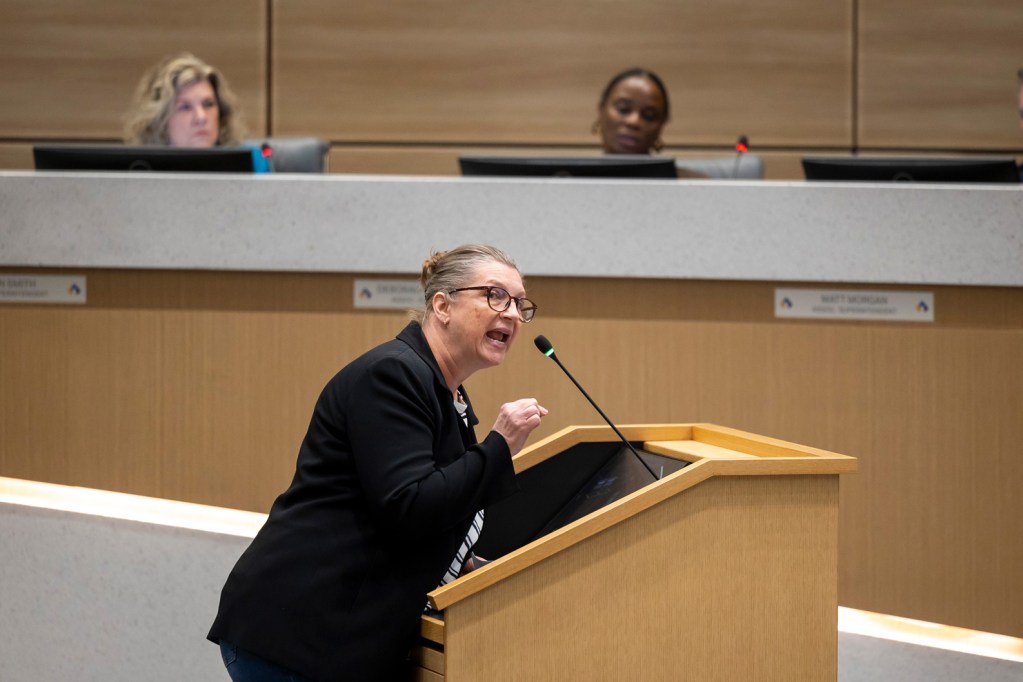
Hinaman repeated questions she asked January during Monday’s meeting but didn’t receive answers. She questioned what she describes as inaccuracies within the policy and unintended consequences if the policy were implemented.
She also directly asked the board how the policy would improve reading or math proficiencies, or any other district strategic goals such as improving its graduation rate.
No one responded to her questions after a long, silent pause.
“Wow!” an attendee yelled.
Hinaman said the policy originated from an email from an anti-public education organization to trustees advocating for it and how it quickly progressed to being considered “behind closed doors” in a board subcommittee.
“We heard overwhelming opposition from our communities,” Hinaman said. “No discussion was held by the board. It was voted 6-1 without public discussion by any other trustee as we have seen again here tonight. I ask, ‘Is this good governance?’”
Todd LeCompte, the chair of the board’s policy review subcommittee, defended the policy Monday, claiming that it is consistent with state, federal and case law regarding a parent’s right to direct the education and upbringing of their children, and that it adheres with Texas family code Chapter 32, section 32.004 and chapter 26 of the Texas education code.
Hinaman said the district’s policy is redundant.
LeCompte justified the policy by stating he believes the school district could lose federal funding for programs like food assistance, which offers free or reduced-cost meals to eligible low-income families.
“Taking no action could affect federal programs such as feeding our children,” LeCompte said at Monday’s meeting. “It would be a disgrace if some of our children went hungry if this policy failed to pass. For many of our students, it could potentially be their sole meal of the day.”
The connection was met with sharp neck turns and disgruntled sighs of disapproval from attendees, including a wide-eyed Hinaman. LeCompte didn’t elaborate further and didn’t return calls to clarify.
Hinaman repeatedly questioned the trustees over the policy’s intent. When they ignored her questions, she suggested they instead focus on a teacher policy that provides guidance rather than a parent policy, table the policy so it can be clarified, or dismiss the policy altogether.
The scene in the boardroom closely mirrored one that took place in neighboring Katy ISD in 2023. Katy’s passage of a nearly identical policy caused massive opposition in the district, prompted a wave of student activism, caused a transgender student to drop out, and spurred an ongoing federal investigation.
The contention and legal uncertainty brought on by Katy’s policy recently deterred Conroe ISD from passing a similar policy. Trustees ultimately decided to see how the investigation panned out before making a decision.
Hinaman also requested the board subcommittee take the same precaution and delay the vote given Katy’s ongoing investigation, but everything she suggested was rejected.
In the last two months, the Landing has reached out to every member on the CFISD board of trustees multiple times for comment. The Landing only received a response from Hinaman, who pointed to her public comments and reiterated her discontent with the board’s new “subcommittee” structure.
Following a precedent set by Katy ISD
When Katy introduced the policy in August 2023, community members showed up to oppose it, resulting in hours of public comment railing against the policy.
Still, the board passed the policy by the slimmest possible margin — setting off a chain of protests, pushback and student activism by LGBTQ+ students.
Jarred Burton, a senior from Katy ISD and the president of Obra D. Tompkins High School’s sexuality and gender alliance club, spent the last year organizing against Katy’s policy. He traveled more than 30 miles to advocate for CFISD students who may not have felt safe attending the CFISD trustee meetings, let alone speaking out. He also spoke about his experience and how the policy rocked his district and LGBTQ+ students.
Burton left disappointed after speaking at the first reading of the policy at the Jan. 16 board meeting. He said he believes the election of President Donald Trump along with plans to eradicate the Department of Education influenced this vote.
“I think this is emboldening them to impose these ideological culture wars onto their students because they know now … they’ll be able to get away with it,” Burton said.



Federal DEI programs have come under attack since Trump took office. Trump said in his inaugural speech on Jan. 20, that there are “only two genders: male and female.”
“It’s just very disappointing to see that they are willing to risk their federal public funding for something that nobody wants,” Burton said. “Other than 3 total people in this meeting, nobody has come out in support of this policy.”
Supporters of the policy argued that it would provide necessary guidance to educators and prevent them from advising students on life decisions without parental consent.
“To exclude parents from any process or decision regarding their child represents a nefarious attempt to undermine the family structure and unity,” said Julie Nix over a sea of boos.
“Consequences legally and financially reach beyond the child and are ultimately the parents. These are facts. So to bypass parents and give trusted adults that have no financial responsibility and can walk away at any time without consequence, [the] power to keep things secret and hidden from parents, is outrageous.”
Natalie Torres, who identified herself as a former educator, supports the policy. At the Jan. 16 meeting, she urged the board to provide clear instructions to educators.
“In my experience, the situation created significant tension as I was navigating policies and expectations that conflicted with my personal beliefs and professional judgment,” she said.
“The challenges I faced then reflect the broader issues we see in classrooms and society today where there is increasing pressure to reference individuals by genders other than what God created: male and female. This shift has raised complex questions about identity, respect and the role of educators. While it is essential to create a supportive environment for all students, it is equally important to have clear, thoughtful policies that address the implications for educators, students, and their families.”
Austin Davis Ruiz, president of the Houston LGBTQ+ Political Caucus, said he wasn’t surprised by CFISD’s decision and expects to see the trend continue in other districts, particularly in rural, conservative areas.
“I think it’s not if, it’s just a matter of when,” Ruiz said. “Unfortunately I think we’re going to see a wave of harm when we’re looking at LGBTQ+ students in the state and that’s not even including what may or may not pass at [the Texas Legislature].”
Now that the policy has officially been adopted, Students Engaged in Advancing Texas, commonly referred to under the acronym SEAT, is contemplating its next steps.
This could include a rally or pursuing legal action as Katy students did last year, but they’re unsure how successful it’ll be if they lose Title IX protections under Trump’s administration.
“It’s hard because the political climate at the moment is very tumultuous,” said Cy-Fair High School junior Alissa Sundrani after Monday’s meeting. “It’s harder to file things because we don’t even know if we’ll have the legal backing anymore.”
While definitive plans are currently unclear, Sundrani said SEAT is going to revamp its website and build a comprehensive guide to provide resources to the community. They will also try to partner with and spur the launch of more gay and straight alliances across campuses.
Miranda Dunlap contributed to this report.

