


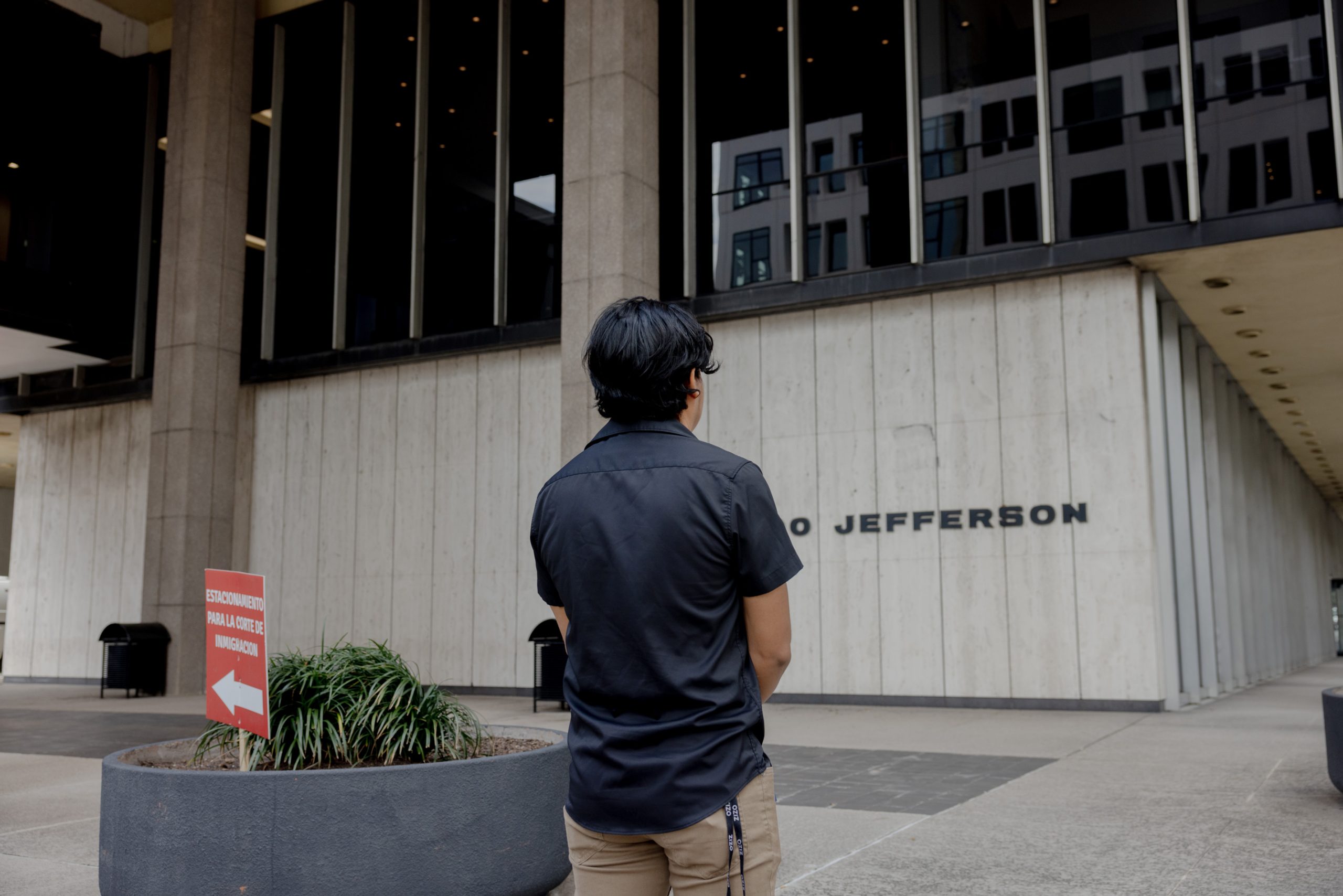
N. frantically searched for a lawyer before his February court date in Houston. Finally, he found a lawyer who claimed to be able to switch his case to a virtual hearing for $250.
N. was relieved. Without a car, he needed to find someone to drive him the 75 miles into downtown Houston from where he lives and works outside the city.
The supposed lawyer sent N., an immigrant from Honduras who is being identified by his first initial because he fled gang violence in Honduras, a document for his new court date. The Houston Landing is identifying the man by his first initial.
The document raised a few red flags. It was addressed from U.S. Citizenship and Immigration Services, which does not oversee the immigration court system. The Executive Office for Immigration Review, which is part of the Justice Department, runs immigration courts. The document also stated N.’s court had moved to Los Angeles, despite not living there. His hearing would be at 6 p.m., outside of normal court office hours. The $250 fee should be paid to USCIS, it said.
A search for N.’s case online showed that he was still scheduled to appear at a Houston court the next day. In short, he had been duped.
Immigration scams have existed for years, preying on vulnerable migrants confused and overwhelmed by the maze of the immigration system. A 2022 study by an assistant professor at UC Santa Cruz found that more than 2,300 immigration scams were reported between 2011 and 2014, and this number was likely underreported.
Although the exact number of people who fall victim to these scams is hard to quantify, fear of immigration enforcement and the urgency to fix their immigration status under the Trump administration could be fueling more immigration scams, according to immigration lawyers.
“A lot of people who haven’t initiated their immigration process before are now running to start their immigration process and they’re looking for any way that they can to obtain any type of benefit,” said Jenifer Sanchez Alarcon, a Houston-based immigration lawyer. “So that leads to people falling for the easy scams.”
N. was able to spot the scam on time and made it to his court date. If he didn’t, he could have been ordered deported in absentia. His next court date is in May, but he’s still searching for a lawyer.
Here’s what to look out for and how to ensure you don’t get scammed.
Common scams
Immigration scams can range from someone impersonating an immigration official or lawyer, offering to act as a sponsor for a fee, or claiming to provide a job in the U.S., according to USCIS.
Scammers often reach out through email, social media or text, so being asked for money through one of these platforms should be a red flag, according to Jacqueline Watson, an Austin-based immigration lawyer on the Executive Committee for the American Immigration Lawyers Association (AILA), a nationwide nonprofit and coalition of immigration attorneys. She cautioned people against sharing their immigration status on social media, because this could make them a target for scammers.
Government agencies such as USCIS will solely contact you by mail, she said. USCIS does collect a fee for many of their services, but all payments to USCIS should be made online when you fill out your application or by mail. Fees vary so check online the correct fee and where to send a check.
“They [USCIS and other federal agencies] will not text you and ask you for money. They will not email you and ask you for money and they certainly won’t send you a bill,” Watson said.
USCIS did not respond to a request for comment.
Vetting your lawyer
Since immigration law is federal, any qualified immigration lawyer in the U.S. can represent you. Just be sure that they are recognized by the state bar, the agency that regulates who is allowed to practice law in a state. If your lawyer is based in Texas, vet them through the Texas State Bar.
Watson also recommends checking that your lawyer is board certified in immigration law, since it is a complex legal area and you want someone with specialized knowledge to handle your case. AILA also has an online tool to find a board-certified immigration lawyer.
Some people might assume that notaries and other low-cost services offering to help immigrants file paperwork are certified lawyers. That’s why it’s important to check their credentials.
Notaries can perform roles similar to lawyers in some Latin American countries, but in the U.S., they are not lawyers. Their main function in the U.S. is to mark signed documents as legitimate. Their services shouldn’t cost more than about $50, according to Sanchez Alarcon.
“Notaries can’t give you any legal advice. The only people who can are attorneys,” said Sanchez Alarcon. “So if a notary is trying to give you some legal advice, they shouldn’t be doing that.”
If a lawyer contacting you to handle your immigration case claims to work for a government agency, such as Immigration and Customs Enforcement (ICE), the Department of Homeland Security (DHS), or USCIS, that’s a red flag. These government agencies never represent clients in immigration proceedings.
When in doubt, Sanchez Alarcon recommended seeking a second opinion from another immigration lawyer. “Getting a second opinion to vet the first one – see if it’s actually legit, if it’s around the same price, what would what were you told — is very helpful,” she said.
Too good to be true
Immigrants looking for low-cost services are often more vulnerable to scams. As a general rule, what seems too good to be true should raise an alarm, said Watson and Sanchez Alarcon.
Lawyers charge hundreds of dollars per hour, and immigration cases can drag out for years, so people should expect the process to cost thousands rather than hundreds of dollars. A lawyer promising to handle a case for a few hundred dollars may not be legitimate.
There are some exceptions to this. Some private lawyers do take cases pro-bono, meaning they don’t charge a fee, but they will specify if they plan to take your case this way. Many nonprofits offer free or low-cost services in the Houston area. Lawyers also offer free consultations to assess a client’s opinions and the cost before contracting their services.
Any lawyer promising a certain outcome should set off an immediate red flag.
“A good attorney will never give you a guarantee, especially in this area of law,” Watson said.
Verify your case
If you’re unsure about a notice you’ve received about your immigration court case, you can verify it yourself. USCIS has an online platform where you can look up the status of your application. EOIR, which oversees immigration courts, has an online platform to check the status of your case and your next court date.

When in doubt, you can also call the court directly to double check. They likely have Spanish-language translators, especially in Texas, said Watson, so don’t be afraid to call because of a language barrier.
How to report
Various local, state and federal agencies track fraud and scams. Some of the tactics in these scams, such as impersonating a federal employee, are federal crimes.
If you believe you’ve been a victim of immigration fraud, you can report the scam online to USCIS, which tracks immigration fraud, or to the Texas Attorney General. If you live in Harris County or the fraud occurred in Harris County, you can report it to the Harris County Attorney. You can also file a police report in the city or county where the crime occurred. If you want to report a lawyer in Texas for malpractice, you can file a grievance with the Texas State Bar.
Watson cautioned people to do their research, take their time, and not panic when trying to find a lawyer. “Fear motivates people to be a little less careful,” she said.
Do you believe you’ve been a victim of immigration fraud? Reach out to the Houston Landing if you want to share your story.

