

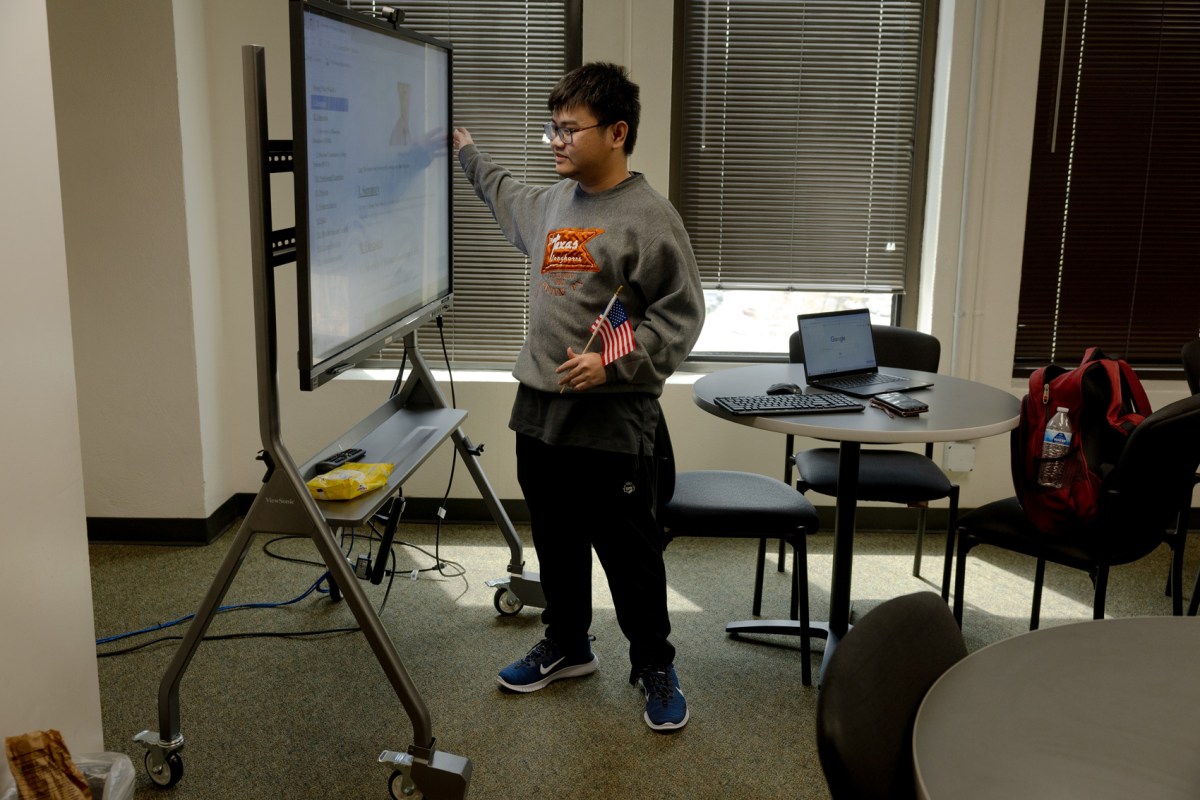
When Houston Community College international student Quang Nhat Minh Le secured a part-time job crunching data in the school’s recreational sports department last summer, he unlocked a coveted experience few of his classmates get.
Le, a native of Vietnam, faced stiff competition for the role at HCC, where thousands of international students compete each year for a few dozen openings. The money helped offset his tuition costs and clear the way for his transfer to the University of Houston-Downtown, where he’s now pursuing a bachelor’s degree in mathematics and applied statistics.
“The department only needed one international student. Luckily I got in,” Le said. “I (had to) compete with at least like 10 people. … I felt very lucky when my manager selected me.”
At HCC, which boasts the largest international student population of any community college in the country, students from abroad routinely contend for a tiny number of part-time, on-campus jobs as a result of strict federal limits on their right to work. Just 44 of HCC’s 3,600 international students worked for the school — the only place they can get a job, per federal regulations — in a part-time capacity, records obtained by the Landing in February show.
For HCC’s international students, who hail from roughly 130 countries, the restrictions often leave them without much-desired work experience and income. The limited job prospects mean some students can’t afford to transfer to a four-year university program, struggle to find a job in the U.S., or return home with no employment on their résumé.
“I would love to have a bachelor’s degree from here, but the prices are just sending me away,” said Zaidy Villoria, a first-year psychology major from Venezuela. “Once your degree is over, you have to leave the country. So you want to stay here (and study), but with the prices, it’s a tricky thing.”
In interviews, several students said they didn’t realize it would be so difficult to find work while attending school in the U.S. While federal rules require international students to have money in the bank before arriving in the U.S., some take a financial risk by coming to HCC.

An HCC spokesperson did not respond to questions about how HCC supports international students seeking to work at the college. HCC employed 825 part-time staffers in 2024, according to the college’s most recent financial report, making international students roughly 5 percent of its part-time workforce.
HCC Director of International Student Services Nithy Sevanthinathan acknowledged the challenge of finding work for international students. He said he’s advocating for the college to provide more financial assistance — such as scholarships, job opportunities and professional mentoring — to students who travel across the globe to study.
“I’m pushing the idea that we need to somehow reimagine what we do every day to support these students,” Sevanthinathan said.
‘I need a job’
Under federal law, international students who attend HCC on an F-1 visa — which allows them to reside in the U.S. while they study — are subject to numerous rules and restrictions. The rules are designed such that international students aren’t relying on work in the U.S. to make ends meet.
At HCC, international students and their financial supporters, such as parents or other relatives, must have at least $10,000 to roughly $23,000 in a bank account to enroll. International students are ineligible for federal loans, grants and work-study programs.
Students on F-1 visas also can only work at their college and are prohibited from working over 20 hours per week. Often, the only jobs available to them are in the campus cafeteria, library or offices.
While international students must have upfront money to attend HCC, tuition and fees — $2,730 for the average 12-credit semester, more than double the amount paid by most Houston-area residents — and living expenses can add up.
Pavitra Patil, a computer science major from India, said securing a part-time job would help ease his family’s financial burden. Patil has applied for several jobs at HCC — tutor, library helper, office assistant — with no luck.
“I did not get a follow-back email yet for the positions I have applied for,” Patil said. “The reason for applying to all those jobs is … to pay my tuition fees so my parents do not have to pay that much.”
Feeling the trump effect?
President Donald Trump’s administration has not broadly targeted students on F-1 visas as part of his higher education policies.
However, Secretary of State Marco Rubio said it has revoked about 300 such visas while targeting pro-Palestinian protesters on campuses.
For more information on the impact of the Trump administration on Houston-area community colleges, see the Landing’s report from last week.
For many international students who can afford HCC tuition and living in the U.S., an on-campus job can help pad their résumé, make the transition to a university easier, or gain a leg up in their home country’s job market.
Wilfredo Ekua Adjaba Mbasogo wants to return home to Equatorial Guinea to work in the business sector when he finishes his HCC associate degree. But Mbasogo worries he won’t have enough work experience to get a good-paying job in the central African country.
“I feel bad for (myself) because I need a job, not just for the money, but I want to gain expertise,” said Mbasogo, a business major. “In my country, actually, most of the time when you apply for a job, they ask you for like five years of experience.”
In the absence of a part-time gig, some HCC students volunteer or join student organizations to beef up their résumé.
“Without an on-campus employment, (that) doesn’t mean we can’t shape the experience better in many ways,” said Sevanthinathan, the HCC director. “If I know some students want to get the experience, I work with departments to create some kind of a volunteership to get that experience.”
Seeking clearer communication
While many of the barriers facing international students are out of HCC’s hands, some students still say the college could better prepare them for the tough employment landscape.
For example, college officials could share clearer information about open jobs available to international students, provide more advice from hiring managers and better warn incoming students of how difficult it will be to find employment, the students said.
Zayed Sohail, a civil engineering major from East India who volunteers as an HCC “international student ambassador,” said fellow exchange students ask him over and over where they can find work. But Sohail doesn’t have the answer: he hasn’t been able to find a job, either.
“I say, ‘There are (jobs), but it’s hard to get,’” Sohail said. “It’s limited, and the number of applicants is too high. There are not as many (jobs) as I was expecting when I came.”
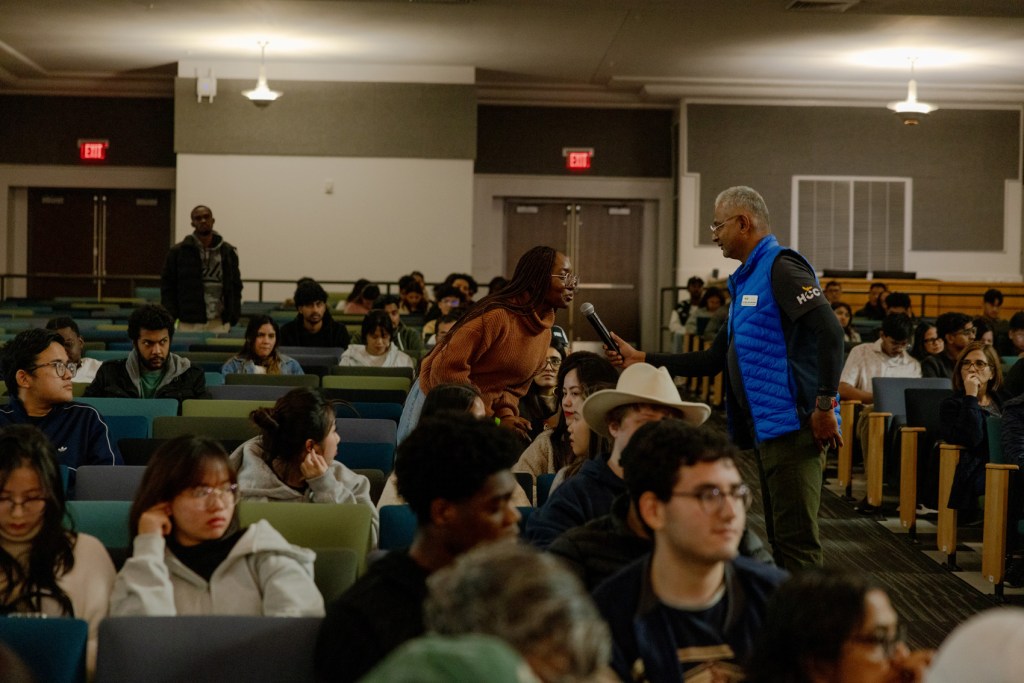
Sevanthinathan said the college could help students with their finances and experience in other ways.
For example, while students with F-1 visas aren’t eligible for federal financial aid, they can accept money from their institution. HCC doesn’t supply scholarships for international students, though some scholarships awarded by the HCC Foundation — a nonprofit supporting the college — do not have citizenship requirements.
“Some of these students come with great academic skills. We should acknowledge them with some kind of a scholarship,” Sevanthinathan said. “Their journey has been a lot of sacrifice. If their experience feels affirmed and valued, their own life will change forever.”
Miranda Dunlap covers Houston’s community colleges in partnership with Open Campus. Despite roughly half of Houston’s higher-education students attending community colleges, there hasn’t been much news covering these systems or students — until now. Her reporting holds institutions accountable, highlights barriers faced by students and helps them navigate their opportunities. Reach Miranda at miranda@houstonlanding.org or on Twitter and Instagram.

