

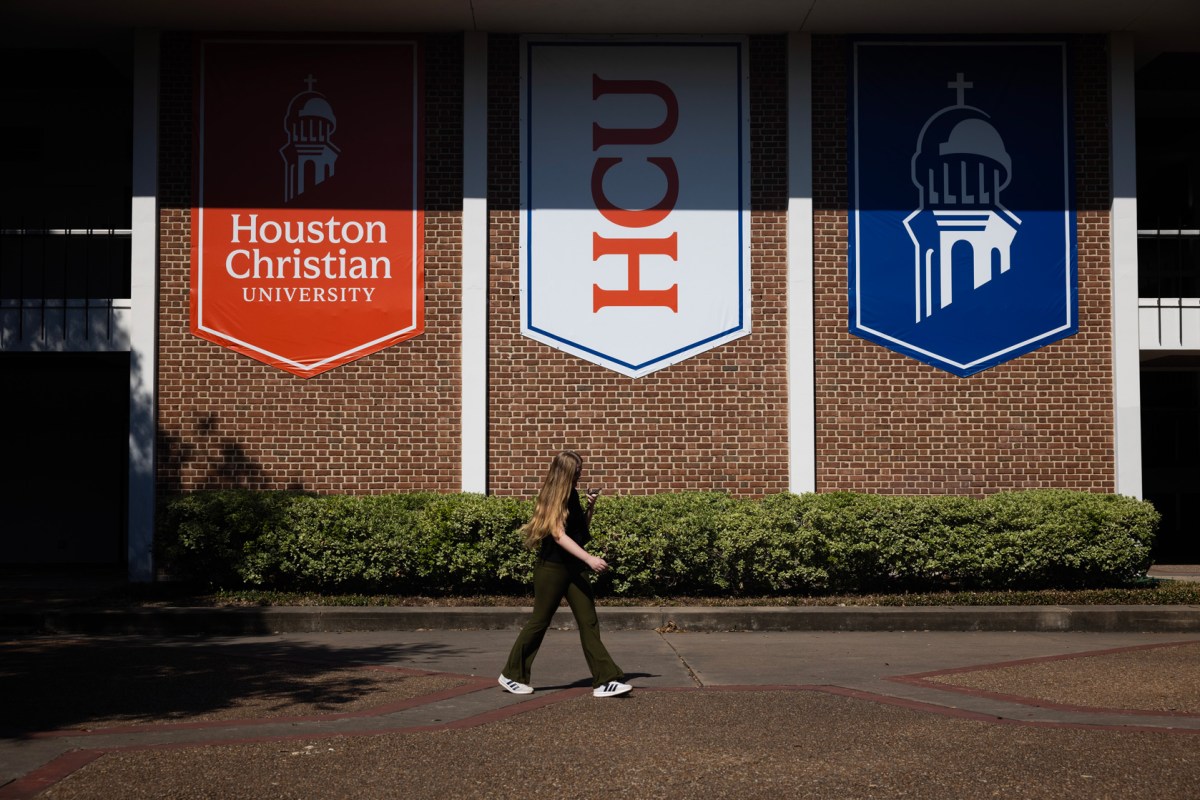
As some small private universities weather financial struggles due to declining enrollment, Houston Christian University is in the midst of an ambitious enrollment push.
The southwest Houston school, which rebranded from Houston Baptist University in 2022, is looking to increase enrollment from 4,000 to 10,000 students by the end of the decade.
To help fill those seats, HCU is turning to a new and increasingly popular “direct admissions” pipeline, in which qualifying students are accepted before they formally apply. The school aims to attract students through partnerships with local school districts, including Alief and Katy ISDs, which approved agreements this month, and Fort Bend and Humble ISDs, which are considering a similar collaboration.
Under the agreements, school districts share data with HCU about students who meet the university’s criteria for being automatically accepted. In Alief, for example, students with a 3.0 GPA or higher who are on track to complete high school math requirements would qualify for direct admission.
HCU, in turn, would notify the students they automatically will get into the school if they complete a simplified application form.
James Steen, HCU’s vice president of enrollment, said the approach would make more families aware of the university and options beyond community college and state schools.
Many public schools across the state already offer similar guaranteed admissions avenues, including the University of Texas at Austin and Texas A&M University. Unlike guaranteed admissions programs, however, students admitted through direct admissions do not have to complete an application ahead of time.
“It kind of just flips the script,” Steen said. “Instead of saying, ‘Fill out an application and then we’ll tell you about this offer that you’re eligible for,’ we’re basically saying, ‘Here’s the offer you’re eligible for.’”

Reward and risk
For universities that admit most applicants — HCU’s acceptance rate is about 85 percent — the typical application process can discourage students who otherwise would have a high chance of admission.
Taylor Odle, an assistant professor in the Department of Educational Policy Studies at the University of Wisconsin-Madison, said essay and other application requirements historically have kept lower-income and first-generation students from applying to college. Odle’s research, which analyzed six universities in four states, found direct admissions increase a student’s likelihood to apply to college by 12 percent, with a bigger boost among lower-income, Black and Hispanic students.
“Unsurprisingly, when you remove barriers for people taking up things, like, if organic food at the grocery store was a hell of a lot cheaper, you’d be more likely to buy organic food,” Odle said. “Well, if going to college is a lot easier, more people are going to go to college. And that’s what we see.”

related to education
Learning Curve: Search where Houston high school grads go to college by district, campus
by Michael Zhang / Staff Writer
While direct admission would help clear a path to HCU, attending a private university — which often costs tens of thousands of dollars more than a state school or community college — still carries risk for many students.
After federal and school-provided financial aid, attending HCU still costs about $17,000 to $20,000 annually for students from lower- and middle-income families, according to the U.S. Department of Education. Most students who complete college at HCU graduate with more than $20,000 in debt, and about three-quarters of students were not making payments toward their loans after two years, federal data show.
College graduation rates
The percentage of students who graduated within eight years of enrolling at Houston Christian University, the five largest public schools in Texas and the midpoint rate for all four-year schools.
- Houston Baptist University: 48%
- All four-year institutions: 58%
- Texas A&M University-College Station: 84%
- University of Texas at Austin: 84%
- University of Houston: 63%
- University of North Texas: 60%
- University of Texas at Arlington: 58%
HCU’s below-average graduation rates also mean many students need more time — and take on more debt — to complete their degree, if they get one at all.
While direct admissions programs increase some students’ likelihood to apply to college, they don’t necessarily boost enrollment, Odle said. Tuition costs remain the deciding factor in students’ decision to enroll, and students should be wary of schools that don’t provide a quality education for the price tag, he said.
“There are good actors and bad actors in every sector,” Odle said. “What I don’t want to do is funnel students to institutions that are not only going to be a bad fit for them, but they’re going to provide a really poor return on investment.”
For Steen, direct admissions isn’t solely about attracting students to attend HCU, but to empower qualified students to consider four-year college as an option. He highlighted the university’s close-knit, Christian community as a potential benefit for students looking for a more personalized experience than the ones being offered at community colleges.
“We’re hopefully helping (students) elevate and get better offers and get access to programs they wouldn’t know even existed,” Steen said. “A lot of students that enroll in two-year institutions, they don’t always have a good experience. They don’t always make it to a four-year institution.”
‘This is another option’
Although the decision ultimately lies with students, school districts across the Houston area now are weighing the same set of pros and cons in their decisions to greenlight such a novel proposal.
In Katy, the direct admissions program already has been approved and announced to high school students, with promotional materials promising “peace of mind” to eligible seniors. Katy’s media relations general manager, Rachel Ross, said district leaders hope the program provides better access to students who may be hesitant to apply to colleges and universities.
The Alief school board approved a memorandum of understanding and data sharing agreement with HCU in early October.
Alief Board President Darlene Breaux directed questions about the proposed agreement to school district administrators. The district’s chief of communications and public relations, Kristyn Cathey, did not respond to multiple requests for comment before publication of this article. After it published, Cathey said in an email that Alief agreed to participate because “this is a fantastic opportunity for students in Alief to enter a local university, potentially get scholarships, and allow them to stay in the Houston community.”

Fort Bend Communications Coordinator Natalie Rivera said the program is an “amazing opportunity” for high school seniors, although the district has yet to finalize a memorandum of understanding. Humble and Lamar CISD also are eying similar programs, as is the charter school network YES Prep Public Schools.
Local partnerships are particularly important because the vast majority of the HCU student body comes from the Houston area, Steen said.
“These are the students that we know how to serve, that we love to serve,” Steen said. “This is really just an opportunity for us to put an offer in front of them and communicate to them, ‘Hey, this is another option that I have that I wasn’t aware of.’”
Correction, Oct. 31: An earlier version of this story incorrectly stated the status of Alief ISD’s vote on a memorandum of understanding and data-sharing agreement with Houston Christian University. The district’s school board approved them in early October. The story also has been updated to include comment from Alief officials provided after the story published.

