

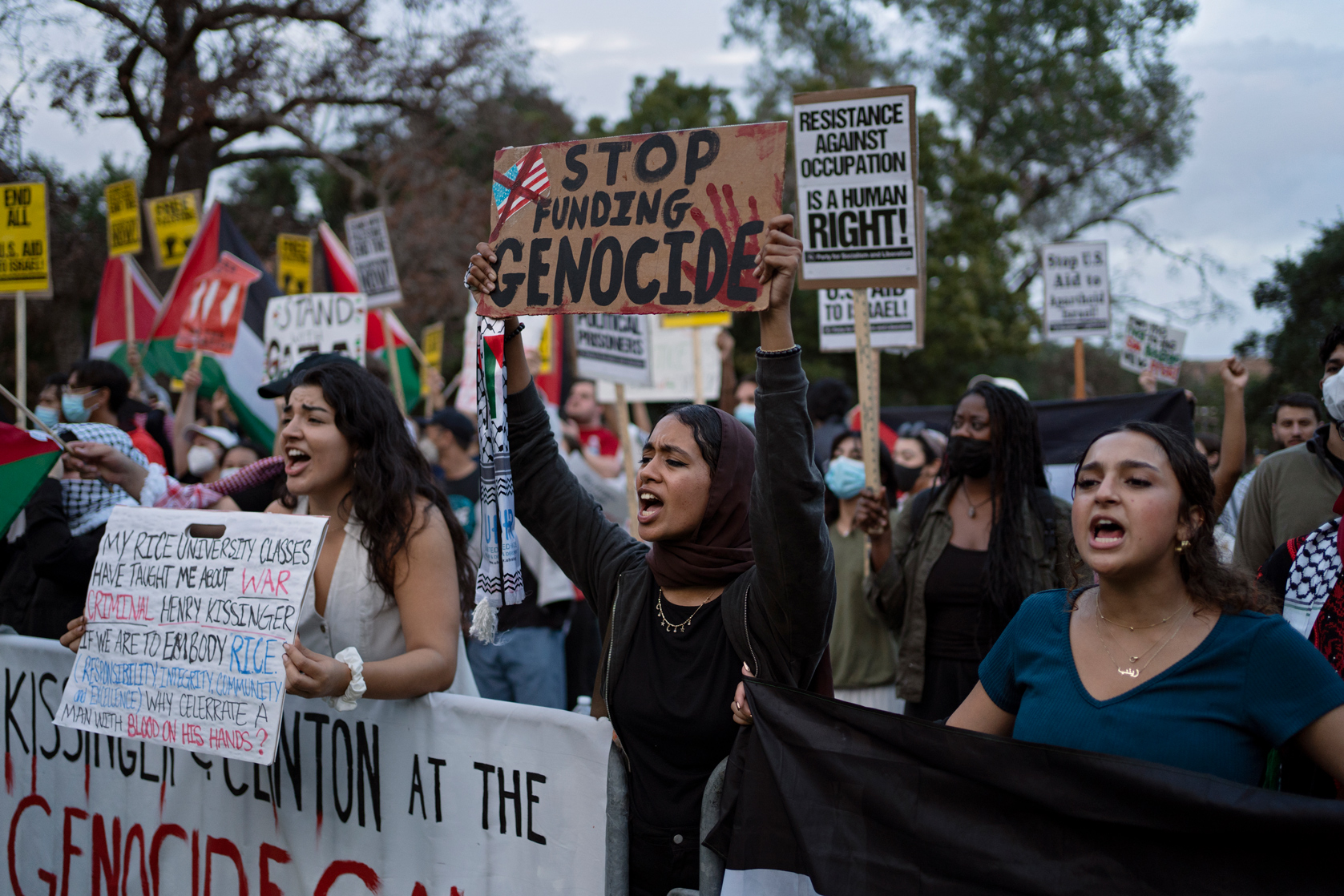
A proposal from Mayor John Whitmire to ban protesters from coming within 200 feet of a targeted residence was “tagged” by four council members on Wednesday, delaying consideration of the item for two weeks.
While the ban is a blanket proposal that applies to all types of demonstrations, Whitmire said the measure is in response to months of protests by pro-Palestinian activists in front of his and other public officials’ homes.
The council members raised concerns the proposal was being used to target a specific group and could infringe on their First Amendment rights, while Whitmire encouraged members to support the ordinance to protect his and his neighbors’ peace.
“I believe if you had to go through what I go through, four times now, at night, as late as 11 o’clock,” Whitmire said. “It’s very frightening. It’s not fair to my neighbors.”
The proposal is constitutional and similar to ordinances in other cities, the mayor said.
At issue are several months of regular protests in front of the homes of Whitmire, U.S. Sen. Ted Cruz, R-Texas, and U.S. Rep. Lizzie Fletcher, D-Houston, by small groups of protesters from a coalition of pro-Palestinian grass-roots organizations. The protests sometimes begin in the morning and some begin after dark, according to local media reports. The protesters normally chant, clap and hold signs encouraging officials to cut ties with Israel over the war.
Council members said the proposal was unnecessary and risked a chilling effect on protests in the city. Violating Houston’s noise ordinance and blocking public roads already are outlawed in the city, District J Council Member Edward Pollard said.
At-Large Council Member Leititia Plummer said she was concerned the proposed ordinance clearly is targeting a specific group of protesters. While neighbors should be protected from disturbances, Plummer said protests are a part of life for public officials.
“We have chosen to be elected officials, so we have to stand behind our belief system, and if we’re putting ourselves out there, unfortunately that’s a risk we’re taking as individuals,” Plummer said.
Pollard, Plummer, District B Council Member Tarsha Jackson and District F Council Member Tiffany Thomas all joined the tag on the proposal.
The tag is a legislative maneuver that automatically delays consideration of an agenda item for a week. Because the council does not have a meeting next week, the protest ordinance will be delayed two weeks.
Whitmire said laser pointers, drums and whistles have been used in front of his house and that protesters can be “aggressive” at times. On June 20, eight protesters in front of the mayor’s house were detained and cited for violating the city’s noise ordinance, according to the city.
Whitmire went on to claim he was being targeted by “professional protesters” who are being paid.
The protesters denied anyone was paid to gather in front of the officials’ homes and said their gatherings are peaceful. Like much of the nation, protest activity surrounding the Israeli-Palestinian conflict has surged since the latest war began last Oct. 7, after Hamas launched a cross-border attack on Israel that left around 1,200 people dead. The protesters say Israel’s response — an all-out invasion of densely-populated Gaza that Palestinian authorities say has left at least 39,000 people dead — is excessive and call for an end to U.S. military and financial aid to Israel.
They say they are targeting Whitmire because of his refusal to speak out against Israel and because of an Israeli government bond the city of Houston holds. Cruz and Fletcher have been targeted because they accept money from the American Israeli Public Affairs Committee, a pro-Israel political action committee with ties to the Israeli government.
“We’re all sensitive to their concerns, but it’s not a city issue,” Whitmire said.
Residential protests have occurred in U.S. cities for decades. Municipal governments have regulated the practice, particularly after anti-abortion activists began staging protests in front of the homes of doctors after abortion was legalized nationally by the U.S. Supreme Court in 1972.
The Supreme Court OK’d the ability of cities to regulate the targeted protesting of residential dwellings in 1988, but has struck down broader laws that regulated protesting in entire neighborhoods.