


Texas has the largest pipeline infrastructure in the nation – about 480,000 miles of pipelines – and maps show many of these lines are concentrated in the Houston area.
Yet when an above-ground pipeline exploded this fall in Deer Park, some nearby residents told Houston Landing they had never previously been aware of the pipeline or knew little about its risks until after the inferno forced them to flee their homes.
The dramatic explosion and fire – which killed the driver of the SUV that crashed into the pipeline, burned homes and forced thousands to evacuate – was among more than 200 pipeline incidents across Texas and more than 560 nationwide during 2024, according to data collected by the federal Pipeline and Hazardous Materials Safety Administration.
“Houston has some of the densest pipeline infrastructure in the country,” said Bill Caram, executive director of the Pipeline Safety Trust, a national safety advocacy group. “The more educated the public is, the better they can advocate for their own safety.”
Here are three things pipeline safety and local emergency experts say you can do to improve your awareness of pipelines near where you live, work or your children attend school – and also help improve their safety.
1. Identify pipelines near you
State and federal pipeline regulators publish interactive maps on their websites that allow the public to see the routes of hazardous liquid and gas transmission pipelines near where they live.
Johnny Morales, emergency management coordinator for the City of La Porte, suggests these maps as a starting point for Houston-area residents interested in pipeline safety. “That way they can first assess: do I have a lot of pipelines around me? And obviously, in this area, this region, we do,” he said.
The Texas Railroad Commission’s pipeline maps allow users to zoom into individual neighborhoods, revealing sometimes dense webs of bright green lines crisscrossing neighborhoods.
The lines initially show general labels such as: “Highly Volatile Liquid Transmission,” “Natural/Other Gas Transmission,” and “Crude Oil Transmission.” But when a user hovers their cursor over individual lines, the map provides additional information about the product the pipeline carries and the name of the pipeline’s operator.
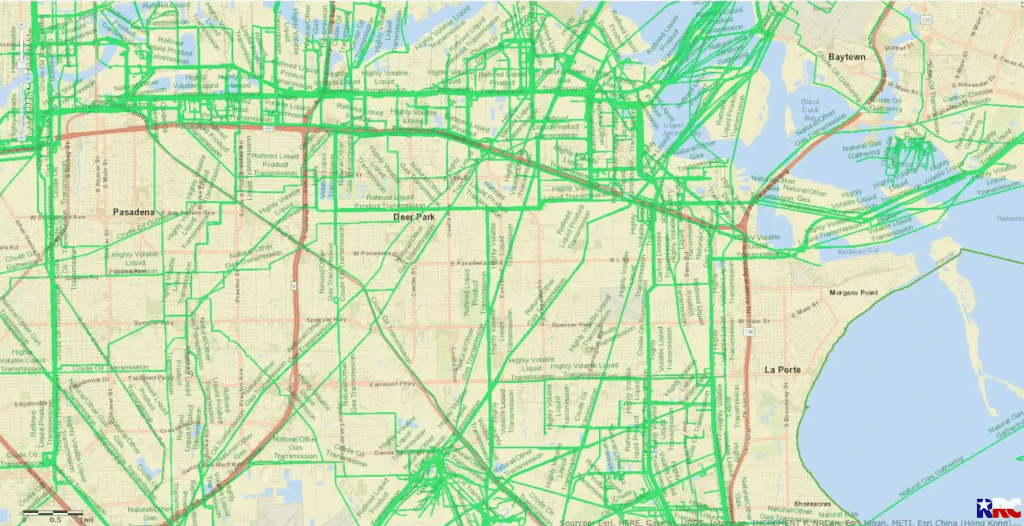
The Texas maps are available here: https://www.rrc.texas.gov/resource-center/research/gis-viewer/
Similar information is available nationwide for individual counties in other states through the National Pipeline Mapping System, posted by federal pipeline regulators here: https://www.npms.phmsa.dot.gov/AboutPublicViewer.aspx However the federal map restricts how closely a user can zoom into individual neighborhoods.
The Pipeline Safety Trust website has education materials, many written in both English and Spanish, to help people understand the various types of pipelines in their communities, their regulation and safety. They are available at: https://pstrust.org/briefing-papers/
2. Talk with local officials and pipeline operators
If residents have concerns about the safety of pipelines in their neighborhood, Morales said they should contact the pipeline operators and their community’s local office of emergency management emergency planning department.
“Just ask the questions,” he said, noting that pipeline operators have public education programs and materials to share with area residents. “We understand that there’s always a lot of curiosity, especially after an event.”
The American Petroleum Institute has issued industrywide best practice standards that call for operators of hazardous liquid and gas transmission pipelines to answer questions and share information with members of the public who live near their pipelines.
Under API Recommended Practice 1185 for “pipeline public engagement,” the industry group says a core principle of engagement is “openness and transparency” and that operators “should answer questions objectively and as fully, clearly, and directly as possible.” The guidance document can be read here: https://publications.api.org/AccessToDocuments.aspx
“It’s voluntary,” said Caram, “but it does lay out some pretty high standards for operators and how they should be engaging with the public, including the people who live along that pipeline and hearing their concerns and incorporating them into how they operate that pipeline.”
Caram added: “It’s a great place to start for the public to start holding operators who aren’t living up to those ideals accountable for not following their own industry’s best practices.”
The American Petroleum Institute’s media office did not respond to requests from Houston Landing for an interview or information about how residents with safety concerns can best engage with pipeline operators.
3. Report pipeline safety risks:
The public can help companies keep pipelines safe by not digging anywhere without first contacting Texas811 to get any underground pipelines and other utilities marked, by reporting to law enforcement any suspicious activity near pipeline right-of-ways, and also watching for any spills, leaks or changes in the soil coverings where pipelines are located.
Complaints about pipeline safety issues can be filed with state regulators at the Texas Railroad Commission by calling 512-463-7058 or sending an email to safety@rrc.texas.gov.
Houston Landing also wants to hear from Houston area residents about above-ground pipeline structures located near roads and parking lots that may not be adequately protected from vehicle. The Deer Park pipeline that exploded after a vehicle crash in September was protected with only a chain link fence.
A recent Houston Landing investigation found that pipelines hit by vehicles across Texas and the U.S. often lacked reinforced protective barriers. The news organization is seeking help identifying above-ground pipelines that they think may not have enough protection from nearby cars and trucks. Readers can suggest pipelines for further investigation by filling out this form.

