

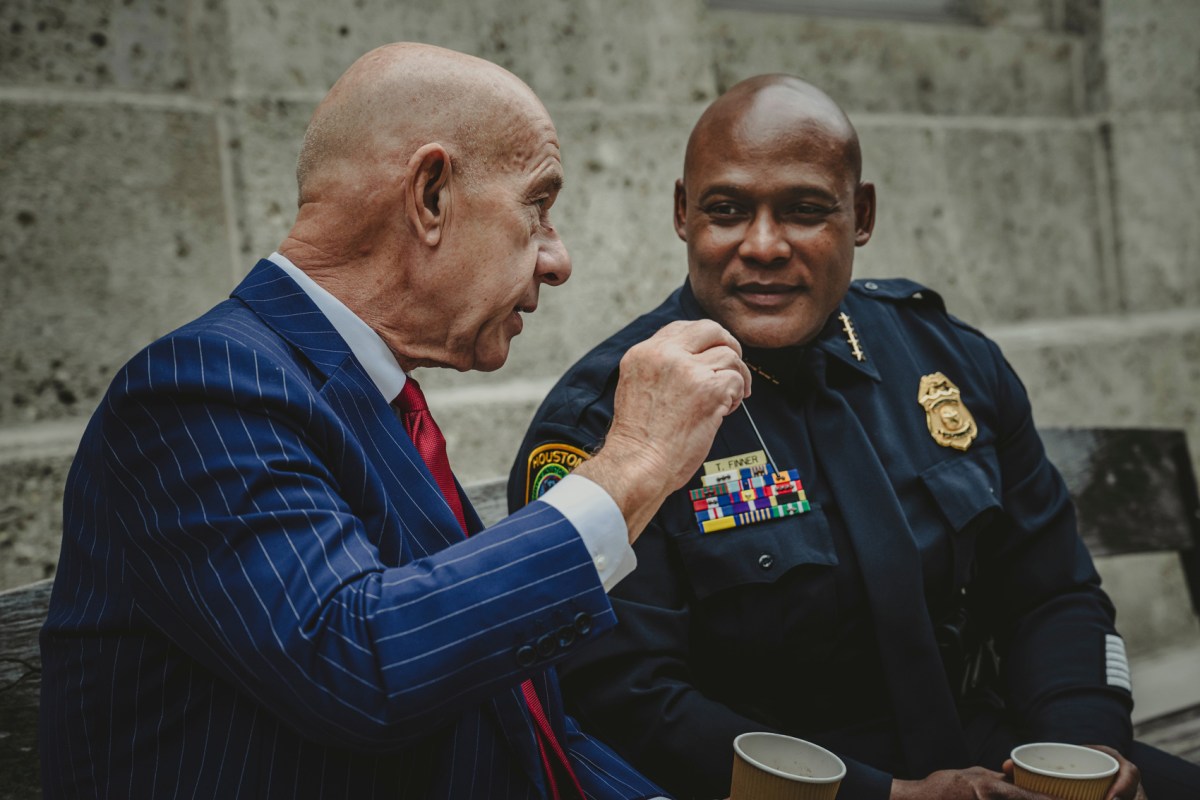
Several “critical issues” in the Houston Police Department, including mismanagement by agency leaders and understaffing in key divisions, contributed to a scandal involving suspended investigations into criminal cases, an independent committee wrote in a report released Wednesday.
In the report, the five-member committee urged various improvements to the department, such as adopting a more standardized approach to case management across divisions, updating records management systems and hiring more civilian staffers.
“Addressing these problems is vital for boosting crime response and managing efficiency,” said Christina Nowak, a member of the committee who serves as the city’s deputy inspector general at the Office of Policing Reform and Accountability
The report, commissioned by Houston Mayor John Whitmire earlier this year, marks the end of the latest probe into city police classifying about 268,000 cases as suspended due to a lack of personnel. Then-Houston Police Chief Troy Finner resigned in May amid pressure stemming from the investigations.
Dozens of sexual assault cases have been reopened, with investigators pursuing fresh evidence and leads, after Finner disclosed that about 10 percent of the agency’s cases and incidents had been labeled as suspended. In addition, cases that were suspended over the past eight years received minimal, if any, follow-up, and crime victims were left in the dark about their case status, the panel reported Wednesday.
At the same time, HPD leaders have said many of the 268,000 cases were wrongly classified as suspended, didn’t have clear leads for follow-up or were related to relatively minor property crimes.
meet the panel
The five-member independent review committee featured prominent community leaders and government officials.
- Ellen Cohen: Former member of the Texas House of Representatives and Houston City Council, and former CEO of the Houston Area Women’s Center for 18 years.
- Jeff Owles: Captain with the Texas Rangers and 21-year veteran of the Texas Department of Public Safety.
- Christina Nowak: Deputy inspector general of the city of Houston’s Office of Policing Reform and Accountability.
- The Rev. Leon Preston II: Pastor of Yale Street Baptist Church in Independence Heights.
- Arturo Michel: City attorney for the city of Houston.
In their own report, HPD leaders wrote in July that officers began assigning the code in the mid-2010s to crime and incident reports that had viable leads but lacked the staff to pursue them. At the time, then-chief Charles McClelland Jr. introduced the code to illustrate the impact of officer shortages on crime investigations.
But over the years, HPD leaders did not give staff written guidance on its use, leading to widespread confusion among officers, investigators and other employees. Ultimately, the code had a “major impact” on the Special Victims Division, which investigates sex crimes and child abuse, and the Major Assault/Family Violence Division, the review released Wednesday found.
Among the committee’s key findings:
- “Inconsistency in case management” practices and understaffing led to uneven usage of the code across divisions, affecting some more than others.
- The current records management system in operation at HPD is “inadequate” to meet demand.
- A shortage of civilian staff, who are often responsible for managing information and keeping in touch with crime victims, has contributed to operational inefficiencies.
- A “communication breakdown” between divisions and department leadership also drove the misuse of the code.
Whitmire pledged that the 88-page report would be a blueprint for change, saying several of the recommendations are already being implemented.
“This one will not collect dust,” said Whitmire, who took office in January. “It will sit on my desk and councilmembers’ desks.”
A records mess
In a presentation to Houston City Council on Wednesday, Nowak said HPD’s data is scattered across multiple case management systems and often poorly kept. As a result, information is difficult to share, records contain incomplete or inaccurate information, and agency staff struggle to compare data because it’s not standardized.
Nowak added that investigative divisions operate with “near-total autonomy,” resulting in different ways of classifying cases.
The committee also found that officers haven’t received adequate training when it comes to when and how to classify cases, which led to the misclassification of thousands. About 8,800 cases were classified as non-criminal when they met the elements of a crime, the committee reported.

related to public safety
‘A leadership fail’: Multiple HPD brass didn’t stop suspended case code, probe finds
by Monroe Trombly / Staff Writer
Among the committee’s recommendations is that HPD create “defined case management units” within every investigative division to regularly review suspended cases and conduct audits.
The primary record management system is ineffective, the committee found, and many officers are not given the necessary training to use it. Nowak urged HPD to incorporate the committee’s recommendations into a new record management system, or RMS, that’s set to debut in the new year.
“As a city, we don’t want to find ourselves in a position several years from now, frustrated and making the same complaints about the RMS system that we’re facing currently,” Nowak said.
Help wanted
Other recommendations for HPD include:
- Having a third-party conduct a “performance-based” staffing analysis to address staffing challenges and ensure resources are being utilized effectively.
- Improving its human resources department by first evaluating workload distribution and team management practices.
- Increasing leadership training. The committee found that leaders at every rank wanted to succeed in their positions but were not given adequate resources and training to do so, Nowak said.
A key recommendation of the report is to increase civilian staff to free up officers’ time. HPD has nearly 900 civilian employees, about half the number it had at the turn of the century. With fewer civilian employees, officers have had to take on increased administrative duties — processing paperwork, storing evidence, filing charges — that take away from their primary responsibilities, the committee found.
Hiring more civilian staff could prove easier said than done, however. Divisional staff described to the committee a slow and convoluted hiring process, with required paperwork still sent through the mail. One unnamed official quoted in the report said the starting pay for civilian employees hasn’t budged in the last two decades from an hourly rate of $15.
In response to councilmembers’ questions, Nowak said the committee has had discussions with HPD leadership about streamlining the process, adding that many job descriptions haven’t been changed since the 1990s.

related to public safety
Can John Whitmire reverse Houston police staffing trends? Experts say there’s no easy fix.
by Matt Sledge and Monroe Trombly / Staff Writer
Ellen Cohen, the committee’s chair, said hiring more civilian employees and officers will be an important tool in fixing the problems her committee identified, but that alone will not be sufficient.
Part of the report said HPD has not used technology as much as other city departments.
For example, the Major Assault and Family Violence Division does not have a video team despite investigating an “extremely large number of offenses where video is key to solving the crime,” the committee wrote. Similarly, the Auto Thefts Division has one employee who reviewed footage.
Cohen, a former state representative and Houston City Council member who also led Houston Area Women’s Center for nearly two decades, said implementing such technology will require a “significant investment.” Committee members argue video analytic software, coupled with more employees, could help reduce the video backlog.
Changes in order
Going forward, Councilmember at Large Willie Davis would like to see monthly presentations from HPD, similar to other city departments.
“I think HPD should make a report to all councilmembers as to where (and what) crimes were committed,” Davis said. “I think that would be very essential to where we are.”
Whitmire said newly appointed Chief J. Noe Diaz will give monthly presentations, and councilmembers will receive updates on HPD’s efforts to implement the report’s recommendations.
The final report from the Independent Review Committee comes three weeks after the police department issued its own report, finding similar problems.
Most significantly, HPD’s report found that between 2016 and 2024, department leaders had at least seven chances to question — and potentially stop — the use of the suspended case code.
Among the steps HPD has taken or has pledged to take in the wake of the scandal:
- Adopting written directives to ensure clear communication of department-wide policy changes
- Documenting attendance at leadership meetings
- Thoroughly reviewing cases before investigations are suspended
- Reconfiguring case management codes so they align with the Texas Penal Code.
Some of the changes are specific to certain divisions. In the time since then-chief Finner announced a review of 4,017 adult sexual assault cases, a new commander, Elizabeth Lorenzana, has been assigned to the division that investigates sex crimes.

related to public safety
Did HPD neglect ‘suspended’ cases? We asked 24 crime victims about their experience.
by Monroe Trombly / Staff Writer
Lorenzana has since restructured the Special Victims Division, revamped its workflow and created a detailed outline of how cases should be handled, the committee wrote in its report.
In addition, Lorenzana has beefed up the division’s staff, bringing the number of allocated positions from 136 to 194. The division still has 22 vacancies but the staff additions have “greatly improved working conditions,” the panel wrote.
Still, HPD continues to face challenges in finding and retaining experienced sex crimes investigators, the committee said. An “exodus” of highly trained and experienced investigators over the past eight years has pushed employees with far less experience into investigative roles, the panel wrote.
Other changes Lorenzana and HPD leadership have made to the Special Victims Division include requiring investigators to complete trauma-informed training and expanding the hours for when officers are available for a forensic interview.
The panel found forensic interviews, which involve trained professionals asking survivors to recount their assault or abuse, were only available during business hours Monday through Friday.
Paul Cobler and Clare Amari contributed to this report.


