

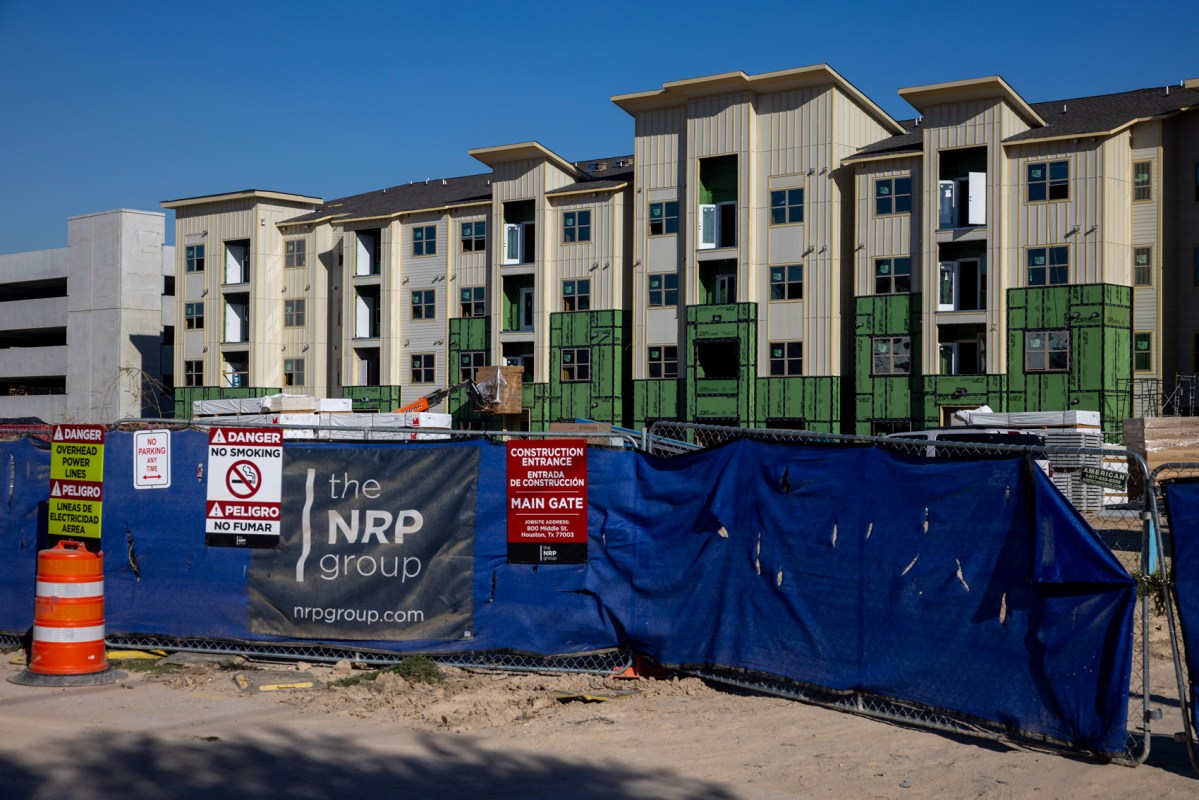
The Kinder Institute for Urban Research has been at the forefront of conversations about affordable housing in Houston for the past several years. Now, it wants to talk about the quality of housing in the Bayou City.
“It’s not just enough to pay for a roof over your head,” said Dan Potter, director of the institute’s Houston Population Research Center. “What is the quality of that roof?”
The institute began conducting its annual “State of Housing” reports in 2020. The 2023 report estimated that 1 out of 5 Houston renters lived in “below average” quality housing, according to the Harris Central Appraisal District’s assessment of a building’s overall value.
The appraisal district’s data, however, is limited, Potter said.
So, the Kinder Institute is launching a Housing Quality Registry – a short survey designed in collaboration with local nonprofits to better understand the housing quality challenges facing Houstonians. To be a part of the study, participants must be at least 18, a Houston resident and willing to answer questions about where they live.
“This isn’t about, ‘I want marble countertops versus Formica,’” Potter said. “This is a question of, ‘I have a house that is making me sick … it’s unsafe for me to live here,’ and how do we create a better environment knowing the quality and conditions of our home (impact) our physical and mental well-being.”
Potter, Project Row Houses, Rebuilding Together Houston and the United Way of Greater Houston, developed a questionnaire that asks residents not just about the exterior conditions of their homes but also less visible qualities, such as safety, noise, plumbing and proper ventilation.
“It’s a very short survey that gives us types of information we currently just do not have access to that we can put in front of decision-makers,” he said. “We want to hear from folks whose house is fine, just as much as we want to hear from folks whose house is not fine.
How does HCAD grade structures?
Potter said Kinder cannot rely solely on HCAD’s assessments of a house’s quality because that data is relative to how an appraiser evaluates the physical appearance of a building and compares it to others across a neighborhood.
Jack Barnett, the appraisal district’s spokesperson, emphasized that HCAD’s appraisers assess the value of each structure across Harris County to determine how much a property owner owes in taxes each year — not to establish metrics for community advocates or politicians to influence housing policies.
“Our job is laid out in the Texas Property Tax Code and we follow the laws and rules that are in the tax code,” he said.
Sheri Potts, a valuation manager at HCAD who has worked for the district for 30 years, said there are multiple factors that go into determining the quality of a property as “average,” “above average” and “below average.”
Potts said the district’s appraisers assess the conditions of a structure over time, as well as assign a “grade adjustment” that measures the quality of construction at the time it was built.
“We are not engineers. We are appraisers,” she said. “We estimate based on what we see and make judgment calls based on guidelines.”
Ultimately, Potter said, the Kinder Institute needs more complete data about the interior of structures, from electricity to plumbing.
“What might we be missing that would really help us to better understand what are the genuine conditions of the housing available here in Houston?” he said.
Why does the survey matter?
Potter said it is important to build a housing quality registry to improve the living conditions of Houston’s neighborhoods.
One of his biggest concerns, however, is that as conditions improve, gentrification often follows.
“Unfortunately, we live in circumstances in which a lot of landlords look around and say, ‘Hey look, if I’m going to spend $20,000 to repair X,Y and Z and update A, B and C, then you’re out and the next person is coming in,’” he said.
The last thing the Kinder Institute wants to do is hurt the people it is trying to help, Potter said.
“We want to make sure that we don’t inadvertently convert housing quality into displacement,” he said.
The goal is to collect enough data – roughly a couple thousand cases – so the Population Research Center reasonably can determine what are residents’ most pressing needs, including plumbing, air conditioning and heating, foundation issues and safety.
From there, Potter said, the coalition of nonprofits the Kinder Institute is working with will put that information in the hands of Harris County Commissioners Court and Houston City Hall.
Residents can participate in the survey through Friday, Feb. 28.

