


At the base of the overturned train car, Jackie Medcalf scoops small plastic pellets from the muddy ground and deposits them in a mason jar. When it’s about halfway full, she caps the jar and places the container in her tote bag. For every mason jar filled, she snaps a photo of the location.
Plastic pellets right by the train car. Pellets a few yards away. Pellets spewing directly from the train car.
“This has to do with accountability,” Medcalf said. “If they won’t tell us what’s going on, we’ll find out.”
It’s early Monday afternoon and Medcalf – the founder of the Houston nonprofit Texas Health and Environment Alliance – is standing where 14 train cars derailed Friday night in East side Harris County, expelling mounds of nurdles, small plastic pellets used in plastic manufacturing.
The train derailment alarmed environmental activists and residents. While the city and the train operator – Union Pacific Railroad – have confirmed that any immediate danger has passed, residents and activists said they are being left in the dark with little to no information about the nurdles spread across the area and what is being done to clean it up. Because of this, environmental activists like Medcalf are out in the field – sampling for what they say may never be publicly available.
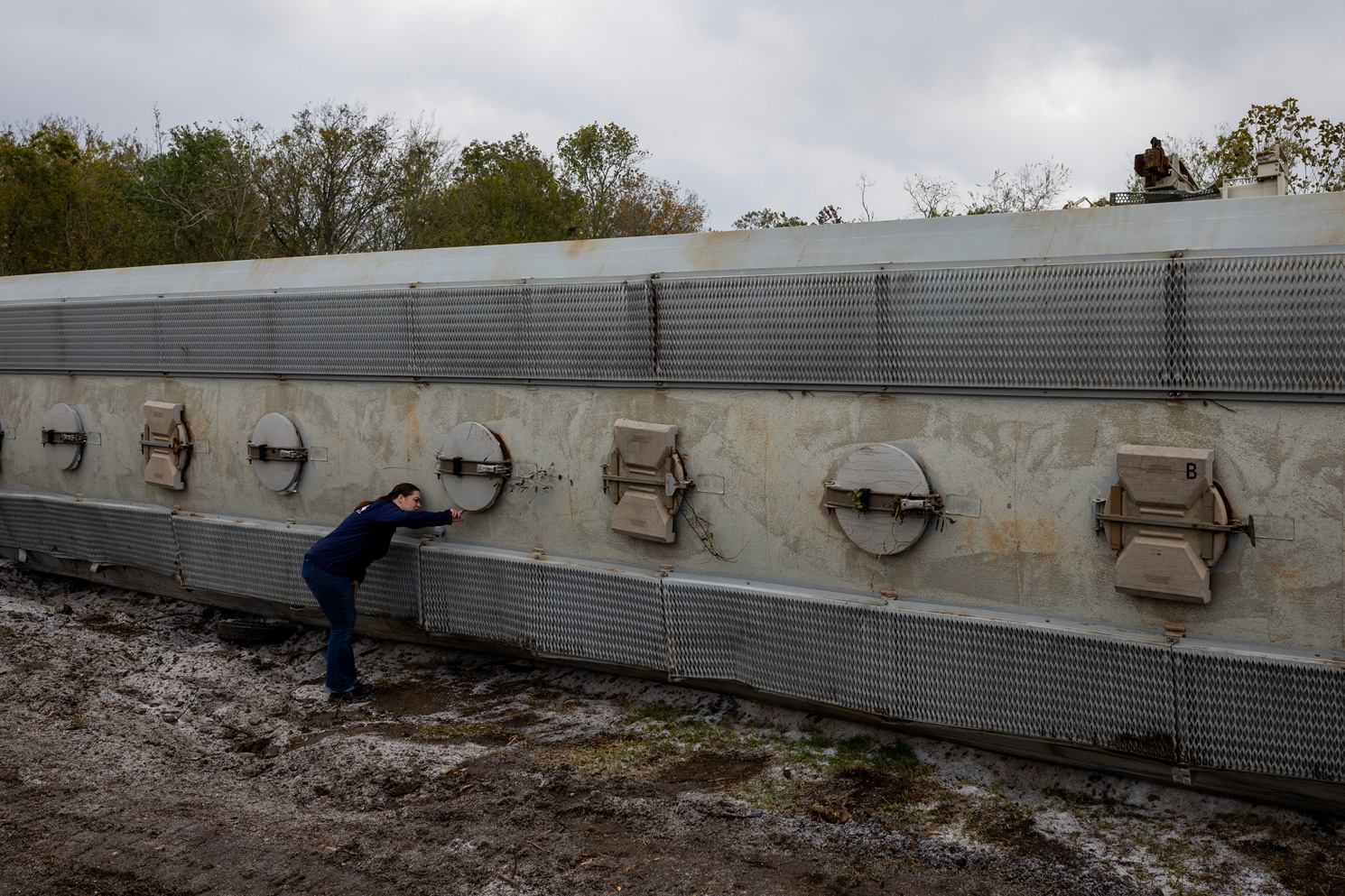
Medcalf heard about the incident only a couple hours after it occurred Friday evening. Residents in the area contacted her, concerned about the train cars exploding or leaking environmental contaminants. Along with the pellets, some of the cars held petroleum gas. She decided, along with her team, to check out the area Monday and to collect samples.
The train cars rammed into each other after the conductor attempted to connect two trains together, according to Harris County Sheriff’s Office. The collision derailed the cars from the tracks. Two train cars also smashed into the side of a blasting and coating facility, tearing down the entire outer wall of the building.
Some train cars landed in residents’ yards and others ended up in the canals that feed into Lynchburg Reservoir for the City of Houston’s East Water Purification Plant – a source for Houstonians’ drinking water supply. However, no train cars released any contaminants into the water or air, according to city officials.
In a statement, Union Pacific said the investigation into Friday’s derailment remains under investigation.
At the collision site, Medcalf and two other THEA members walked down the train tracks, pausing every once in a while to scoop a sample or veer off the track to analyze a derailed car. The trains, which have crisscrossed Harris County for decades, are a common concern for residents. They can stop for hours on end, posing a serious danger to children, and have historically contaminated entire neighborhoods.
Union Pacific personnel used heavy equipment to upright some of the cars and cleared the track so the trains could proceed with their journey several hours after the incident. Union Pacific will be conducting the cleanup, which is ongoing, according to Robynn Tysver, media relations for Union Pacific, but the company said it does not have an estimate on when it will be completed.
Problem with nurdles
After the train cars derailed on Friday night, the city turned off the water pumps from the Lynchburg Reservoir so they were no longer pulling water from the canals. They were turned back on once Hazmat first responders determined there were no leaks.
“There was no impact to the water supply and no contamination,” said Erin Jones, public information officer with Houston Public Works. “Everything was back to normal at the reservoir on Saturday.”
Still, as of Monday afternoon, nurdles were scattered throughout the collision site – concerning THEA members and confusing nearby residents. In one account by Grizzy’s Hood News – a local Houston news source – the nurdles were in massive piles immediately after the accident.
Nurdles are about the size of a lentil, melted down and used in the production process of water bottles, plastic bags, clothes and other items. They are a major element of microplastic pollution with an estimated 230,000 metric tons entering the ocean every year.

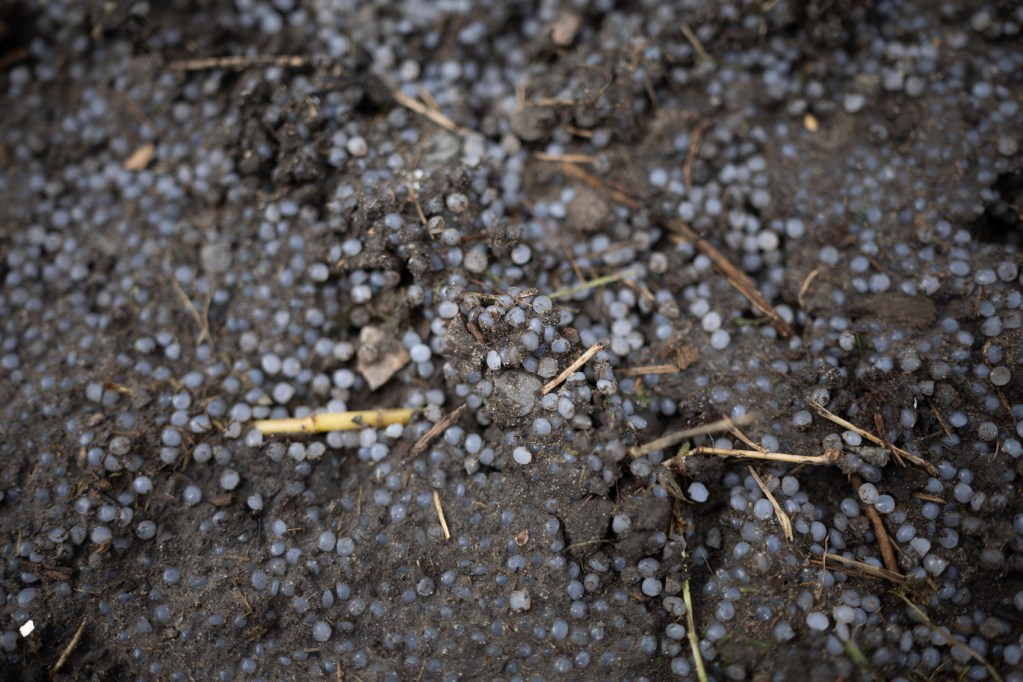
Because these little plastic pellets look like food, wildlife often eats it when it finds them. Because the plastic cannot be digested, this can ultimately lead to malnutrition or starvation.
The pile of nurdles from the night of the accident had since been removed, but still the remaining little plastic pellets looked like a layer of snow in the mud.
Near one tipped train car, Medcalf gestures to a resident’s chicken coop, looking concerned. The resident had about six train cars in his yard after the incident. It also rained the night of the derailment, meaning water could have moved the plastic around.
“I mean, absolutely these birds are going to eat the plastic if they haven’t already,” she said. “The nurdles get everywhere and it’s hard to track them all down.”
At another spot, THEA member Rachel Jordan stopped to spoon up some green-looking sand – and pellets. Everywhere they look, the team is finding pellets.
“I am told these types of pellets have very specific chemical signatures,” Medcalf said, rolling one around between her fingers. “We’re really concerned, the pellets are so openly exposed right here and plastic persists for a long time.”
The green sand comes from Interfab Services, a blasting and coating facility that had its outer wall facing the train tracks completely destroyed in the incident.
The company’s president and CEO, Felix Valdez, said he had just left the facility for the night when he was called back by a neighbor saying, “Something is blowing up your place.” He arrived around 8:45 or 9 pm and didn’t leave until around 4 am.
“It was scary,” he said on Monday. “You get to a point when you are looking at the damage and you’re looking at a tanker five feet from you that could explode at any time. They are handling such sensitive material.”

He estimated the damage to the property at around $250,000, but he said Union Pacific told him they would take care of everything. Valdez said they also said not to worry about the nurdles, that the plastic can be dangerous for wildlife and fish, but he shouldn’t be worried about ground contamination.
The train cars that fell in the canal have since been removed. One car with the words “Non odorized liquified petroleum gas” is lying on its side just across the tracks. Another THEA member, Kristy Smith, takes a photo of the train car and looks around it to see if she should collect any samples.
Medcalf and Jordan look around the canal where the train cars fell in.
“You know, maybe people are doing work on cleaning this up, but too often these kinds of things get brushed under the rug,” Medcalf said. “And if they are doing work, we’re not being informed about it.”

