


Each week, “Pop Quiz” features an interview with a member of Greater Houston’s education community. To suggest someone we should interview with an interesting story to tell, email us at education@houstonlanding.org.
Editor’s note: The story has been updated to reflect a different job title for an HISD executive.
Meet the interviewee
Houston ISD offers a wide range of resources for families navigating poverty and other challenges, but community members can often find the process of accessing support confusing or frustrating — especially amid recent changes to the district’s main offerings.
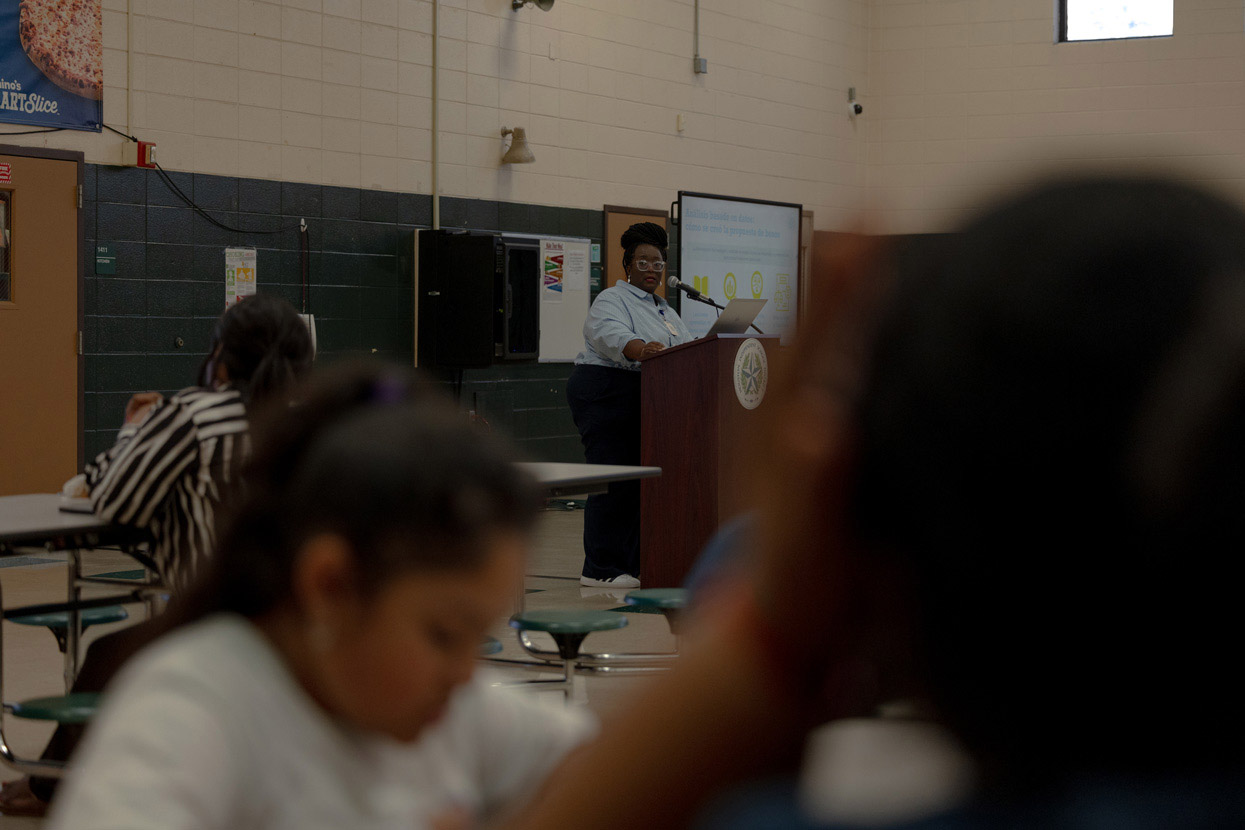
So in our latest Q&A, the Houston Landing sat down with HISD Deputy Chief of Family Community Partnerships Najah Callander to understand how families can find the help they need.
The background: Last year, HISD rolled out a new system of sites, called “Sunrise Centers,” that offer food, clothing, hygiene products, mental health services and more to families. But, so far, only a small percentage of families in need have accessed those services. Some community members have argued their off-campus locations pose a barrier for families that don’t have a car.
Meanwhile, in June, HISD made large-scale reductions to on-campus support staff, called “wraparound specialists,” slashing the number of such employees from roughly 280 to 60. Last year, practically all high-needs schools had at least one dedicated wraparound specialist, but now each worker splits their time between five to 10 schools, HISD Communications Chief Alexandra Elizondo said.
Money crunch: The reductions came amid a massive $500 million budget shortfall last year, caused by a combination of declining enrollment, expiring pandemic stimulus funds and expensive new programs rolled out in 2023 by state-appointed Superintendent Mike Miles.
Now, HISD is spending about $6 million on wraparound and $7 million on Sunrise Centers, compared to $20 million and $9 million, respectively, last year, according to HISD. Some community members protested the wraparound cuts, arguing the district should have made other spending reductions, rather than shrink a department vital to families in need.
Slow start: Though HISD finished rolling out its Sunrise Centers last fall, more families sought resources from wraparound specialists than from the newly opened resource hubs. Sunrise Centers served roughly 23,000 families last year, while the wraparound department served about 107,000 students, according to information provided by HISD.
Here’s what Callander told us, lightly edited for clarity and length:
Najah Callander
At this point there are significantly fewer wraparound specialists in schools and families have to travel to the Sunrise Centers. Does HISD see this and argue that it’s a better setup for kids, or does it argue that the money previously going to wraparound could be better spent somewhere else? Or was it just that HISD couldn’t afford the wraparound system as it was previously set up?
We don’t see Sunrise as a replacement for wraparound, right? So, from our perspective, what we’re attempting to do as a district is set up this continuum of care. So, there is an opportunity for our students to be served on the campus: There are nurses, there are counselors, there are teachers and, yes, there are wraparound specialists that can meet students’ immediate needs on campus.
But what we know about our students is that they often have more than one need. We know that if there’s a hungry kid, there’s probably a hungry family as well. So we are trying to link up not just the services that are available on campus, but then then connect that with the Sunrise Center services, so that families have not just those immediate and initial needs met, but also those longer-term things that are going to … change the trajectory for that student, so that that student is able to come every single day, ready to learn, ready to do the business of getting their education.
I think the way that wraparound was funded, with it being primarily (pandemic stimulus) dollars, does have a bearing on how we’re able to continue these services, because that funding is gone.
We are a district that, for better or for worse, has had a large (budget) deficit. But what we’re doing is we’re making lemonade. We’re taking those limits and we’re saying, ‘OK, we’re going to right size this…. We’re going to connect it, we’re going to utilize our community partners to extend our capacity so that we can more deeply serve families.’
Looking at the (Sunrise Center) numbers, 23,000 families served. It’s significant, but it’s also only a percentage of the total universe of families in HISD that need some sort of resources or support. So what’s HISD’s plan to expand the reach?
We’re doing a couple of things immediately that will help bring awareness to what is available at the Sunrise Centers. The first thing is, we’re talking more and more with families … to help us get the word out about the continuum of care.
We’re doing a lot more (of) putting the information out that if you have needs, if you want to … improve your English, if you want to improve your workforce skills so that you can get a better job, these things are not just happening in the community, but they’re happening in the Sunrise Center.
We’re making those connections between our student body who are going and putting in student aid forms and asking for assistance, we’re following up with their families to say, ‘Hey, we noticed that your child needed support with uniforms, or your child asked for support with food, or your child’s on the backpack buddy program.
Do you have more needs, and is there something else that we can help you with?’ So that’s kind of the function and the focus that we’re taking.
We’re trying to build awareness. We are really touching back with all 23,000 of those families to say, ‘Hey, you came to us more than once, or you came to us twice. … Are you still needing support? What does that look like? How can we help you?’ … What we’re trying to really focus on with Sunrise Centers is those families with the deeper, more complex needs and how we can reduce barriers and get their services to them.
For example, we’re really focused on our homeless students. In HISD, we have somewhere between 7,000 and 9,000 homeless students that we’re identifying. I think last year that number was (around) 7,000. And as we’re talking to those families, they’re not families that are necessarily living on the street. Very few of them are living on the street or living in a car.
Most of them are living with other family members, and they’re what we call ‘doubled up.’ And so as we’re thinking about what it takes for those students to learn, it oftentimes points very much back to that family structure. How are we helping those adults … get the training and the resources they need to stabilize so that their children can show up to school and they’re ready and they have what they need so that they can do a good job in the classroom?
One of the common critiques of the Sunrise Centers is that there could be transportation barriers for families that don’t have car access. … How would HISD respond to those criticisms and what is the district doing to address transportation barriers?
Yeah, we know that transportation is a huge problem in our city. We’ve done a good amount of work to understand more about this challenge. One of the first things we did is we worked with the Rice University (Houston Education Research Consortium) to talk us through … the accessibility questions.
What we found is about 80 percent of the families in HISD are a 10-minute drive from a Sunrise Center. We know that, in Houston, 10 minutes can be a long way or short way. I think about times when I’ve had a 10-minute drive and it’s been two miles away, or I’ve had a 10-minute drive and it would be 10 miles away. So … we do think that we have done a good job placing centers in places where our families have needs.
If I’m frank, … there were community partners that were not willing to partner with us. So, we’re not everywhere we wanted to be, but we’re in a good portion of where we want to be. … I will say this: We spend a lot of time. We do things like Sunrise to You, where we go to those communities.
There are a couple (areas) where a Sunrise Center is kind of out of reach for them. So we do that work, and then we also provide things like bus passes and gas cards for families who are trying to get to us. But, more than anything, I think the accessibility thing is something that we’ll have to continue to work on.
Right now, we only have seven Sunrise Centers. Ideally we would have a few more. There are some places where I can see we have gaps. But we also know we have to be thoughtful about the financial means (and) we have to have the partnerships in place, so it’s not a small thing to say, ‘Well, let’s open up four more centers.’ I wish it were that easy.
If I’m a parent reading this article who doesn’t have access to a car, what steps should I take to access resources?
The first is … talk to someone on your campus or complete a (Student Assistance Form) yourself. You can also do a Sunrise (Center) intake form. Those things are all available electronically.
If you complete a Student (Assistance) Form, then it will be reviewed by the wraparound specialist or the counselor or the nurse. Immediate needs will be met. Anything that can happen right away would be met. Anything that they don’t have access to on the campus or requires some deeper information would be transferred to the Sunrise Center.
The Sunrise Center staff is going to call that family and they’re going to say to that family, … ‘Can you come in?’ And if the family’s like, ‘Yes, I can come in, but I don’t have access to a vehicle,’ then, it’s like, ‘OK, a bunch of our centers are within bus routes.
So, can you get here on a bus? Do you need a bus pass?’ Those are things that we can provide. We can (also) bring those things to schools if it’s something like, ‘We need clothes. I need clothes for a job interview.’ A lot of times, my staff are bringing those things to schools. We’re going to make sure that those families get served. That’s the commitment that we have made.

You mentioned earlier certain areas of the city that might be a little bit out of reach (of Sunrise Centers). Which are those neighborhoods?
I think the northwest side is where we have some gaps, where we would want to, obviously, do a little bit of a better job.
Thinking about the Sunrise Center system as an investment HISD is making, this past summer around budget time, the school board had some questions about what sort of analyses the district had done to show the Sunrise Centers are worth the investment versus wraparound (specialists). Has HISD conducted or commissioned any analyses of the Sunrise Center system? And, if so, what did they show?
As I mentioned, we’re working with (Rice University’s Houston Education Research Consortium) on an overall review of the Sunrise Centers. We’re at the beginning of that, not at the end. We did the preliminary work, and it was really focused on the accessibility piece, and then it was also focused on the awareness piece.
So now we are in the space where we can really address our effectiveness, and so we’re at the beginning of that process of understanding how well we’re doing what we’re aiming to do. And so I don’t have that yet, but once we do, we’ll be happy to share what those results are.
I know you’re in the early stages (of studying the Sunrise Centers), but what are some of the early takeaways in terms of wins or areas for growth?
I think early takeaways are around awareness and people understanding what is available at the centers. We have a lot of noise around HISD and so helping our teachers understand what’s available, helping our students and our families understand what is available, and just really making sure that people know that they can send people to the center.
The second thing is really being able to tailor our services around homeless students. Part of the reason that we wanted to incorporate our work with homeless (services) in all seven Sunrise Centers is because it is a huge hardship for homeless families to go to the one central place that used to be just downtown at the Brock Center. So now we have integrated that work around all six (other) centers.
Asher Lehrer-Small covers Houston ISD for the Landing. Find him @by_ash_ls on Instagram and @small_asher on X, or reach him directly at asher@houstonlanding.org.