

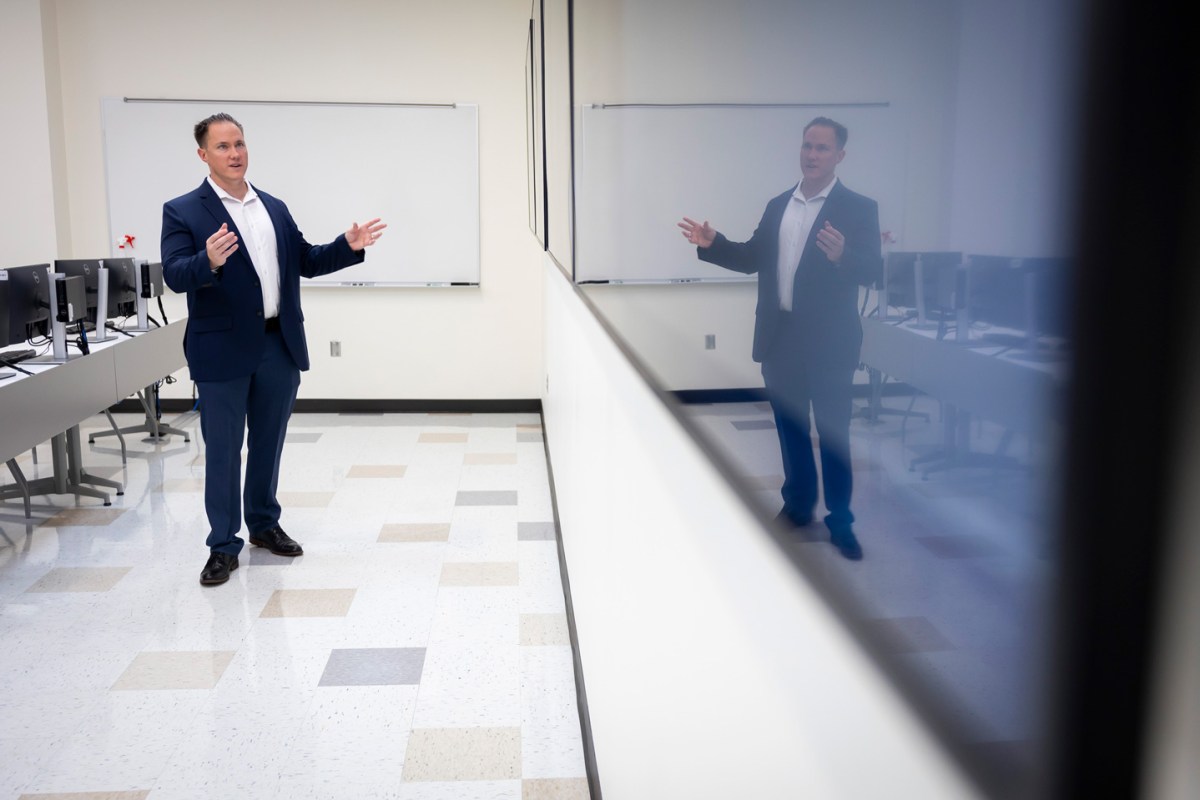
Inside San Jacinto College’s Security Operations Center, four flat-screen TVs lining the front wall flash with real-time cyberattacks against the college’s network. From a row of desks, a handful of students “threat hunt,” investigating suspicious users logging in from faraway countries or attempting dozens of incorrect passwords.
While the students are still learning, the cyberthreats they’re confronting in class are real. They’ve signed confidentiality and ethics agreements, pledging to keep the college’s information secret, and a film over the classroom’s window prevents anyone from peering in at their screens.
“The experience we’re giving (students) is a real experience, because this is a real, live security operations center,” said Joshua Dray, San Jacinto’s Chief Information Security Officer. “They’re gonna be combating real world threats that the college faces every day, helping to secure and protect the college.”
San Jacinto leaders hope the modest Security Operations Center — currently, a single classroom — can expand in a few years to help meet Houston’s growing demand for cybersecurity workers. College officials are asking state lawmakers for $4.5 million to help realize their vision, which includes a potential new building, more staffing to train students, larger classrooms and partnerships with businesses and institutions.
This expanded investment in the program, Dray said, will help close the cybersecurity talent gap in Houston. There are 6,200 job openings in the field across the region, according to Cyberseek, a tool the college uses to track the job market. Plus, the U.S. Department of Labor projects the profession will grow 48 percent in Texas by 2032.
San Jacinto also wants the cybersecurity center to swell into a regional facility, where students protect other local and state business and institutions.
“Say if the Fort Bend County library had a cybersecurity incident, we could sync up with that entity and provide that incident response capability,” Dray said. “Not only would they be helping protect the college, but they would also be helping protect their local businesses in the area. … In the meantime, it also provides network opportunities to the students, because they’re gonna be working in local industry through the college.”
Public Texas colleges regularly submit requests for extra money to fund special programs or basic functions before each legislative session. The growth of the cybersecurity center hinges on whether lawmakers grant the southeast Houston college’s request. Without the extra funding, the center won’t grow beyond an internal protection service, college leaders wrote to lawmakers.
Experience needed
At the back of the classroom on a recent Wednesday, San Jacinto Senior Cybersecurity Analyst Nico Hovsepian sat behind three computer monitors, ready to help students if needed — and also learn a thing or two. While he’s been in the cybersecurity industry for over two decades, he’s also studying for a bachelor’s degree in the subject from the college.
“I’ve been able to see both sides of it,” said Hovsepian. “I want the students to get a really good education and be able to hit the workforce smart, right? So if there’s anything that I can see or do to help the program, me being in the industry and being a student, then I can offer some.”


In the last five years, Houston’s community colleges have expanded their investment in the cybersecurity field, with San Jacinto and Lone Star colleges introducing bachelor’s degrees in the subject. This spring semester, 190 students enrolled in San Jacinto’s associate degree program and 95 enrolled in its bachelor’s program, which college leaders aim to boost if they can expand the center.
After students train at the center, college officials say they’ll be qualified for a variety of roles in the industry — which tends to pay well. Information security analysts in the Houston region earned an average salary of $121,000 in 2023, federal data shows. Major cybersecurity employers in the area include Cisco, LyondellBasell and JP Morgan Chase, among others.
Roughly 2,200 people work in information security analytics in the Houston metropolitan area. Still, even with an academic degree, it can be hard for students to break into the industry.
“A lot of these beginning jobs, they are requiring experience,” Dray said. “How do you get experience without having experience? One solution to that is (this center).”
Funding in flux
A region-serving cybersecurity center would likely take two years to build out, leaders estimated in their request to lawmakers. The pace and level of growth would depend on the amount of interest college leaders can drum up for the program — from students and state and local entities.
Program leaders are courting local businesses for partnership, and they hope to partner with school districts to add dual credit coursework to give high schoolers a jump start on a college degree in the subject. They also want to add internship and apprenticeship programs so students can be employed in the industry throughout their studies.

While he couldn’t point to a specific enrollment goal, Dray hopes an expanded center could multiply the number of cybersecurity students San Jacinto serves. Currently, the center has space to educate 24 students at a time.
“We’re just trying to do as much evangelizing as possible,” Dray said. “The goal right now is to get all the people from the associate degree into the bachelor’s degree.”
If San Jacinto garnered enough partnerships to make the center a regional protection service and learning space, it would be the second Texas college to do so. College officials say they are taking inspiration from Angelo State University’s Regional Security Operations Center in central Texas, which is staffed 24/7 and offers paid internship positions to students.
Still, it’s unclear whether lawmakers will grant San Jacinto’s requests for extra funding. The Legislature must pass a budget by June 2.
“We’re not gonna get this kind of program anywhere else,” Hovsepian said. “Because you’ll get a degree, and you’ll step out and have experience.”
Miranda Dunlap covers Houston’s community colleges in partnership with Open Campus. Despite roughly half of Houston’s higher-education students attending community colleges, there hasn’t been much news covering these systems or students — until now. Her reporting holds institutions accountable, highlights barriers faced by students and helps them navigate their opportunities. Reach Miranda at miranda@houstonlanding.org or on Twitter and Instagram.

