


Inside a packed second-floor classroom at University of Houston’s Agnes Arnold Hall, nearly 20 students waited eagerly to begin class. Only, this wasn’t any ordinary class. It was one inspired by Beyoncé’s latest album, “Cowboy Carter.”
One student came dressed nearly in all-white with a white sweater and a white feathered cowboy hat, an ode to Beyoncé’s all-white, country-inspired look during her “Beyoncé Bowl” performance at the Houston Texans versus Baltimore Ravens game on Christmas Day.
“See this is what I wanted,” said class professor Alicia Odewale in admiration.
The UH course, “Before Cowboy Carter: Black Towns, Black Freedom,” uses the Houston singer’s album to explore the influence of Black people in shaping the American West, including the long legacy of Black towns, Black cowboys and Black country western artists, and the multiple pathways to Black freedom beyond Juneteenth. The course is being offered for the first time this spring as a hybrid course.
Beyoncé’s historic debut as the first Black woman to land at No. 1 on Billboard’s Top Country Albums chart with her “Act II: Cowboy Carter” album and to top Billboard’s Hot Country Songs chart with her debut single “Texas Hold ‘Em” from the album sparked a national conversation about the exclusion of Black country music artists from the genre. For her course, Odewale takes the album and uses it to teach the history behind the music.
Each week has a new topic connected to a song or two from “Cowboy Carter,” usually centered around Black freedom and paired with literature, podcasts or other related resources for students to explore. The course will not have any exams but instead will focus on production and interactive community engagement. Students are required to select a Black town to research. Each assignment — from curating a Spotify playlist of Black freedom to creating a photo archive story — will build up to a story map presentation about their Black town.
“No part of this that I’m giving you is busy work,” Odewale said to students during the class. “Every piece of this is going to connect together.”
The course will also include five field trips to some of Houston’s historic Black towns. Students will contribute to a collective course syllabus to share publicly in an effort to integrate students into the local community and put them in the driver seat of their own knowledge.
“Rarely are students in a space to create knowledge for others,” said Odewale in an interview with the Landing. “Usually it’s all academics, people who have been living about this and writing about this for years. But I really want these students to be a part of this conversation. These students are going to be the experts.”


Odewale joined UH in September after teaching anthropology at the University of Tulsa. When she first joined UH, the university initially wanted her to teach a course related to her archaeological research on Black towns. As an African American diaspora archaeologist and native of Tulsa, Oklahoma’s historic Greenwood district, Black towns mean a lot to Odewale.
For her UH course, she wanted to take history and bring it to life.
She workshopped a few titles and posed them to family, friends and her social media followers for feedback. They were: “Rise Up: the Underground History of Black Freedom,” “The Archaeology of Black Freedom,” and the one she was set on, “Beyond Juneteenth: Black Town, Black Resistance.” The last title was winning before she added a fourth: “Before Cowboy Carter: Black Towns, Black Freedom,” referencing Beyoncé’s latest work.
From there, the “Before Cowboy Carter” title became the clear winner as a creative way to leverage Beyoncé’s cultural relevance. And it worked. The class quickly met its 20-person capacity for the spring semester, Odewale said.
“This is a dream course for me to teach,” she said.
She said she also feels at home joining the African American Studies department, one that is solely made up of Black women from various backgrounds and academic disciplines.
“I think a lot of people’s understanding about African American Studies is very, crazily set back in the past,” she said. “This radical field of just Black intellectuals philosophizing what Black life is like, but in 2025, our group is more about how we prepare these students for the jobs they’re going to be getting, for the future of this field, all the different methods they should be learning.”
So far, the experimental learning and community engagement approach is a hit among students in the class.
Senior African American Studies major, Andrea Tribble said she loves the contemporary shift she’s seeing in the African American Studies department.
“A lot of times, AAS (African American Studies) classes are history-based,” she said shortly after the first class wrapped up. “So it’s nice to kind of have that rounding.”
“Our music now tells us something instead of always working [with] primary documents. Listening to an album that just came out and understanding how that teaches us about the past is really cool,” Tribble said. “And it’s really engaging and I think it gets students more excited.”

Janiyah West, an African American Studies major on a pre-law track, said the course originally didn’t align with her degree plan, but she elected to take it anyway.
“It was unique to me,” she said on the first day of class as everyone introduced themselves and shared what sparked their interest about the course. “I’ve never seen a course or anything like this, and I just love everything Black so I was like, why not?”
Tribble and West are among the few who majored or minored in African American studies. Other students come from unrelated majors, such as political science, psychology, architecture, photography and digital media. Many non-African American Studies majors said they signed up for the course out of a love for Beyoncé or a passion for Black history and desire to incorporate African American studies into their disciplines.
While the majority of students taking the course are from Black and Brown communities, the diversity of majors indicates that the course is designed for everyone, Odewale said.
“I think everybody should be taking this class especially if you’re in Houston,” Odewale said. “If you’re getting a degree from the University of Houston and you know nothing about Black towns in Houston or the practice of Black history around you in one of the most diverse cities in the country, that’s a problem.”

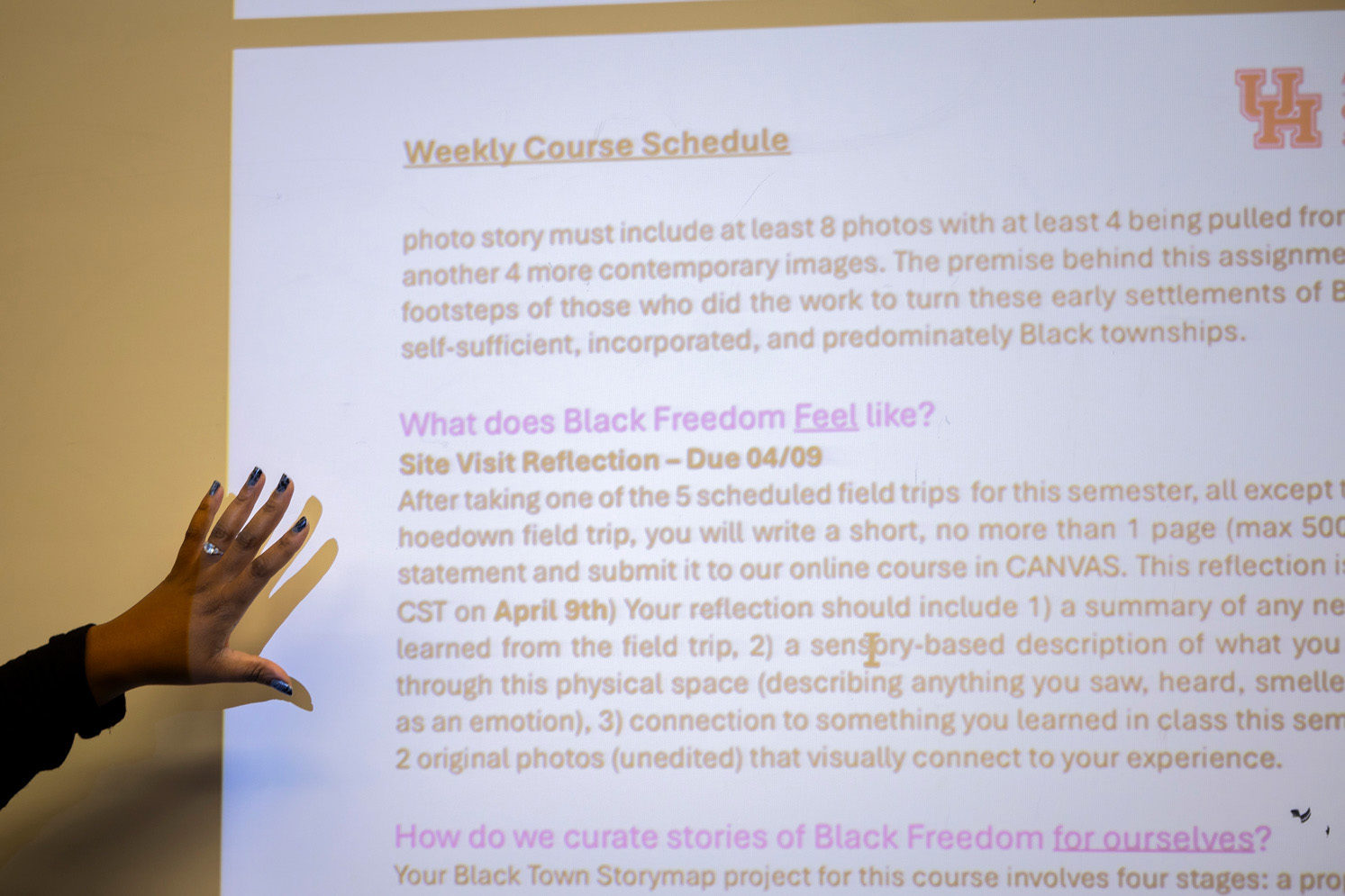
As students found their seats, Odewale opened the class by passing everyone a fan in either red or black and instructed them to take care of it throughout the semester like it’s their “baby.”
“The fans are important because there will be certain points of the semester where we’re either dancing or doing something as a group,” Odewale said to the class, referring to its first field trip: a hoedown, or country line-dancing class.
As she maneuvered through the course syllabus, she explained the learning objectives, course texts, assignments and other field trips. In addition to the hoedown, those include a trip to the Black Cowboy Museum, an optional trip to the Houston Livestock Show and Rodeo for Black Heritage Day on March 7, a trip to the historic Freedmen’s Town in Fourth Ward, and to Ivy Leaf Farms in the historic Sunnyside neighborhood. Students must complete a site reflection from one of the field trips.
“My goal is by the end of this class you all know a lot more about Black freedom than Juneteenth,” she said to the class. “You all know a lot more than just the Emancipation Proclamation. If you take nothing else from this class I hope that you’re able to see that there’s so many other pathways to Black freedom, so many other ways we freed ourselves than just the June 19, 1865 narrative. Even though that narrative is very important, it’s just not the only way.”
Being able to pick their own Black town for the story map excited Tribble most. She hopes to find a Black town in her home state of Minnesota or one in a place where most people wouldn’t expect Black people to live, she said.
“I get that all the time,” she said of Minnesota.
Tribble is also excited about the class field trips particularly the line dancing and visiting Freedmen’s Town.
“UH preaches a lot about connecting UH to Houston and especially Third Ward, and I think it happens very intentionally with this department,” she said. “We’re actually connected to the community that we’re in as an institution rather than just saying that.”

Odewale said she is grateful for the freedom and autonomy she has at UH to teach such a class. Last year with the passing of Senate Bill 17, Texas public colleges and universities, including UH, were forced to close their diversity, equity and inclusion offices and end all DEI programs and initiatives. Now state lawmakers are looking to expand the DEI ban to include college classrooms, according to KUT Radio. As a result, some of her colleagues at other institutions, like the University of Texas at Austin, have altered their syllabi or the way they describe certain courses in fear of promoting anything connected to DEI.
“There’s a real value in being in an institution where you have the freedom to even teach this and it being something that’s completely under my control as an educator to dive as deep as we want to go,” she said. “It’s sad, but that’s kind of where we are, where your understanding of your own history is limited by where you’re getting educated.”
Odewale and African American Studies department chair, Professor Tara Green, know the evergreen course will be a huge benefit to students regardless of their major.
“We are happy that Dr. Odewale’s course is meeting the mission of African American Studies at UH — to teach students about important connections between the past [and] the present,” Green said in an emailed statement. “These students will emerge from the course with informed knowledge about U.S. culture and the place that Texas has as one of America’s gems.”

