
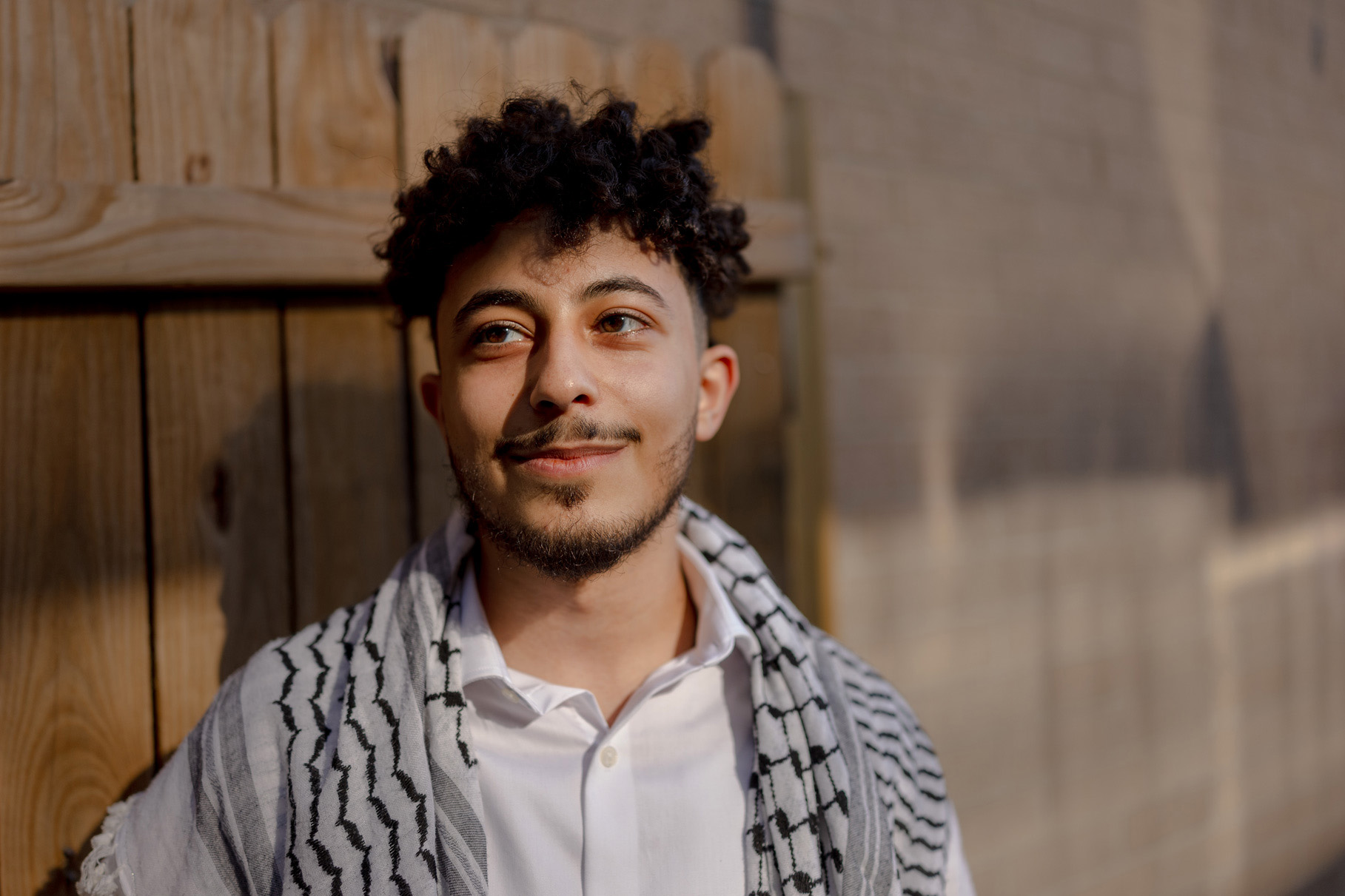

This Q&A is an installment of Houston Landing’s Who are HOU? series that aims to tell stories celebrating the melting pot of communities, cultures and experiences that define this city. From personal histories to challenges to everyday triumphs, each story is told in the words of the person being interviewed to capture their voices and the journeys that shape Houston’s identity.
It takes only a minute for Hamza Abuharb to scroll through his phone and find the poem he wants to read. He smiles slightly, and a little sadly, and recites “You ask me why” with rhythm, taking his time with each word – like he’s on stage performing it. We’re sitting outside a Yemeni coffee shop called Qamaria in west Houston, discussing, amongst other things, his poetry.
He wrote this one over a year ago, just a month or so after the October 7 Hamas-led attack on Israel and the subsequent Israeli invasion of Gaza. It’s a war that affects him deeply. Abuharb, his parents and his three older siblings relocated to Houston from Gaza as refugees about 15 years ago. He still has family there and, because of the ongoing invasion, has experienced unimaginable loss in the past year.
Throughout it all, what has helped Abuharb is his community and family in Houston, his writing and his work as president of the Students for Justice in Palestine at the South Texas College of Law, where he is a 3rd year student. At Qamaria, he orders a carafe of traditional Yemeni coffee to share. Normally, the 23-year-old comes here to see friends or study for school. To Abuharb, culturally Middle Eastern places like this are homes outside of home.
You moved around a lot when you were a child, but finally settled in Houston when you were in 5th grade. How was it when you first moved here?
I think the back and forth as a kid helped me be able to adapt more between different cultures. I don’t remember many Arabs in my elementary school as a kid, but there were more Arab kids when I went to Middle School so that was a bit more comfortable. You’re still a kid, though, so it wasn’t too much in my experience.
But it was nice for other people to understand the culture of fasting, for example. A lot of kids I went out to play on the street with, they didn’t know what fasting was and they were like ‘why don’t you just hide in the closet and eat.’ But you know, Ramadan is very important in the Middle East and being able to be with people my own age who also experience it, that was great.
Since you’ve moved here, do you feel like you’ve been able to carve out a community that feels like home?
At South Texas College, where I am right now, there are a lot of Arabs and Muslims, but when I started Students for Justice in Palestine, that presented an opportunity not just for people who are Arab and Palestinian, but also for all races and religions for this cause. That feels great because we’re always going back and forth and debating political topics, how some politicians aren’t doing what they’re supposed to do, and so on. But everyone is advocating for justice and that really reminds me of home.
How about in Houston as a whole? You’ve gone through a lot in the past year, how has that experience been for you here?
I think I’ve seen Houston grow both physically but also in how people interact with each other. The communities have gotten larger and stronger. Houston has given a space for people to give their opinions and ideas without feeling like they’re attacking someone. There are a lot of community members and leaders here that are doing their best to make sure we have safe spaces to discuss. Sometimes you end up in an echo chamber, but it’s important to try to communicate with everyone.
I’m sure that can come with challenges.
So at South Texas, even though it’s a small campus, I still view it as a little microscope in America and so we have reached out to a lot of people to try to have these conversations to move forward and not have a cycle of hatred over and over again.
When I first started organizing on my campus, my dad sat me down and he said to me, ‘you have to stay cool, calm and collected.’ And for three straight weeks after that, I don’t think I heard any other word come out of his mouth. That’s how I have had to deal with it. There’s been a lot of loss of life, some of it extended family. I have to remember that my actions don’t always represent myself. I represent the movement as a whole.
You keep bringing up South Texas College when you talk about community and the Justice in Palestine movement. Why do you care so much about what happens there?
When I came to law school, I came to help. I wanted to help people. That was my intention. How am I going to help people? If we make small changes on this campus, I think it’ll be a ripple effect on other campuses. Not to say I’ll make the change myself, but at least it’ll lay the foundation for others. My parents always say they may not change tomorrow, might change in a year, might change in two years. So it’s small steps.
Writing is a big part of your life. How did you start working on poetry?
As for writing, I never really like writing essays. Somehow, I’m becoming a lawyer (laughing), I don’t want to get into that. But poetry allowed me to be creative. In 7th or 8th grade, there was a poetry club and I wrote how it felt coming back to the States after the 2014 war in Gaza. My family had been visiting and we had been caught in that enough to be evacuated. Writing poetry helped me collect my emotions. Writing has always been like that for me.
How do you usually write poetry? Does it just come to you, or do you sit down and designate a time to write?
When it comes to me, I have to write it down. Like yesterday, there were a couple lines that came to my head, so I did that like 12 hours later, but it still got down. And sometimes I’m just feeling a lot on a certain day and there’s no real good way to process it. So sometimes the best way is to write it out.
I wrote in public one time and I can’t do it again. It’s hard to get out of that shell, it’s too private and personal.

Something that stands out to me as we’re talking and the poem you just shared is the idea of home and what having a home means. Is that something you could speak on?
The bombings have been indiscriminate in Gaza, so I would be remiss not to talk about that when we’re talking about home. Home is where someone lives their life. You know, it’s not work; it’s where they talk with their family, their friends, and their significant other. You have Thanksgiving, you know. We moved around a lot, so home wasn’t ever the white picket fence story – well, it was a little for a bit (laughing) – but it was wherever my parents are, where my siblings are, that’s home. You know we do want to go back to Palestine eventually, but we also have to make home with what we have here.
Eventually. Do you feel like you’ll be in Houston for a while?
I always toy with the idea of moving, but Houston feels like home now. I’ve memorized the city. We have great artists coming out of Houston, and I want to be able to claim them. Our city made that, you know? So, for the time being, yeah, it’ll be Houston.