

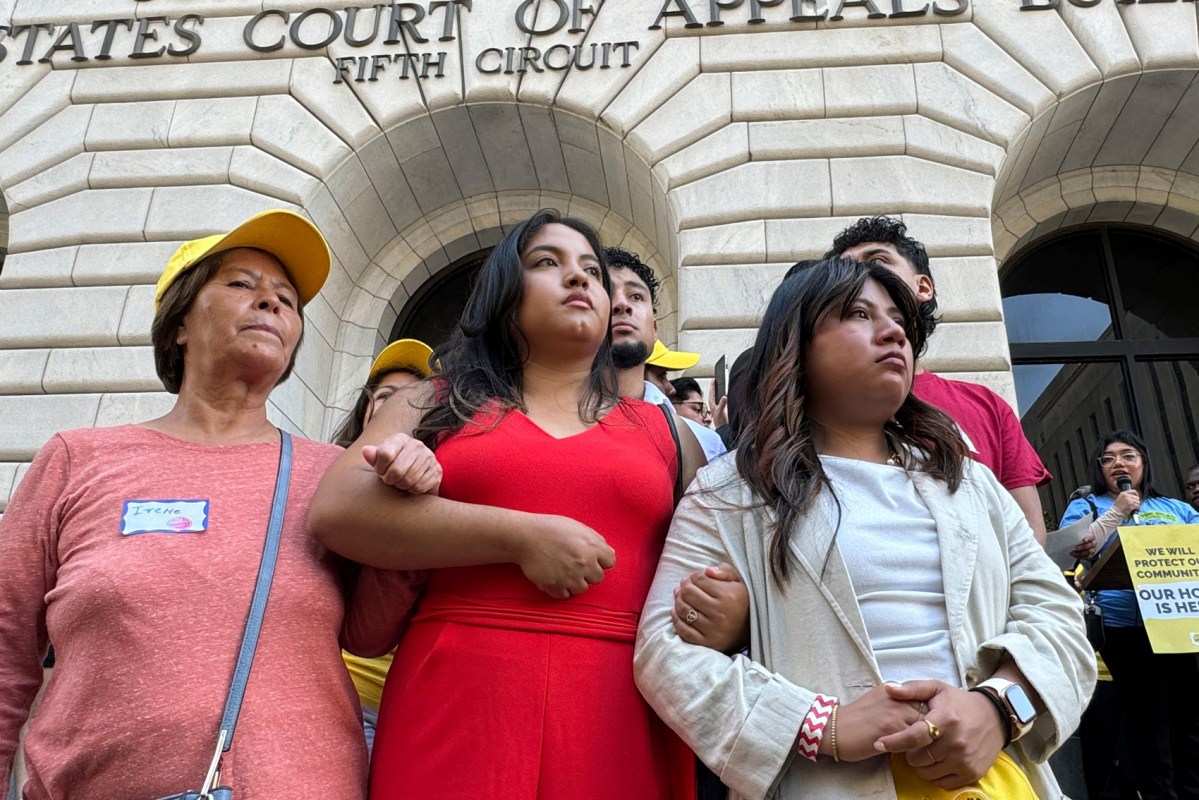
President Donald Trump has placed immigration at the center of the executive orders signed during his first few weeks back in office. And although the president voiced a possible change of heart when it comes to Dreamers during his campaign, the program protecting some of them from deportation is still in legal limbo.
The Fifth Circuit Court of Appeals recently issued a ruling that sides with Texas on its claim that the Deferred Action for Childhood Arrivals program, or DACA, has caused financial harm to the state. Texas argues that DACA recipients have cost the state $750 million in social services expenses, such as education and Medicaid.
The court ruled to maintain protections for current DACA recipients, including as many as 90,000 individuals in Texas, until there is a final decision on the case. This means DACA protections remain for those already in the program, but no new applications will be processed at this time and the future of the program remains uncertain, especially in Texas.
The court of appeals ruled that Texas has a legal standing to pursue this claim, but limited the effects of this lawsuit to Texas alone.
DACA is meant to protect some of these Dreamers – individuals brought to the U.S. illegally as children – from deportation. But the program only provides temporary relief and the ability to work legally, with applicants having to renew their permits every two years.
What’s the difference between DACA and Dreamers?
“Dreamer”: Anyone who was brought into the U.S. illegally as a child.
DACA: The federal program that has allowed some qualifying Dreamers to gain temporary protection from deportation and work permits.
This lawsuit was filed by Texas and eight other states in 2018 questioning DACA’s legality.
This is the latest in a series of halts to the program protecting an estimated 27,000 Houstonians from deportation and about 528,000 individuals across the U.S.
In December, Trump said Republicans were willing to work with Democrats on a plan for Dreamers. But the president also moved to end the program during his first term, making advocates wary of what could come next.
Here’s what the appeals court decided:
- The Fifth Circuit Court of Appeals in New Orleans issued its latest decision on Jan.17, ruling that the program is inconsistent with federal immigration law and Texas has a standing to pursue its lawsuit, returning the case to a district court.
- The court also limited the effects of this lawsuit to Texas, allowing the Biden Administration’s 2022 DACA rule, which aimed to incorporate DACA protections into federal regulation, to go into effect in every other state.
- The court of appeals ruled that the claim of financial burden to Texas can be addressed with an injunction limited to this state to avoid impact to other states that have not claimed or proven such harm.
- The court preserved the stay of its injunction for current DACA recipients, meaning that those currently under the program can continue to renew their permits.
- The court stated that DACA’s forbearance policy, which deprioritizes these individuals from federal deportation procedures, and other benefits such as work permits, should be treated as independent, legally distinct parts of the program.
Here’s what it means for DACA recipients:
- The latest ruling preserved the benefits of the program for current DACA recipients, who are able to continue renewing their permits, including those living in Texas.
- Advocates are urging current DACA recipients to renew their permits at least six months before its expiration date. If the expiration date falls more than a year from today, legal counsel is advised.
- New applicants can continue submitting their applications, but at this time these will not be processed.
- Because of the uncertainty that this program remains in, organizations are urging DACA recipients to seek legal aid to verify if they qualify for any other immigration relief if the program ends.
What’s next?
Advocates are calling on Congress to pass additional protections and pathways to citizenship for these individuals. U.S. Rep. Sylvia Garcia (D-Houston), whose district covers much of east Houston, said she plans to reintroduce the American Dream and Promise Act in the House of Representatives’ 119th session in coming weeks.
The congresswoman had originally introduced this bill to the House in 2023, seeking to create a path to conditional permanent resident status for 10 years to Dreamers who could prove they had continuously lived in the U.S. since 2021, could pass a background check, and were enrolled in school or graduated from educational programs. It also barred the Department of Homeland Security from using applicant’s information for immigration enforcement purposes.
Garcia said there are no plans to make drastic changes to the bill, other than to update its sponsors. As of now, she said the bill has bipartisan support. And while she’s heard the president claim he believes Dreamers deserve some protections, she is not sure he understands the scope of his remarks.
Across the U.S., there are an estimated 3.6 million undocumented people who arrived in the U.S. as children, but the DACA program is currently protecting an estimated 530,000 of them.
“The president has said more than once that he wants to make sure he does something for the Dreamers… I’m sometimes afraid that he is confusing DACA, and only the DACA kids that have applied with Dreamers,” Garcia said. “My Dream Act is more than that, because it does include TPS (Temporary Protected Status) and DED (Deferred Enforced Departure).”

