


Sitting in a small, windowless cell at the Montgomery Processing Center, Salvador Bautista was ready to give up.
Bautista was placed in solitary confinement for disciplinary reasons for six weeks, a length in isolation considered torture by the United Nations.
“They are driving me crazy here,” he wrote in Spanish in a letter sent from his cell in Immigration and Customs Enforcement detention to his sister, Mayra Bautista Cerda, dated Feb. 18.
Bautista, 40, prepared to abandon his immigration appeal and be deported to Mexico. His plan included divorcing his wife — to free her of the burden of having a deported husband — and leaving behind his five children, ages 2 to 18, and his 8-year-old stepdaughter, along with the country he called home most of his life, he wrote his sister from his cell.
Despite an oversight policy implemented by ICE in 2013 meant to prevent detainees like Bautista to be placed in isolation as a last resort, the Montgomery Processing Center, has had the highest number of cases of solitary confinement in the Houston area, according to the most recent data released by ICE.
The detention center placed 542 people in solitary confinement between September 2018 and September 2023, according to a recent report by Physicians for Human Rights and Harvard Law and Medical Schools.
ICE did not respond to a request for more recent data on placements in segregation.
The agency’s guidelines state that alternatives should be considered and even more restraint against isolation should be used in the case of vulnerable populations, including people with mental health and medical conditions.
The PHR and Harvard reports revealed more than 14,000 solitary confinement placements nationwide during a five-year period ending in September 2023, spurring legislation to enact harsher oversight. Since then, the Houston Landing has identified an additional five cases at Montgomery Processing Center, including Bautista’s. Four exceeded the 15 days of confinement defined by the UN as a form of torture.
“There are other alternatives and ICE has not put any sort of resources into understanding, utilizing, and implementing those,” said Katherine Peeler, assistant professor of pediatrics at Harvard Medical School and co-author of the February report.
In a written statement via email, an ICE spokesperson said that the agency is “firmly committed to the health, safety, and welfare of all those in our custody,” and that it follows national detention standards and compliance mechanisms.
GEO Group, the private prison company that runs Montgomery Processing Center, said that it follows all DHS policies and standards for segregation.
“Under no circumstances is an assignment in a special management unit used in a retaliatory manner or without careful adherence to the performance-based national detention standards and the ICE notification procedures,” the spokesperson said.
Democratic legislators are demanding stricter guidelines to limit solitary confinement in ICE detention and the anxiety and post-traumatic stress disorder it can cause. Bautista’s sister watched as her brother changed temperament and lost hope in solitary. She likens his isolation to “mental abuse.”
Ultimately, Bautista gave up his appeal and was deported to Mexico this summer. He’s still grappling with the effects of his time in solitary. And he’s not the only one.
Legislators debate future of solitary confinement
While Bautista was isolated in a small cell from January to March, sending desperate letters to his family, legislators debated the future of the practice, which has been proven to cause mental health issues and shorten lives.
ICE 2013 Segregation Guidelines
- ICE should place detainees in segregation “only when necessary.”
- Segregation is used as a “last resort” for detainees with special vulnerabilities, including mental illness or medical issues.
- ICE requires “additional steps to ensure appropriate review and oversight of decisions to retain detainees in segregated housing for over 14 days.”
- ICE says solitary confinement placements require “careful consideration of alternatives.”
In March, Democratic lawmakers wrote a letter to Department of Homeland Security Secretary Alejandro Mayorkas that criticized the agency’s failure to comply with its own policies and urged ICE and DHS to issue binding rules limiting the use of solitary confinement.
The death of a man in a Tacoma, Washington, detention center in March after being in solitary for years further highlighted the potential harms of such confinement.
“These types of incidents should be really clear indications that not only is ICE not providing the appropriate mental health care support for people in detention, but it is often exacerbating trauma and the likelihood of risk to people, including suicide, through its solitary confinement practices,” said Eunice Cho, senior staff attorney at the American Civil Liberties Union National Prison Project.
In April, Democratic lawmakers introduced legislation to limit solitary confinement. Republicans at the hearing criticized the bill for failing to focus on other immigration policies, such as so-called “catch and release” at the border. Sen. Ted Cruz (R-TX) and Sen. John Cornyn (R-TX), did not respond to a requests for comment.
In May, 475 healthcare professionals sent a letter to the Biden administration demanding the end of solitary confinement in ICE detention. “Despite repeated, loud calls to end solitary confinement over the last decade, nothing appears to have changed,” they wrote.
Private prisons for immigrant detention have increased since President Joe Biden took office, despite a pledge to reduce the practice. More than 90 percent of detained immigrants are in facilities run by private prison companies, compared to 81 percent during the last year of the Trump administration. GEO Group, the private prison company that runs Montgomery Processing Center, reached a record $1 billion in profits from ICE detention in 2022.
The use of solitary confinement in federal prisons has also increased despite Biden’s pledge to reduce the practice.
At least six complaints have been filed to DHS’s Office of Civil Rights and Civil Liberties related to the use of solitary confinement at MPC since 2022, according to a database of complaints obtained through a Freedom of Information Act request. One alleged verbal abuse. Another alleged assault. One called solitary “psychological torture.” Four of the complaints were closed, some within days. One was recommended for investigation. Another was issued a referral for medical care.
‘He’s already paid his consequences for whatever he did’
Bautista was detained Sept. 19, 2023, when he went to the home of his wife, Joselyn Rosales, so she could take him to the hospital. He suffered a stroke in 2020 and developed a heart arrhythmia, and frequently needed hospital care.
While most of his family became U.S. citizens after leaving Mexico three decades ago, a problem with his paperwork meant he never legalized his status, according to his sister Bautista Cerda. In April 2021, Bautista was charged with assault after hitting his wife during an argument. He pleaded guilty to reduce his sentence to 27 days in jail. This got him on ICE’s radar.
More than 60 percent of people in ICE detention have no criminal record, according to data from Transactional Records Access Clearinghouse. Even for those with a criminal record, their time in ICE custody is not part of any sentence they serve.
“He’s already paid his consequences for whatever he did,” Bautista Cerda said. “It’s supposed to be a detention facility. It’s not supposed to be a punishment facility.”
Once in ICE custody, Bautista was immediately taken to Conroe Regional Medical Center hospital for chest pain and atrial fibrillation, according to medical records reviewed by the Houston Landing. He was then sent to Montgomery Processing Center. He remained there while awaiting his appeal.
Montgomery Detention Center in Numbers
561
Total solitary confinement placements
427 days
Longest solitary confinement placement since September 2018
36.6 days
Average length of placement in solitary confinement
Source: Physicians for Human Rights and Harvard Law and Medical Schools, February 2024 report
On Jan. 26, Bautista was placed in a restricted housing unit, the term for isolation used by GEO Group that advocates say is better described as solitary confinement. ICE did not confirm the number of placements in segregation as of August 2024.
An ICE spokesperson said Bautista committed multiple infractions of the facility’s policies, including spitting on the floor and walls, and stealing food from the kitchen.
“Prior to placing Bautista-Olvera in the SMU [Special Management Unit], lesser alternatives were considered, but they were ultimately determined to be insufficient because his conduct directly put the health and safety of other detainees and facility personnel in danger,” an ICE spokesperson said.
Bautista denies that he stole food or committed any infractions. He filed a complaint with the detention center requesting they check the security cameras to clarify his innocence.
His time in detention was “the worst knight mare [sic] of my life,” Bautista wrote in a letter. “I’m afraid of [sic] my life. I need the police as soon as possible,” he wrote in another.

On Feb. 12, authorities decided to extend Bautista’s stay in solitary confinement because he was viewed as a safety threat, according to documentation reviewed by the Houston Landing. His stay was reviewed and extended on at least three other occasions for the same reason, according to additional documentation.
Bautista filed more than 20 complaints. He protested his prolonged detention. He requested medical help for tooth and back pain. He filed a maintenance request to flush the toilet because of its vomit-inducing smell. He alleged physical abuse by staff. He requested legal calls. He couldn’t understand why he was there.
“It was making me crazy,” Bautista said. “All I wanted more and more was to just get out of it. It makes you go nuts.”
Bautista had become irritable during calls and visits, his family said. He blamed it on a medication he was prescribed for blood clots. But his family pinpoints his time alone in a tiny cell at the detention center 40 miles north of Houston as the culprit.
On Feb. 18, a letter signed by facility administrator Randy Tate told Bautista he was being placed on “grievance and request to staff restriction” after Bautista submitted 21 requests to staff and 27 electronic grievances in six weeks.

Joselyn Rosales washes dishes at her home Monday, May 20, 2024, in Navasota. (Mark Felix for Houston Landing) 
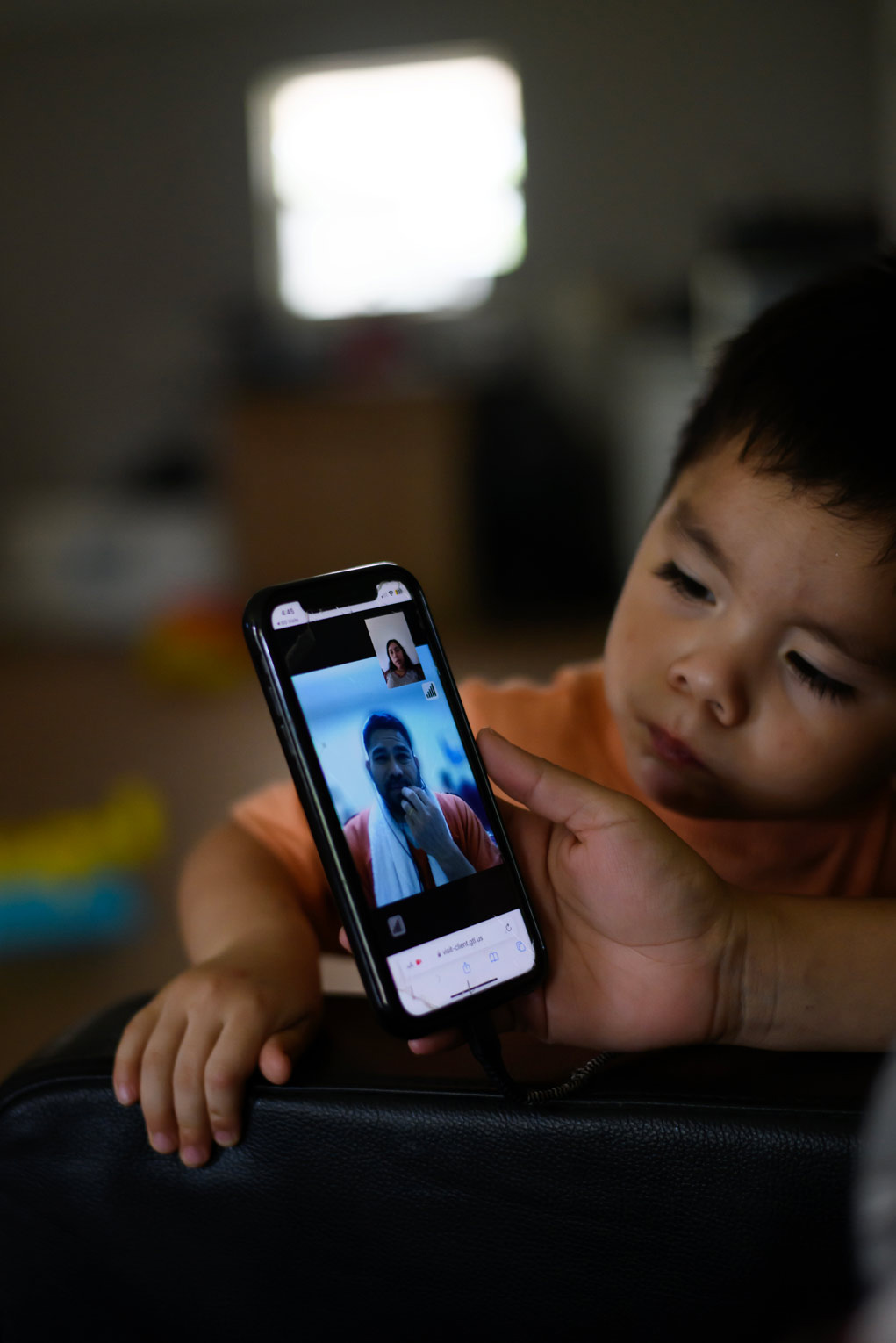
Joselyn Rosales shows her son Mateo Bautista, 5, a video chat of his dad Monday, May 20, 2024, in Navasota. (Mark Felix for Houston Landing) 
Joselyn Rosales video chats with Salvador on the phone while their children play with his guitar Monday, May 20, 2024, in Navasota. (Mark Felix for Houston Landing) 
Emilee Olvera 8, watches television in her room Monday, May 20, 2024, in Navasota. (Mark Felix for Houston Landing) 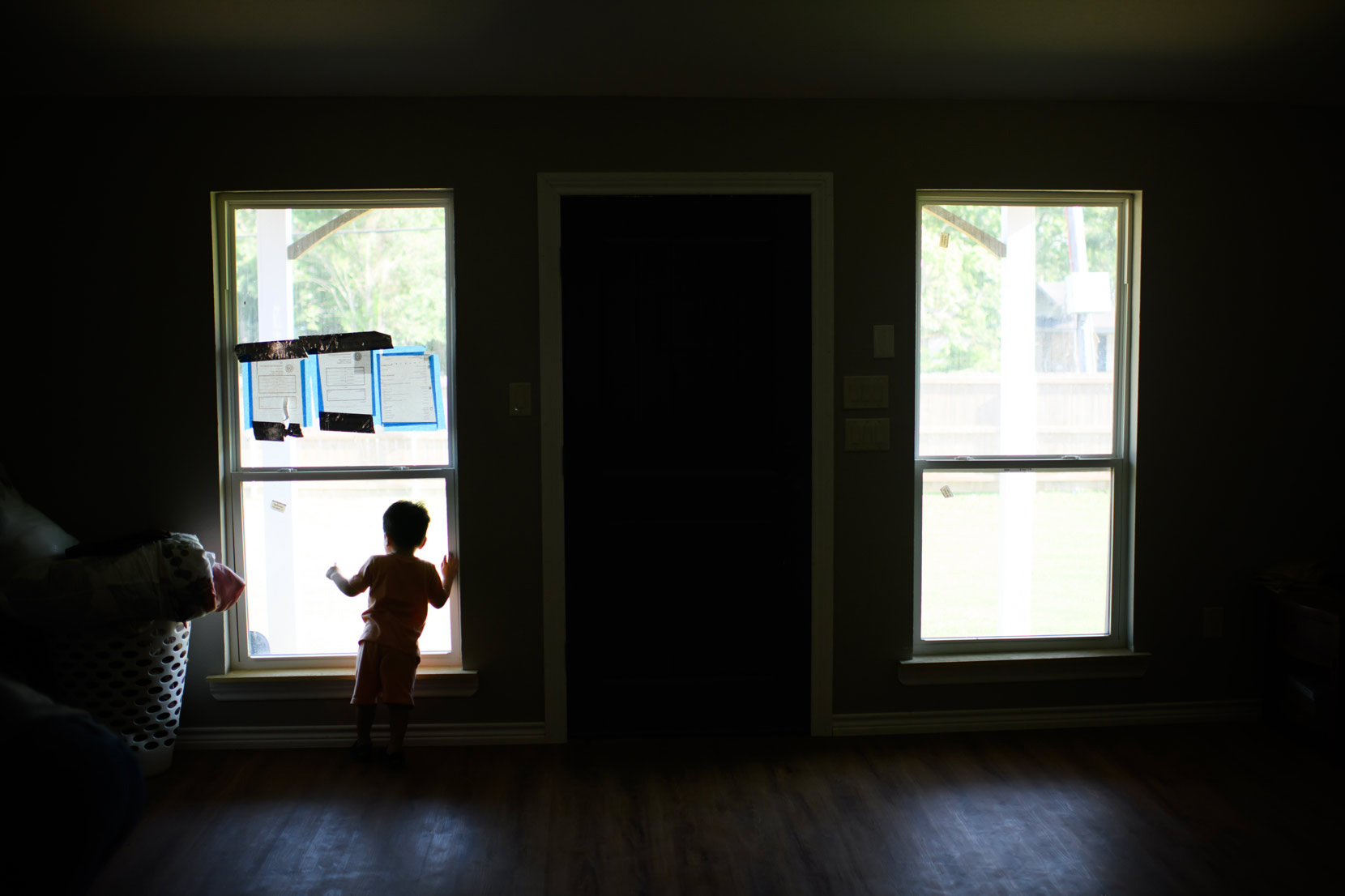
Salvador Bautista, Jr, 2, looks out the window Monday, May 20, 2024, in Navasota. (Mark Felix for Houston Landing)
“The grievance system is an important program to remedy and resolve legitimate issues and not to be bogged down by those abusing the system,” the letter states. An ICE spokesperson said that the complaints were reviewed but determined to “lack merit.”
“The problem is that there is very little consequence or accountability when these abuses actually do happen,” said Cho of the ACLU.
That same day in February, Bautista wrote a letter to his family, asking if he should accept his deportation and divorce his wife. Rosales hoped that he would be able to stay to help provide for the family financially and to see their kids, Mateo and Salvador Jr., and his stepdaughter Emilee grow up. Bautista also has three other kids from a previous relationship.
Bautista went back and forth for months before finally deciding to sign his deportation papers in June.
“They guided me to that by doing what they did, by torturing me,” he said.
‘I just want to know if he’s okay’
Around the time Bautista considered giving up his appeal in February, Yonatan Solís, 29, arrived at the Montgomery Processing Center. He had lived in the U.S. for 11 years after migrating from El Salvador as a teenager.
Solís was arrested in Harris County Jan. 30 for the manufacture and delivery of a controlled substance. He was transferred to the Montgomery Processing Center days later. He was immediately placed in segregation because drugs were found during in-processing, an ICE spokesperson said. Solís denied having drugs on him.
The bright lights, kept on all day, were jarring at first. Then, he got used to them. There in the small room with no windows, Solís had nothing to do but think, he said. Solís was no more than a few dozen yards away from Bautista, but the two never met.
“In solitary, I thought of so many things, in the pozo, like taking my own life,” Solís said.
He wanted to get mental health help.
“But they never took me there,” he said.
That same month, Miguel Antonio Suárez Cáceres, a 32-year-old from Venezuela, was sent to the Montgomery Processing Center. He crossed the border near El Paso in October 2023 after fleeing a death threat in prison. He was immediately placed in solitary confinement because he was determined to be a flight risk since he escaped from prison in Venezuela. Suárez Cáceres' sentence was for the 2015 murder of a store owner during a robbery, which he says was a case of mistaken identity.
Solitary has been lonely, he said. He eats, works out, and writes the story of his life that he hopes to turn into a book. He relishes the few moments he can break this routine, like getting a chance to watch the Celtics win the NBA championship.
The guards are often physically and verbally abusive, he said.
“We have to follow the law, but they don’t,” he said during a recent visit, hands trembling as he gripped the phone to speak through the glass.
An ICE spokesperson said that Suárez Cáceres was placed in administrative segregation “for the safety and security of other detainees and officers at the facility.”
Honduran immigrant Jairo Girón, 31, was also transferred to the Montgomery Processing Center in February. After living in Houston for more than a decade, he was arrested for a family violence charge in March 2023 during a fight with his girlfriend, Angelica Resendiz. The two then decided to work on their relationship, Resendiz said. He moved back in, and she wanted to drop the restraining order, she said. Girón was then arrested for violating the protective order in October 2023 while they were living together.
Girón was then sent to the detention center from a Harris County jail. He was placed in solitary confinement after ICE found drug paraphernalia during his intake, an ICE spokesperson said. Resendiz questions how drug paraphernalia was found on Girón when he was transferred from a jail that would have confiscated it then.
Resendiz became worried when she didn’t hear from him for a month. The couple’s 2-year-old daughter started to mistake photos and videos of him on the phone for her dad on the other line.
“I know she misses him because she's always asking for him at the night time, like, ‘Dada, dada, where go?’” Resendiz said.
Resendiz called the detention center but was told she couldn’t speak to Girón.
“I just want to know if he's okay,” she told the woman who answered.
It was Bautista Cerda who told Resendiz that Girón was in solitary confinement.
“All I do is pray to God and hope for the best that everything will turn out good,” Resendiz said in March. “Maybe hopefully he can get a second chance of being here to be with the kids.”

Solís, Girón and Bautista were released from solitary in March.
That’s when Bautista met Walter Paz Mejia, a 34-year-old Honduran immigrant who had been placed in solitary for a day while ICE investigated a potential policy infraction.
Bautista explained their rights as detainees, and how Paz Mejia could transfer power of attorney to his sister so she would be able to access more of his information. Paz Mejia said he never saw Bautista have any issues with other detainees. Instead, he believes that authorities punished Bautista for speaking up.
“The problem is that the authorities have focused on him because he has insisted on knowing more about his rights and raising his voice so that others also know about their rights and fight for them,” Paz Mejia said.
Bautista seemed worn down by his time in solitary, Paz Mejia said.
“The stress created by being there has damaged him quite a bit,” he said.
Bautista was anxious and angry when he called his family.
“He’s not usually like that,” his wife Rosales said.
Research shows the longer someone is in solitary confinement, the harder it is to recover psychologically. The mental health effects of solitary can lead to behavioral issues upon release, causing more disturbances instead of maintaining order in prisons or detention centers.


Complaint process and oversight mechanisms
While Bautista was organizing his fellow detainees for justice inside MPC, his sister Bautista Cerda was organizing families outside.
“It really is a lot,” Bautista Cerda said. “I tell Joselyn sometimes I don't even know what day it is. We both have full-time jobs and we both have kids at the house.”
How to report abuse in ICE Detention
- Call the ICE Enforcement and Removals Operations Detention Reporting and Information Line at 1-888-351-4024 to report abuse in detention.
- Contact your ICE field office if you think you or someone you know should not be subject to enforcement, detention or removal.
- File a complaint online with the Office of the Immigration Detention Ombudsman for allegations of misconduct, excessive force, or violations of ICE’s detention policies.
- Call the DHS Office of the Inspector General at
1-800-323-8603 to report corruption, fraud, or misconduct by DHS employees.
ICE has increased its oversight mechanisms in recent years, but advocacy groups tracking the issue say these mechanisms have failed.
Three different agencies within DHS and two within ICE receive complaints. The Office of the Inspector General (OIG) and Office of the Immigration Detention Ombudsman (OIDO) conduct inspections. If a detention center fails twice, it can be shut down. But this rarely happens.
In 2021, the OIG determined that Montgomery Processing Center “meets standards.” OIDO has not published any inspections of the detention center.
“ICE has ignored even some of the most egregious lapses of basic care and had few to no consequences for facilities that have failed to provide care in an adequate manner,” said Cho of the ACLU.
Bautista’s wife and sister have two key advantages in dealing with ICE: They both speak English and are U.S. citizens, free of fear of retaliation for their immigration status.
But this is not the norm.
“It's really hard for a family to figure out that process and make sure their complaints are getting to the right people who are actually reading them,” said Setareh Ghandehari, advocacy director at Detention Watch Network.
Bautista Cerda filed a complaint with OIDO. She constantly called Bautista’s deportation officer. But she never heard back.
“Our problem is the poor treatment that they're getting in there, and that GEO does not have any accountability,” Bautista Cerda said.
The new legislation introduced in April would set stricter standards for the use of solitary confinement by ICE, including abolishing disciplinary segregation and prohibiting the use of solitary for certain vulnerable groups. It would also establish more transparency, including a new weekly tracking system for solitary cases.
Ghandehari said more oversight won’t solve the issue, as existing mechanisms have already failed.
“We have to get rid of the practice because for years advocates had been pushing for more oversight,” Ghandehari said. “None of that has created any positive change in terms of the conditions that people face inside detention.”
Girón and Paz Mejia were deported to Honduras in April. Girón did not want to speak about his time in solitary confinement, but consented to having his information shared through Resendiz.
Solís was deported to El Salvador in May. He’s been having trouble sleeping. So he leaves the lights on, just like in solitary.
Suárez Cáceres remains in solitary. A friend worries he is suicidal.
This summer, Salvador Bautista volunteered to be deported, months after being in solitary confinement in Montgomery County, widely considered by physicians to be inhumane and abusive. He hadn’t been to Mexico for three decades.
“It's been too much,” Bautista told the Houston Landing from Querétaro, Mexico. “I couldn’t stay there any longer.”
Adriana Rezal contributed to this report.

